Climate
The Last Embrace of Home
The wind howled through the desolate streets, carrying with it the scent of decay and destruction. It whispered secrets of a world lost to time, of a home that once thrived with life and laughter, now reduced to a mere echo of its former self. Sarah stood at the edge of the crumbling cliff, gazing out at the landscape that had been her sanctuary, her solace, now ravaged by the relentless march of progress.
By olayinka peter2 years ago in Earth
Environmental injustice
There, in the heart of this boiling megapolis, lies a forgotten angle that skyscrapers reach out to in the sky with their tops and at night with neon lights to paint infinity. There existed a neighbourhood, stifled by the suffocating grip of an environmental injustice amidst the shadows of high factories, towering; and neighbourhoods neglected by the upper society.
By Prince Waddle2 years ago in Earth
The Last Oasis, Life by the Shore.
In a small coastal town, nestled between towering cliffs and azure waters, lived a community that thrived off the bounty of the sea. The villagers, led by Emma, had forged a deep connection with their environment. For generations, they relied on fishing as their main livelihood and took pride in living in harmony with nature. Each day brought new adventures as families sailed into the horizon, casting their nets and sharing stories of triumphs and challenges.
By Christabel Appiah kusi2 years ago in Earth
A Celestial Ballet
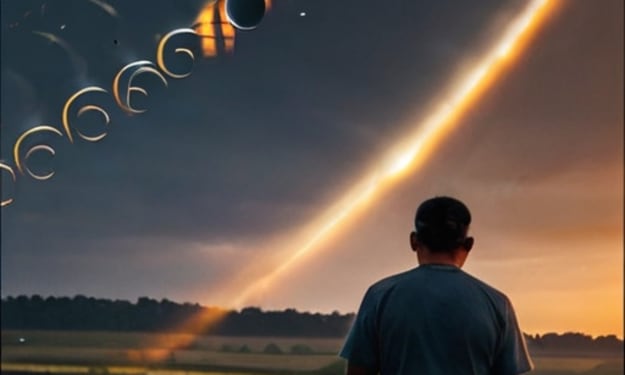
Eclipses, these captivating celestial events, have captured the imaginations of humanity for millennia. Whether it's the awe-inspiring spectacle of a solar eclipse, with the Moon delicately obscuring the Sun, or the dramatic beauty of a lunar eclipse, as Earth's shadow gracefully cloaks the Moon in shades of red, eclipses remind us of the majesty and wonder of the cosmos. In this exploration, we delve into the science, history, and cultural significance of eclipses, unravelling the mysteries of these extraordinary celestial phenomena.
By Chibuzor Eneh2 years ago in Earth
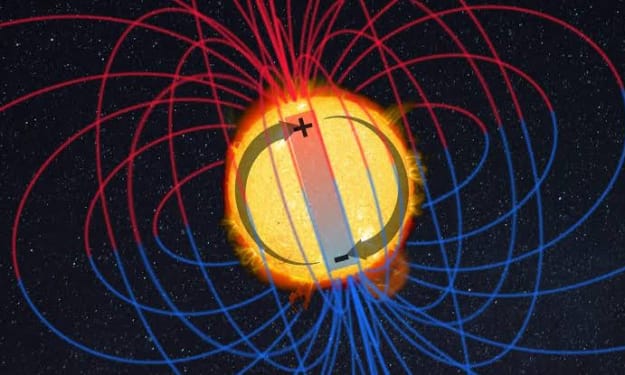
The sun's magnetic poles are set to reverse, a process that occurs more frequently and predictably than on Earth, with the next flip expected between April and August this year.
The sun is preparing to flip its magnetic poles, similar to Earth. This process occurs more frequently and is easier to predict than on Earth. The next flipping is expected to happen between April and August of this year. If you're around 30 years old, you have already experienced this phenomenon multiple times, as the sun flips every 11 years. The flipping process does not have a significant impact on Earth's life. However, this time, there might be some differences. Ocean currents, which play a crucial role in climate and weather, distribute heat from the equator to the poles on Earth. On the sun, these currents are more like an ocean of plasma and also carry electromagnetic energy. This happens because the sun is a massive ball of hot and ionized gases that flow inside its core. These flowing electric currents create magnetic fields. The process through which the sun generates its magnetic field is called a Dynamo. We can observe its effects on the sun's surface through sunspots, which are unstable and intense plasma and magnetism flows. Scientists have learned that the Dynamo process follows a pattern and reorganizes itself every decade. The polar magnetic fields of the sun weaken and eventually reach zero before returning with the opposite polarity. Solar activity has been increasing in recent years, with more solar flares, electromagnetic radiation bursts, and plasma blobs being ejected into space. This solar cycle is particularly lively, and experts believe that the polar fields are almost in sync and steadily weakening. However, the exact point of reversal has not been reached yet. The flipping of the sun's magnetic poles is not as precise as it may seem. The process can be bumpy, and some aspects are still difficult to predict. In the previous solar cycle, the Northern Hemisphere started its magnetic flip in 2012 but lingered around the neutral point until 2014. In contrast, the Southern Hemisphere had a smoother transition in 2013. This time, the poles seem to be transitioning more evenly. However, the reversal processes are never the same, making this phenomenon interesting to observe but challenging to predict its effects on Earth. While we don't need to worry about intense sun explosions happening millions of miles away, a solar storm could disrupt communication satellites in space. The increasing number of satellites, including Elon Musk's Starlink system, raises concerns about the potential impact of a powerful solar storm. Although the chances of a powerful solar storm hitting Earth are low, it is not impossible. In 1859, during the Carrington event, a solar storm caused disruptions in Telegraph communications worldwide. If a similar event were to occur today, it could have severe consequences, affecting communication, navigation, weather forecasting, and power distribution. The impact on satellites and infrastructure could result in significant damages. Fortunately, solar storms as intense as the Carrington event are rare, happening only once every few centuries. However, they offer a spectacular display of auroras, with the Northern and Southern Lights being visible at lower latitudes. The appearance of auroras is one of the expected effects of the sun's magnetic pole reversal. Studying this phenomenon is crucial for scientists to understand how the sun works and improve predictions of solar activity. This knowledge is essential for space travel safety, as more people venture beyond Earth. Understanding the sun's magnetic pole reversal also helps in unraveling the mysteries of other stars in the universe. By studying the sun, we can get closer to answering fundamental questions about our existence. If you enjoyed this information, please like and share this information with your friends. For more content, make subscribe to this channel, thank you.
By Nwachukwu Ella2 years ago in Earth
Climate change. Content Warning.
Introduction Climate change is one of the most pressing issues facing humanity in the 21st century. Over the past century, human activities have significantly altered the Earth's climate system, leading to a range of environmental, social, and economic impacts. In this comprehensive exploration, we will delve into the science behind climate change, its far-reaching consequences, and the urgent need for collective action to mitigate its effects and build a more sustainable future.
By Chibuzor Eneh2 years ago in Earth
Exploring Earth's World of Natural Beauty
In the vast expanse of the cosmos, there exists a jewel of incomparable beauty, a world adorned with the most breathtaking landscapes and teeming with life in its myriad forms. This world, our home, Earth, is a testament to the boundless creativity of nature and the intricate dance of life that unfolds upon its surface.
By Akhlaq John2 years ago in Earth
Island peak
The Island Peak Climbing of Nepal, also known as Imja Tse, is a popular trekking peak in the Everest region. Sitting in the heart of the Khumbu region within Sagarmatha National Park, Island Peak is a popular trekking peak for those looking to combine the thrill of Himalayan mountaineering with the beauty of the Everest Base Camp trekking route. This incredible journey not only offers stunning views but also takes you through the Everest three passes, showcasing some of the world’s most breathtaking landscapes.
By Prashant khadka2 years ago in Earth
"Melting Horizons: Unveiling the Impact of Global Ice Disappearance"
What if a sudden, dramatic surge of climate change melted all of the Earth's ice overnight? Would you wake up to find yourself drowning underwater? Would most of your country be submerged? How would you cope with the slow agony of choking to death? This is the hypothetical scenario explored in the following narrative.
By T. J. Prakruthi2 years ago in Earth
Reverberations of the Woods
Title: Reverberations of the Woods In the core of the Amazon rainforest, where the trees once stood tall and pleased, there was currently just devastation. The land, once overflowing with life and lively vegetation, lay desolate and scarred by the cruel hands of deforestation and out of control fires. Among the remains of what was once a flourishing environment, the Yawanawá clan stuck to the leftovers of their genealogical home. Tahira, a youthful individual from the clan, remained at the edge of the clearing, looking out at the singed scene with overwhelming sadness. The woodland had forever been her safe-haven, a position of miracle and association with her predecessors. In any case, presently, it was just a difficult sign of what was lost. As Tahira strolled through the desolate no man's land, recollections overflowed her brain. She recollected the times of her experience growing up, when she would play among the transcending trees, paying attention to the ensemble of life that reverberated through the woodland. She recollected the lessons of her older folks, who discussed the hallowed connection between the Yawanawá public and the land they called home. In any case, those days were gone now, supplanted by the hints of trimming tools and the snapping of flares. The woodland was vanishing before her eyes, consumed by insatiability and obliviousness. Furthermore, with each tree that fell, Tahira felt a piece of her spirit being torn away. One night, as Tahira sat by the decreasing fire with her grandma, she talked about her sadness. "How might we keep on making due without the woods?" she asked, her voice shudder with feeling. Her grandma, a shrewd lady with eyes that held the insight of ages, put an encouraging hand on her shoulder. "We are versatile, my youngster," she said delicately. "Our association with the land runs profound, and as long as we clutch our customs and values, we will persevere." In any case, Tahira couldn't shake the sensation of sadness that worried her heart. She yearned for the timberland of her precursors, where life flourished together as one with the regular world. Furthermore, as she watched out at the desolate scene extending before her, she realize that she needed to effectively safeguard what remained. Still up in the air to have an effect, Tahira combined efforts with different individuals from her clan who shared her energy for safeguarding the backwoods. Together, they left on an excursion to bring issues to light about the obliteration that was occurring and to battle for the freedoms of native people groups to their property. Their endeavors were met with opposition from the individuals who tried to take advantage of the woodland for benefit, yet Tahira wouldn't withdraw. With fortitude and assurance, she stood in opposition to the treacheries being committed against her kin and the land that supported them. Be that as it may, regardless of their earnest attempts, the annihilation proceeded unabated. Furthermore, as the woods kept on vanishing, so too did the expectation that Tahira held in her heart. She observed powerlessly as the once-flourishing biological system dwindled to nothing, abandoning just recollections of what used to be. At some point, as Tahira remained on the edge of the clearing, she heard a weak sound reverberating through the quietness. It was a bird, its melody carrying on the breeze like a murmured petition. What's more, at that time, Tahira understood that even amidst annihilation, there was still excellence to be found. With recharged assurance, Tahira promised to never surrender the battle to safeguard the timberland and the land that had supported her kin for ages. Furthermore, as she watched out at the scarred scene before her, she knew that for however long there were the individuals who were able to battle for common decency, there would continuously be potential for a more brilliant tomorrow.
By Adeel Khan2 years ago in Earth
Unveiling the Corona: A Scientific Odyssey through a Total Solar Eclipse
Solar eclipses, celestial ballets where the moon briefly steals the sun's spotlight, have captivated humanity for millennia. Yet, beyond the awe-inspiring spectacle, these events offer a unique window into the sun's secrets. A total solar eclipse, where the moon completely covers the sun's disc, unveils the usually hidden corona, the sun's outermost layer. This ephemeral glimpse provides a crucial platform for astronomical research, allowing scientists to study the corona's enigmatic composition, dynamics, and its role in solar weather.
By Nada soliman2 years ago in Earth