Climate
China's Zhurong rover discovers ancient beach evidence on Mars' Utopia Basin.
China's Zhurong rover discovers ancient beach evidence on Mars' Utopia Basin. China’s Zhurong rover has made a groundbreaking discovery that could reshape our understanding of Mars’ history. The rover part of China’s Tianwen 1 mission has found evidence suggesting that an ancient ocean may have once existed in the Utopia Planitia region one of the largest impact basins on the Red Planet. This finding supports the long standing theory that Mars was once a warm wet world with conditions potentially favorable for life. The discovery centers around a set of landforms and sedimentary structures that bear a striking resemblance to those found on Earth’s beaches and shallow water environments. Scientists analyzing the rover’s data have identified ripple like patterns in the Martian soil suggesting that liquid water once shaped the landscape. These patterns are similar to those formed by waves and currents on Earth’s coastlines indicating that a body of water might have once existed in this region.
By Adnan Rasheed2 years ago in Earth
Restoring Native Species: A Crucial Step for Environmental Recovery
In the face of habitat destruction, climate change, and biodiversity loss, restoring native species has become an urgent environmental priority. Native species, which have evolved over time in specific ecosystems, play a crucial role in maintaining the delicate balance of their habitats. However, deforestation, urbanization, pollution, and the introduction of invasive species have severely disrupted these natural systems, often leading to population declines or even extinctions.
By Briar Rose2 years ago in Earth
Partial solar eclipse 1 month away The moon will take a bite out of the sun on March 29.
Partial solar eclipse 1 month away The moon will take a bite out of the sun on March 29. A breathtaking celestial event is on the horizon as the moon will partially obscure the sun on March 29, 2025 creating a striking partial solar eclipse visible across North America Europe and parts of Northwest Africa. While this eclipse won’t bring total darkness it will still be a remarkable sight for sky watchers particularly in eastern North America where the partially eclipsed sun will rise dramatically above the horizon. A solar eclipse occurs when the moon passes between the Earth and the sun casting a shadow on our planet. In the case of a partial solar eclipse the alignment is not perfect meaning only a portion of the sun is obscured. Unlike a total eclipse where the sun is completely blocked for a brief period this event will leave a crescent shaped portion of the sun still visible, creating a mesmerizing effect often described as the sun having a bite taken out of it.
By Adnan Rasheed2 years ago in Earth
Orange deep sea creature with dense eyelashes discovered as new species.
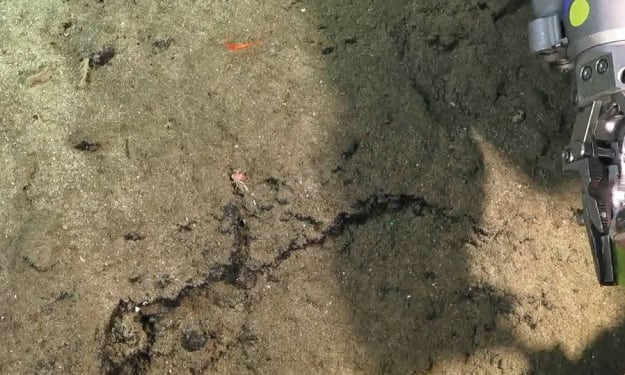
Orange deep sea creature with dense eyelashes discovered as new species. Scientists aboard the research vessel Falkor exploring the depths of the eastern Pacific Ocean off the coast of Costa Rica made an extraordinary discovery an orange deep sea creature with dense eyelash like structures. The moment was captured on the camera of their remotely operated vehicle ROV thousands of feet below the surface in a mysterious underwater canyon. At first glance the researchers were captivated by the creature’s striking appearance but it wasn’t until later that they realized they had stumbled upon an entirely new species. The Falkor research vessel operated by the Schmidt Ocean Institute embarked on its journey in January 2019 for a weeks long survey of deep sea life. The mission aimed to explore the largely uncharted regions of the deep ocean focusing on marine biodiversity and collecting samples for scientific study. The expedition was equipped with cutting edge technology including high resolution cameras and robotic arms on the ROV allowing scientists to document and retrieve specimens from extreme depths.
By Adnan Rasheed2 years ago in Earth
City killer asteroid could smash into MOON as Nasa warns probability of impact set to rise further.
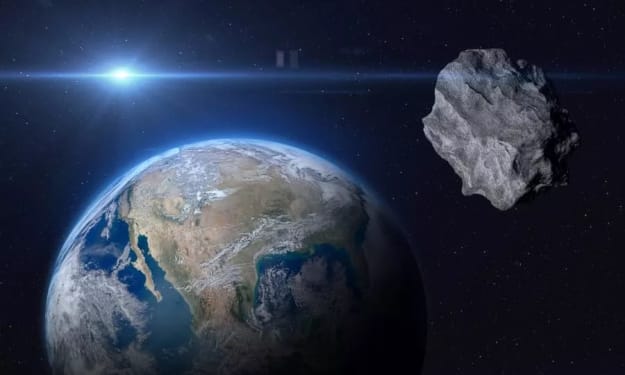
City killer asteroid could smash into MOON as Nasa warns probability of impact set to rise further. NASA has recently raised concerns about a Big Ben sized asteroid that could collide with the Moon in the near future. Scientists have been closely monitoring the trajectory of this celestial body and the probability of impact is reportedly increasing. While the asteroid was initially considered a potential threat to Earth new calculations suggest that it may instead be on a collision course with the Moon. This alarming development has sparked discussions among experts regarding the potential consequences of such an event and what it could mean for future space exploration. The asteroid in question which measures roughly the same size as London's iconic Big Ben has been under observation by NASA’s planetary defense team for some time. Previously there were fears that this space rock could impact Earth with predictions estimating a 20 percent chance of collision by April. However updated calculations now indicate that the Moon could bear the brunt of this cosmic encounter. The probability of the asteroid hitting the Moon has been steadily increasing raising concerns about the potential impact and its implications for both lunar exploration and Earth's space environment.
By Adnan Rasheed2 years ago in Earth
House Sized Asteroid Approaching Earth Tomorrow NASA Reports.
House Sized Asteroid Approaching Earth Tomorrow NASA Reports. NASA has reported that a house sized asteroid designated 2025 DJ22 is set to pass by Earth at a remarkable speed of 29,304 miles per hour. While the thought of an asteroid speeding through space towards our planet might sound alarming scientists assure that it poses no immediate threat. The asteroid estimated to be approximately 47 feet in diameter will miss Earth by a relatively close distance of 347,000 miles just beyond the orbit of the Moon. Asteroids like 2025 DJ22 are a common occurrence in our solar system. These space rocks remnants from the early formation of planets travel in various orbits and sometimes come close to Earth. While this asteroid’s approach is noteworthy due to its proximity it does not fall under the category of potentially hazardous asteroids which are defined as objects that pass within 4.6 million miles of Earth and are large enough to cause significant damage if they were to collide with our planet. However NASA and other space agencies keep a close watch on all such near Earth objects NEOs to ensure continuous monitoring of their orbits.
By Adnan Rasheed2 years ago in Earth
Forget Solar Panels! Bamboo Is the Real Climate Hero – Here’s Why It’s Taking Over. AI-Generated.
🌍 The Silent Superhero of Sustainability Picture this: A plant so powerful it can grow a staggering 3 feet in 24 hours, absorb more carbon than a forest, and replace plastic, steel, and concrete. No, it’s not a sci-fi invention—it’s bamboo, Earth’s most underrated climate warrior. While solar panels hog the spotlight (and rightly so), bamboo works behind the scenes, tackling deforestation, pollution, and emissions with every shoot.
By David Snam2 years ago in Earth
A jump, 100 million seeds, and the rebirth of the Amazon!
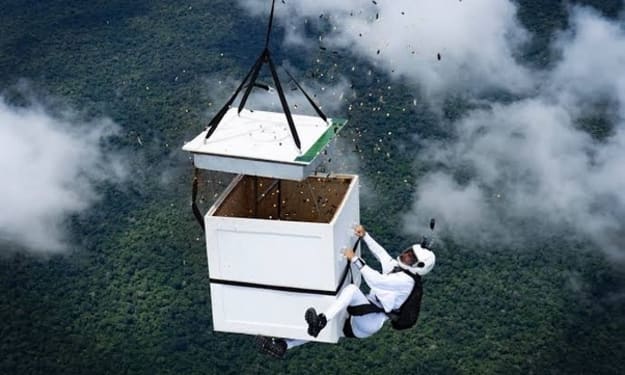
A small cargo aircraft was hovering in the sky at an altitude of 12,000 feet. Inside, Luiji Kani—a famous Brazilian skydiver and environmental worker—stood near the open hatch. In front of him was a large metal box containing 100 million seeds, meant to revive a destroyed part of the Amazon rainforest. This land, once green and full of life, had turned barren due to massive deforestation and devastating fires. Luiji took a deep breath and, without wasting any time, pushed the box out of the aircraft. Within seconds, he followed, diving straight into the open sky. The powerful wind currents hit his body, but his focus remained solely on the box, which was plummeting rapidly toward the earth. This was no ordinary skydive; it was a mission to restore life to a dying forest. The adrenaline rushed through his veins as he tried to reach the metal box. He extended his arms, and after a few tense moments, he managed to grab the edge of the box. But suddenly, a strong gust of wind spun him violently. His body flipped upside down, and his right wrist twisted sharply. A sharp pain shot through his arm. For a moment, he lost control, but years of skydiving experience helped him regain stability. He clenched his teeth, pushing aside the pain, and refocused on the mission. The altitude meter in his gear showed 6,000 feet. It was time. Using all his strength, he yanked open the box’s lid. As soon as the lid was off, the seeds burst into the air, scattering in all directions. The wind carried them over the land below—a vast area of burnt soil that once thrived with dense greenery. These seeds held the promise of rebirth. In a few years, they would grow into towering trees, some reaching heights of 50 meters, covering an area equivalent to 14,000 football fields. It was nature’s second chance. The Amazon rainforest is one of the most important ecosystems on Earth. It produces 20% of the world’s oxygen, regulates the climate, and provides a home for more than 10 million species of plants and animals. But human activities, including illegal logging, agriculture, and uncontrolled fires, have destroyed large portions of this vital forest. Scientists warn that if the deforestation continues, the Amazon may reach a tipping point where it can no longer regenerate itself. This mission was not just about planting trees; it was about restoring balance to nature. These 100 million seeds included a mix of native plant species, carefully selected to support biodiversity. Some would grow into towering hardwood trees, while others would provide food and shelter for animals. The idea was not just to replant trees but to rebuild an entire ecosystem. But the mission was not over yet. The danger was far from gone. Luiji's wrist throbbed in pain, and he still had to deploy his parachute. The altitude had dropped to 3,000 feet. He pulled the parachute cord, and the canopy burst open abruptly. A powerful jolt shook his entire body. For a moment, his vision blurred, and he felt like he might lose consciousness. But he fought against the dizziness and steadied himself. Slowly descending, he looked down. The seeds had dispersed exactly as planned. The barren land below would soon witness the miracle of regeneration. A wide smile spread across his face. His mission was successful. As he landed safely on a cleared patch of land, Luiji let out a deep breath of relief. He looked around and then up at the sky. He had done it. These seeds, now resting in the soil, would soon sprout with the arrival of the rains. This would not just be a new beginning for the forest but also a message to the world—one person, with courage and determination, could make a difference. Luiji Kani’s mission was not just an adventurous stunt; it was a call to action for the entire world. The Amazon rainforest, often called the "lungs of the Earth," had suffered immensely due to human activities. But if one person could take such a bold step toward its revival, imagine what humanity could achieve if they united for the cause. Perhaps, years from now, someone would walk through this forest, unaware of the extraordinary story behind its revival. They might not know that this lush green landscape was the result of one man’s daring leap—one jump that sowed the seeds of hope for the Earth’s future. A single jump, 100 million seeds, and the rebirth of the Amazon!
By Neeraj Tiwari2 years ago in Earth
Architects of Control
The Architects of Control: Who Profits from Humanity’s Repeated Resets? Throughout history, civilizations have collapsed, knowledge has been lost, and humanity has been forced to start over. But what if these resets aren’t accidents? What if they are carefully orchestrated events designed to keep true power out of the hands of the masses?
By Alexander Terrell2 years ago in Earth
NASA Image Reveals Earth's Tallest Lightning.
NASA Image Reveals Earth's Tallest Lightning. The recent capture of a rare atmospheric phenomenon known as a gigantic jet by the International Space Station (ISS) has once again sparked interest in the mysteries of Earth's upper atmosphere. This extraordinary form of lightning often called Earth's tallest lightning is a massive electrical discharge that occurs between powerful thunderstorms and the ionosphere reaching nearly 50 miles into the sky. Unlike conventional lightning that travels between clouds or from clouds to the ground gigantic jets extend upward piercing the atmosphere in a dramatic display of raw energy. These electrical events are rarely observed and even less frequently captured in photographs making this latest image a significant contribution to scientific understanding. Gigantic jets belong to a category of atmospheric discharges known as transient luminous events (TLEs). These phenomena include other unusual forms of lightning such as sprites blue jets and elves each with unique characteristics and behaviors. Gigantic jets however are particularly notable due to their immense scale and power. They have been described as electrical tendrils stretching toward space a stark contrast to the downward bolts of traditional thunderstorms. Though first documented in 2002 they remain an enigmatic aspect of atmospheric science with researchers still trying to determine the exact mechanisms behind their formation.
By Adnan Rasheed2 years ago in Earth