Climate
"Migration of Birds and the Perils of Overhunting"
The skies are a canvas painted by the graceful flight of migratory birds—nature’s travelers crossing vast continents and oceans. For many species, migration is essential for survival. They journey thousands of miles to find food, escape harsh climates, and seek suitable breeding grounds. However, this awe-inspiring phenomenon faces a grave threat: overhunting. The once-protected passage from one land to another has become a perilous route marked by human greed and disregard for nature’s delicate balance.
By Wow Geniusabout a year ago in Earth
Black Holes: The Mysterious Giants of the Universe
Introduction : Black holes are some of the most fascinating and mysterious things in the cosmos. These cosmic occurrences, in which gravity is so strong that even light cannot escape, test our knowledge of physics and space-time. Scientists have studied them for decades, but they continue to astound us with their unusual qualities and enormous power. This page delves into what black holes are, how they arise, the various varieties, and their significance in the universe.
By Sazid Rahman about a year ago in Earth
A Telescope's Powerful New Tool May Offer a Better Way to Forecast Solar Storms
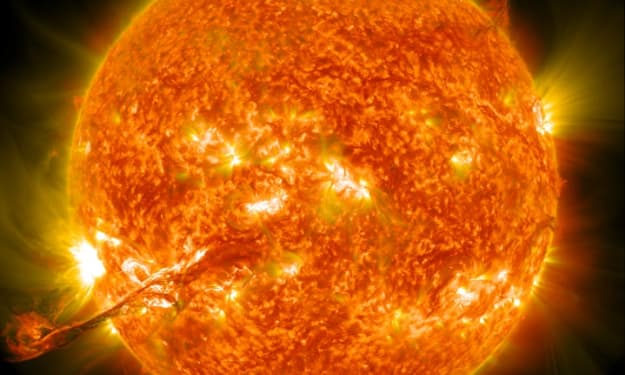
A Telescope's Powerful New Tool May Offer a Better Way to Forecast Solar Storms Solar storms, which are large eruptions of charged particles from the Sun, can have catastrophic consequences for Earth's power networks, satellites, and communication systems. Scientists have long struggled to make more accurate predictions about severe storms. However, a breakthrough in telescope technology could soon change this. A new technique linked into modern solar telescopes is revealing unprecedented insights into the Sun's magnetic activity, with the potential to revolutionize how we forecast solar storms.
By Sazid Rahman about a year ago in Earth
NASA’s $10B Telescope Just Spotted Artificial Light on Another Planet!. AI-Generated.
r sun, which makes it only 50% bigger than Jupiter. Proxima Centauri is also eight times as light as the sun. This star system is 4.2 lighty years away. That's how long it takes a photon of light to travel from this star to Earth. By comparison, it only takes 8 minutes for sunlight to reach our planet. If you decided to travel to Proxima Centuri, it would take you about 73,000 years to fly there in a conventional rocket. That's longer than our intelligent civilization has even existed. But it's not the star itself that interests us. It's the planet orbiting it. That's Proxima Centuri B. It's 17% bigger than Proxima Centuri Bi. Earth and about 10% heavier.
By taylor lindaniabout a year ago in Earth
The White House Releases its 2026 Budget Request for NASA. Cuts to SLS, Gateway and Orion. AI-Generated.
The Committee on Appropriations presented its suggestions for discretionary funding for the upcoming fiscal year 2026 (FY 2026) earlier today. The Budget reduces funding for numerous NASA initiatives and programs in addition to recommending significant reductions for departments such as education, health, international programs, and others. In total, the Budget provides $7 billion for Mars-focused programs and $1 billion for lunar exploration. However, NASA is also facing significant budget reductions and the demise of numerous programs that are integral to its "Moon to Mars" and science goals. NASA should be the first space agency to send humans to Mars and should return astronauts to the Moon before China, which plans to send the first taikonauts to the lunar surface by 2030, according to the budget proposal. The SLS, Orion, Gateway, and Mars Sample Return (MSR) missions are all slated to be canceled at the same time as the Budget does. It also tells NASA to look for more "cost-effective" solutions, like commercial space stations and launch services. When compared to FY 2025, when NASA received $25.4 billion, the budget calls for a total reduction of $6.34 billion. As a result, NASA's budget for the upcoming year is approximately $18.8 billion, or about the same as NASA's budget for 1980, which was $18.925 billion, after accounting for inflation. Moon to Mars Human Space Exploration, specifically "Mars-focused programs," receives an additional $647 million from the proposed Budget as the top priority for FY 2026. This includes the sample-return mission, which will now fall under the purview of crewed missions that will be launched in the 2030s. This indicates that the agency has reversed its previous decision to carry out a joint robotic sample return that involved an ascent vehicle developed by NASA and the ESA, an orbiter, a lander, sample retrieval helicopters, and others.
By Latest Update about a year ago in Earth
Clearly Water is Life
Clearly Water is Life Water is the essence of all life. From the smallest microorganism to the largest mammal, every living being relies on water to survive. It is not just a natural resource—it is the foundation of existence. The phrase “Clearly Water is Life” is more than a slogan; it is a truth that underpins the survival of the planet, the health of individuals, and the progress of civilization. In its clearest and purest form, water sustains ecosystems, drives agriculture, supports industries, and nurtures human health. At a biological level, water makes up about 60% of the human body. It is involved in every vital function—from regulating body temperature to aiding digestion, circulating nutrients, and eliminating toxins. Without access to clean, safe water, communities suffer from disease, dehydration, and death. Across the globe, millions of people still struggle to access safe drinking water, which underlines just how vital and yet often underappreciated this resource is. Where water is clean and abundant, societies flourish. Where it is scarce or contaminated, hardship and illness are common. Environmental sustainability also hinges on water. Forests, rivers, wetlands, and oceans depend on consistent water flow and clean sources. Aquatic life thrives in balanced ecosystems with fresh, unpolluted water. When industrial pollution, climate change, and irresponsible usage threaten water sources, entire ecosystems can collapse. Fish, amphibians, and birds lose their habitats; plants wither; and biodiversity diminishes. Clearly, the health of water is directly tied to the health of the planet. Water is equally crucial to agriculture. Crops and livestock depend on water, and irrigation systems enable food production even in arid areas. A shortage of water results in lower crop yields, food insecurity, and increased prices, all of which disproportionately affect poorer communities. Farmers around the world are becoming increasingly dependent on efficient water management to sustain food supplies, showing that water security is directly linked to food security. On a broader economic level, water fuels industries and energy production. It is used in manufacturing, mining, cooling systems in power plants, and even in the development of renewable energy sources such as hydropower. In regions where water resources are efficiently managed, economic growth tends to be more stable. Conversely, water crises can lead to conflict, migration, and economic decline. The availability of clean water can determine a country's development trajectory just as surely as its access to oil or minerals. The phrase “Clearly Water is Life” also highlights the importance of clean, transparent, and safe water—not just any water. In recent years, brands like Clearly Canadian have helped bring attention to the importance of purity in water. While a commercial product, Clearly Canadian’s emphasis on naturally sourced, clear spring water taps into a growing global awareness: that the clarity of water is symbolic of its safety, its sustainability, and its role in health. Bottled spring water, though often criticized for environmental reasons, also reflects a public demand for trustworthy, contaminant-free water. Yet, in many parts of the world, access to such water is still a luxury. Over 2 billion people lack access to safely managed drinking water, according to the World Health Organization. In sub-Saharan Africa, women and children often walk for miles each day just to fetch water—often from unsafe sources. This crisis is not only a public health emergency, but also a human rights issue. Clearly, where water is denied, so is opportunity, education, and life itself. In addressing this crisis, global cooperation is essential. Governments, non-profits, and businesses must invest in infrastructure, sanitation, and conservation. Innovations in water filtration, rainwater harvesting, and efficient irrigation are already transforming lives. But the first step must be a shift in mindset: to see water not as an unlimited commodity, but as a sacred necessity. To conclude, “Clearly Water is Life” captures both a literal and a symbolic truth. Life cannot exist without water, and the clearer and purer that water is, the better our health, environment, and future will be. As climate change and global inequality threaten our water sources, it is more important than ever to value, protect, and preserve this essential resource. Clean water is not a privilege—it is a human right, and it is the key to a thriving planet.
By Shah saab ITabout a year ago in Earth
First Image from the World’s Largest Solar Telescope Captures the Sun in Unheard-of Detail
First Image from the World’s Largest Solar Telescope Captures the Sun in Unheard-of Detail The Daniel K. Wilson Solar Telescope, the largest solar telescope in the world, marked a significant moment in astronomy and solar science. The Visible Tunable Filter (VTF), a potent new instrument, has resulted in the publication of the Inouye Solar Telescope's (DKIST) first image of the Sun with high resolution. Sunspots and swirling plasma structures can now be seen with unprecedented clarity on the surface of our nearest star, providing an unprecedented look at its surface.
By Sudipto Halderabout a year ago in Earth
🌸 20 Free Spring Coloring Pages That’ll Make You Feel Fresh, Happy & Creative
Spring has a way of making everything feel possible again. After months of gray skies and cold winds, the world bursts back into color — cherry blossoms bloom, birds return with their songs, and fresh grass peeks through the soil. It’s like nature takes a deep breath and says, “Let’s begin again.”
By The Waiting Treeabout a year ago in Earth