Advocacy
"A Ray of Hope"
Lesie had always loved her small town, nestled between the mountains and open fields. The community was close-knit, and life moved at a simple pace. But over the past few years, she had noticed something troubling. The weather was changing in ways she couldn’t ignore: hotter summers, drier winters, and storms that seemed to bring more destruction each season. Fields where wildflowers once bloomed were now barren patches, and the town’s river, once a steady lifeline, was thinning into a mere trickle. The words "climate change" had once felt distant, but now it was something she felt every day.
By Kibwe Kuwa2 years ago in Earth
BRICS: Emerging Economic Alliance Explained. AI-Generated.
The BRICS alliance includes Brazil, Russia, India, China, and South Africa. It's a strong economic group changing the world. This group of big emerging economies is key in shaping global trade, finance, and politics. We'll explore the BRICS' beginnings, importance, hurdles, and future in this article.
By Health&Hustle2 years ago in Earth
6 countries with the largest land mass
1. Russia: A Vast Land of Contrasts Capital: Moscow Russia, the largest country in the world by land area, stretches across vast expanses of Siberia and European Russia. Its diverse landscape encompasses everything from the frozen tundra to lush forests and fertile plains. With a rich history, complex culture, and abundant natural resources, Russia has played a significant role in global affairs for centuries.
By Moharif Yulianto2 years ago in Earth
"Rising Tides, Fading Hopes"
Ally spent her entire life on the coastline. Her family’s small fishing cottage, nestled against the beach, had stood for generations. Every sunrise over the ocean felt like an unspoken promise: that this life, built on salt air and steady waves, would last forever. But lately, things were changing. And for the first time, that promise felt fragile.
By Kibwe Kuwa2 years ago in Earth
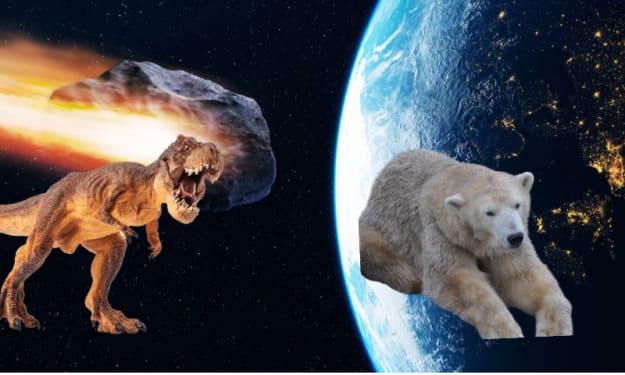
Could Modern Mammals Survive in the Age of Dinosaurs?
**Could Modern Mammals Survive Among Dinosaurs?** Millions of years ago, a massive asteroid struck Earth, wiping out the dinosaurs and giving mammals a chance to thrive. Their small size and ability to survive in difficult environments played a key role in their survival. But what if that asteroid had never hit? Would today’s mammals have what it takes to survive in a world still ruled by dinosaurs?
By Sciences and Wisdom2 years ago in Earth
"Seeds of Change"
Ally had always loved the smell of fresh coffee. Each morning, the rich aroma filled her small apartment, marking the start of her day. But as she stood in her kitchen, spooning coffee grounds into a paper filter, her eyes fell on the bin overflowing with single-use plastic packaging and food waste. Something felt off. The comforting routine was tainted by a nagging sense of guilt that had been building for months.
By Kibwe Kuwa2 years ago in Earth
The Life-Changing Power of Urban Farming.
The stereotype many of us have of cities being soulless concrete jungles dominated by skyscrapers and highways, and colonies of bustling humans shuttling around in poison-emitting vehicles disconnected from the natural world, thinking about tomorrow and the next dollar while feeling stressed and burned out, has been subtly, almost imperceptibly, shifting before our very eyes.
By Kimberley Silverthorne2 years ago in Earth
"Harvest of Uncertainty"
For generations, the lush fields of Green Hollow had been the pride of its people. Situated in the fertile heartland of a once-thriving agricultural region, the town was built around the rhythms of the seasons. Spring was for planting, summer for tending, and autumn for the great harvest festivals, where farmers would display their bountiful crops with pride, their hands calloused from work but their hearts full of satisfaction. But as time wore on, an invisible force began to unravel the delicate balance that sustained their livelihood—climate change.
By Kibwe Kuwa2 years ago in Earth
10 Compelling Reasons to Visit Nepal in 2025.
Nepal is a mesmerizing destination, offering stunning landscapes, a vibrant culture, and exhilarating adventures. With the "Visit Nepal 2025" campaign on the horizon, now is the perfect time to dive into the many wonders this incredible country has to offer. Here are ten enticing reasons to make Nepal your travel spot in 2025.
By Jivan Mangarati2 years ago in Earth
Comprehensive Guide to Business Insurance for Fiber Optic Cable Installers: Coverage, Costs, and Risks
The fiber optic cable installation market is becoming fast-expanding due to the requirement of enhanced communication networks and high speed internet. But the work is risky as hell. Fiber optic cable installers have many liabilities, from be it property damage or injuries at the site. If you lack appropriate insurance coverage, even a single accident could result in significant financial hardship. In this article, we discuss: The Insurance Fiber Optic Cable Installers Need Common Risks for fiber optic cable installers How much does business insurance cost of a year
By Kashaf Ilyas2 years ago in Earth
Earth's New Mini-Moon Signals a Bright Future for Space Mining, Scientists Say
In a remarkable cosmic event, Earth has gained a temporary new mini-moon. This asteroid, named 2024 PT5, was captured by Earth’s gravity on September 29, 2024. While it’s not visible to the naked eye, this small space rock is sparking excitement among scientists and space enthusiasts alike. More than just a curious visitor, 2024 PT5 offers a glimpse into the potential future of space mining, a field that could change the course of human history. The Discovery of 2024 PT5 2024 PT5 was discovered on August 7, 2024, by the Asteroid Terrestrial-impact Last Alert System in Sutherland, South Africa. This asteroid, measuring about 33 feet (10 meters) across, is part of a group of near-Earth objects known as Arjuna asteroids. These asteroids have orbits around the Sun that are very similar to Earth’s, which sometimes causes them to become temporarily trapped by Earth’s gravity, turning them into mini-moons for a short time. 2024 PT5 will stay in Earth’s orbit for 56.6 days, returning to its heliocentric (Sun-centered) orbit on November 25, 2024. Though small and dim, the asteroid offers scientists a unique opportunity to study a piece of the solar system up close. A Window into the Solar System’s History Dr. Nico Cappelluti, an astrophysicist at the University of Miami, explains that asteroids like 2024 PT5 are remnants from the formation of the solar system. “These near-Earth objects give us a window into the processes that shaped our solar system billions of years ago,” he said. Most asteroids are rocky fragments left over from the early days of planet formation, making them valuable for understanding the origins of our cosmic neighborhood. 2024 PT5, like other Arjuna asteroids, occasionally gets caught in Earth’s gravitational pull, which is why it’s now orbiting our planet. While this mini-moon won’t stay long, its brief visit helps maintain scientific interest in space rocks. The Growing Interest in Space Mining Beyond the scientific interest, asteroids like 2024 PT5 hold tremendous potential for space mining. Dr. Bertrand Dano, another astrophysicist from the University of Miami, explains that asteroids are not just lumps of rock. “Some asteroids are made of stone, but others are rich in valuable metals like platinum, gold, nickel, and cobalt,” he said. These metals are essential for electronics, fuel-cell technology, and other advanced industries. Asteroids could be the next frontier for mining, with millions of them orbiting in our solar system. Many are larger than 1 kilometer, and inside them lie vast reserves of precious resources. As Dr. Dano puts it, “The resources contained in asteroids are the new dream of El Dorado.” Several private companies are already exploring the possibility of sending spacecraft to mine these celestial bodies. The Challenges of Asteroid Mining While the potential rewards of asteroid mining are enormous, the challenges are equally daunting. Extracting metals from space rocks requires technology far beyond what we currently have. First, mining equipment would need to function in the vacuum of space, where there’s no atmosphere. Then there’s the issue of transporting these minerals back to Earth. Dr. Dano notes that launching mining missions from Earth is energy-intensive, so it might be better to start them from low-gravity locations like the Moon or Mars. One major challenge is returning the mined materials to Earth safely. “Returning to Earth is relatively easy, but it’s dangerous for the materials,” Dr. Dano explained. If not done properly, the precious metals could be lost during re-entry. One possible solution is refining the metals in space and shipping smaller, refined batches back to Earth over time. Despite these hurdles, the potential payoff is staggering. Mining a single asteroid could yield enough platinum or gold to make someone a trillionaire overnight. As renowned astrophysicist Neil deGrasse Tyson once said, “The first trillionaire there will ever be is the person who exploits the natural resources on asteroids.” A New Age of Space Exploration The capture of 2024 PT5 as a mini-moon is more than just an astronomical curiosity—it’s a reminder of the untapped resources floating around in space. Recent missions, such as NASA’s DART mission that successfully altered the path of an asteroid, show that we’re getting closer to being able to interact with and manipulate these space objects. While asteroid mining is still in its early stages, the dream is slowly turning into a reality. However, space mining isn’t just about making money. It could also help solve some of Earth’s biggest problems. As natural resources on our planet become scarcer, asteroids could offer a sustainable supply of critical metals and minerals. By moving heavy industry off-Earth, we could reduce the environmental impact of mining here, while also opening up new opportunities for exploration and innovation. Conclusion As 2024 PT5 orbits Earth for its short two-month stay, it serves as a symbol of both the mysteries of our solar system and the possibilities that lie ahead. Scientists are studying it to learn more about the origins of space rocks, while private companies eye similar asteroids for their potential riches. The future of space mining may still be uncertain, but one thing is clear: the resources floating around in our solar system are too valuable to ignore. Whether it’s for scientific research or economic gain, asteroids like 2024 PT5 offer a glimpse into a future where space holds the key to solving some of humanity’s greatest challenges.
By Black Rose2 years ago in Earth