Advocacy
Florida’s Fight Against Hurricane Milton: A Story of Grit and Togetherness
Oh my God!, Florida was holding its breath in early October 2024 when Hurricane Milton came knocking. The sky looked like it was about to unleash hell, and the news wouldn’t shut up about this Category 5 beast tearing toward the Gulf Coast. It wasn’t just another storm—it was a gut punch, especially after Hurricane Helene had already left folks reeling. This is the story of regular people staring down a monster, scared outta their minds but finding ways to hold it together and lift each other up. Take Maria Gonzalez from Tampa. She was on her porch, hands shaking, taping up her windows like her life depended on it. Helene had just trashed her neighborhood a couple weeks back, and now Milton was coming in hot, hitting land near Siesta Key on October 9 as a Category 3. Still scary as hell. Her kids, clinging to her legs, were like, “Mama, is our house gonna make it?” Maria didn’t know, but she hugged them tight, promising they’d be okay. All across Florida, people were feeling that same knot in their stomachs, packing up to evacuate or bracing for the worst. Milton didn’t mess around. It slammed through with 101 mph winds, ripping the roof clean off Tropicana Field in St. Pete and knocking out power for over 3.4 million homes. Floods swallowed cars and houses in Clearwater, and—get this—43 freaking tornadoes, including three EF3s, tore across the state like something out of a disaster flick. In Bradenton Beach, one house just slid right off its stilts, like it was saying, “I’m done.” The damage was brutal, but the real kicker? The emotional toll. Families like Maria’s were terrified of losing everything—their homes, their memories, their whole damn lives. But here’s the thing: even in the middle of all that chaos, people showed up. In Seminole Square, folks watched Milton shred their condo’s roof. Eight months later, by June 2025, they’re still waiting on repairs, but you know what? They’re not giving up. Neighbors started sharing food, swapping stories, and acting like family. One lady there said, “We’re not just neighbors anymore—we’re in this together.” That’s the vibe all over Florida. Strangers pulling people out of flooded apartments, volunteers hauling debris, even Governor DeSantis stepping up to get federal help rolling. It was messy, but it was beautiful. Some stories hit harder. A buddy of a Tampa guy went back to find their house just… gone. Roads were so bad they couldn’t even get to the rubble. On X, someone posted about how even lifelong Floridians were shook—this storm felt different. A weatherman broke down crying on live TV, talking about how Milton got so fierce so fast because of the Gulf’s crazy warm water. Climate change ain’t no joke, and it made this storm a beast. But the way people responded? That’s what sticks with you. From the National Hurricane Center’s nonstop updates to regular folks handing out water and blankets, Floridians said, “We’re not going down like that.” As Milton fizzled out into the Atlantic, leaving rough waves to bug the Bahamas, Florida started picking up the pieces. The price tag’s steep—$90 billion in damages—and it’s a long road back. But Maria, now helping out at a shelter, found herself smiling at kids playing in the middle of all the mess. “We lost a lot,” she said, “but we found each other.” That’s the real deal. Milton was a nightmare, but it showed what Florida’s made of—grit, heart, and a whole lotta love. No storm’s big enough to break that.
By Synchronizer xvvmabout a year ago in Earth
Teleios: The Silent Sphere That Defies the Cosmos
In the immense stretch of the Milky Way, astronomers have recently discovered a mysterious object that challenges traditional cosmic categories. Dubbed Teleios, this celestial entity is notable not only for its flawlessly spherical form but also for its unusual quietness—transmitting merely weak radio signals while being invisible in other wavelengths.
By MILTON CHANDRA ADIKARYabout a year ago in Earth
Unraveling the Cosmic Metronome: Strange Radio & X‑Ray Pulses Every 44 Minutes
In a finding that seems almost like something out of science fiction, astronomers have identified a cosmic entity that emits precisely timed signals—both radio and X-ray—every 44 minutes, a pattern that has never been seen before. This entity, now referred to as ASKAP J1832–0911, was initially detected by the Australian Square Kilometre Array Pathfinder (ASKAP) and subsequently verified with data from NASA’s Chandra X-ray Observatory.
By MILTON CHANDRA ADIKARYabout a year ago in Earth
Rage at politicians, corporations, and powerful entities who prioritize profit over planetary health.
Lena stood at the edge of the forest she had grown up exploring, the crisp mountain air replaced by thick smoke. Her little brother, Sam, clutched her hand, his face half-hidden behind a reusable cloth mask-decorated with cartoon trees that were now burning. “They said it’s under control,” he whispered. She didn’t answer. She couldn’t. How do you explain to a child that “they” have been saying that for decades? That “under control” is just a political phrase now, a bandage slapped on the gaping wound of a dying world. Lena was 19 and angry. Not the social media kind of angry, not performative hashtags or filtered eco-aesthetic angry. Her anger simmered, real, raw, and relentless. It pulsed in her veins when she saw images of oil spills and deforested land. It surged in her chest when billionaires launched rockets for fun while the oceans choked on plastic and people in her town drank bottled water because the tap wasn’t safe anymore. But the thing that tore at her most-what clawed at her gut every single night-was how nobody seemed to care enough to change. Not really. Not her father, who chuckled every time she tried to bring up carbon emissions. “We’ve always had hot summers, Lena,” he’d say, popping a beer, “you’re just too sensitive.” Not her aunt, who mocked her bamboo toothbrush and called her a “hippie freak” at family dinners. And certainly not the politicians on TV, who spoke of climate like it was a distant, polite topic, not an emergency. They smiled while forests burned, ice melted, and futures collapsed. Lena tried. God, she tried. She organized local cleanups. She switched to a plant-based diet. She cycled everywhere, avoided fast fashion, reused, recycled, reduced. But still-her hometown was on fire. Again. Sam’s school was closed for the third time this year due to “smoke risk.” He was only seven, and already knew how to pack a “go-bag.” Last night, she had cried quietly into her pillow while he slept beside her. The guilt was suffocating. I should’ve done more. I should’ve screamed louder. Why didn’t I chain myself to something? March more? But the real fear, the one that kept her up, was this: What if it doesn’t matter? That morning, she had opened her phone and found a new video trending. Some politician was laughing about climate activists. Again. Calling them “emotional kids” who “don’t understand the economy.” Her hands trembled. The economy? What use is an economy if there’s no air to breathe? Later, they went to her grandfather’s house, a safer area upwind from the fires. As they sat around the dinner table, the conversation turned, as it often did, to “back in my day.” Her grandfather, a retired farmer with sun-wrinkled skin, gestured with a spoon. “Lena, I’m proud of you for caring. But the world isn’t going to change because of your composting. We’ve got bigger fish to fry.” Lena bit her lip. “Maybe,” she said quietly, “we’re out of fish because everyone just kept saying that.” The room went quiet. Her father cleared his throat. “Don’t talk to your grandfather like that.” She stood up. “I’m not being disrespectful. I’m just tired of pretending this isn’t a crisis. That it’s not your generation that burned through all the resources. That we’re the ones being ‘dramatic’ when we’re just trying to survive what you left us.” Her voice cracked. Sam looked up at her, wide-eyed. Her mom sighed. “This again?” “Yes,” Lena said. “This again. Because I can’t go a single day without thinking about the end of the world. I have nightmares about rising seas and burning skies. I panic when I see a single-use plastic bottle. I cry when I read climate reports. And you all just... act like it’s not happening.” Her fists were clenched. Her chest heaved. She didn’t mean to explode. But it was too much. It had always been too much. “You get to be nostalgic,” she said through tears, “because your childhood wasn’t on fire.” Later that night, her grandfather knocked gently on her door. He entered slowly, holding something in his hand: an old photo album. Pictures of his farm, from decades ago. Green fields. Bees. Wildflowers. Clean rivers. “I didn’t know,” he said quietly. “Not really. We weren’t taught. We thought progress meant machines, fuel, bigger harvests, more comfort.” He sat down beside her, flipping a page. “I thought I was building something for you. A better world. I didn’t see what we were breaking.” Lena cried again. This time, not out of anger. But grief. And something softer, quieter-shared sorrow.
By Sisipho Machithiabout a year ago in Earth
June 2025 Sky Spectacle: 9 Astronomical Events That Will Leave You Starstruck
June 2025 is poised to be an exceptionally exciting month for astronomy enthusiasts in recent times. With at least nine significant celestial occurrences scheduled, the night sky will be bustling with activity—from meteor showers and planetary alignments to full moons that hold cultural importance. Regardless of whether you have a telescope or simply a keen pair of eyes, these events can be observed with little equipment from various locations around the globe. Here’s what to anticipate this month and the reasons behind its significance.
By MILTON CHANDRA ADIKARYabout a year ago in Earth
Chasing Dusk A Crescent Farewell
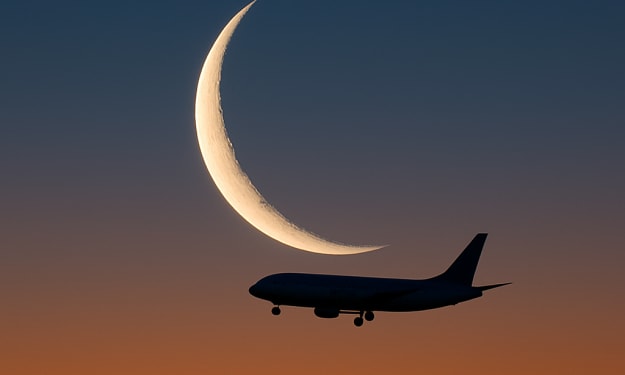
Imagine a scene that captures the quiet power of motion, the elegance of light, and the poetry of timing—all within a single, hyper-realistic frame. The image prompt presents a deeply evocative concept: a crescent moon gently holding the tail of an aircraft, flying away into a post-sunset sky with a perfect gradient of colors. This composition is not just visually striking; it’s emotionally rich and metaphorically layered.
By Anees Kaleemabout a year ago in Earth
A Quiet Home in the Heart of the Forest
There are places in the world where time slows down—not because clocks tick differently, but because the soul finally exhales. Deep within an ancient forest, tucked far from the hum of highways and the glow of cities, lies one such place. A quiet home, built not of marble or modern ambition, but of wood, stone, and stillness.
By Anees Kaleemabout a year ago in Earth
Yasmin Bashirova: Advancing Global Change Through Human Rights Advocacy
Human rights are not privileges—they are entitlements that every person should enjoy, regardless of nationality, gender, religion, or background. They form the basis for freedom, justice, and peace in the world. Yet millions still suffer discrimination, violence, and oppression. In this landscape, human rights advocates emerge as the critical voices pushing against injustice and shining a light where others choose to look away.
By Yasmin Bashirovaabout a year ago in Earth
The Jungle's Secret
The dense canopy of the jungle was alive with the hum of life. Above, the towering trees swayed in the wind, their leaves brushing together like whispers shared between ancient giants. Below, the air was thick with humidity, and the ground, soft with the weight of countless years of decaying leaves, held the secret of an untold history. It was a place where every step seemed to echo with the weight of time, a place that held its truths closely, fiercely.
By Muhammad Atifabout a year ago in Earth
Rocks show the moment when oxygen permanently altered the planet.
Two basic issues are addressed by several events in Earth's distant past: How did we get here? And where are we going? These pivotal moments demonstrate how life adjusts to shifting environmental conditions.
By Francis Damiabout a year ago in Earth
Loneliness associated with poverty creates actual mental and physical suffering.
In many parts of Europe, poverty and loneliness create unrelenting pain, both emotionally and physically. New research suggests that poverty is the primary reason why these conflicts persist.
By Francis Damiabout a year ago in Earth