Advocacy
The Importance of Strong Passwords
Introduction: In today's digital age, where our lives are increasingly intertwined with the online realm, safeguarding our personal information and accounts from unauthorized access is of paramount importance. The first line of defense in this battle against cyber threats is a strong password. A robust and well-crafted password not only serves as a shield to protect us but also acts as a crucial deterrent against potential data breaches. To enhance our online security and preserve the sanctity of our valuable information, it is imperative that we adhere to certain guidelines when creating and managing our passwords.
By Joseph Micheal Nnamdi3 years ago in Earth
E-waste and Land Contamination
Introduction Electronic waste, commonly known as e-waste, has become a growing concern in many parts of the world. With the rapid advancement of technology and the shortening product lifecycles, discarded electronic devices are piling up at an alarming rate. Ghana, like many other developing countries, is facing the hidden economic burden of e-waste and its associated environmental consequences. This article delves into the impact of e-waste on land contamination in Ghana, exploring specific examples and highlighting the economic challenges it poses to the nation.
By EDWIN ADDOTEY GLOVER3 years ago in Earth
The Wonders of Lemongrass:. Content Warning.
In the lush fields of Lemongrass Valley, there grows a plant that locals have cherished for generations - lemongrass. Beyond its tantalizing aroma and unique flavor, this plant has been believed to offer a myriad of health benefits. Although scientific evidence is still emerging, the ancient wisdom and cultural practices surrounding lemongrass tea have piqued the interest of health enthusiasts worldwide.
By Michael Rama3 years ago in Earth
The Moringa Tree
The enigmatic Moringa, also known as the "wonder tree," is an ancient botanical treasure steeped in the history of Africa. This remarkable tree, with its elongated, drumstick-like pods, holds an impressive lineage of use in the Indian subcontinent, but it has found its true essence in the diverse landscapes of Africa, where it has been cultivated and cherished for over two millennia.
By Michael Rama3 years ago in Earth
Study of Video Games Shows What People Do If The World Ends
Few things are as challenging as studying the end of the world and how people will behave in its aftermath. You probably won't get a true impression if you attempt when the world isn't actually ending because the world isn't really ending.
By Francis Dami3 years ago in Earth
Doomsday
This article challenges concerns about overpopulation and resource scarcity by proposing the concept of "super abundance." There are currently 8 billion people living on the planet. Questions about whether there is enough room for everyone and concerns about running out of natural resources are not new; they have been raised by doomsayers for at least 200 years. In 1798, English economist Thomas Malthus wrote his famous essay on the principle of population. He argued that while population grew exponentially, resources needed to feed that population grew at a linear rate, leading to potential starvation. However, Malthus' predictions proved to be far from accurate. As the population grew, so did food production and overall prosperity. A comparison of a typical American blue-collar worker's life over a century, using time prices, reveals significant improvements. Between 1900 and 2018, the time required for a blue-collar worker to earn enough money to buy a pound of pork fell by 98 percent, while pounds of rice and coffee saw respective decreases of 97 percent and 94 percent in the time needed to afford them. Though commodities like rubber, aluminum, and cotton are not edible, they are valuable inputs in production processes that influence the prices of goods and services, thus contributing to an overall improved standard of living. Over the same period, prices for these commodities fell by 99 percent, 98 percent, and 96 percent. Despite a significant increase in the United States' population from 76 million to 328 million, famines have largely disappeared outside of war zones. Instead, obesity has become a problem in much of the world today. This counter-intuitive relationship between population growth and abundance indicates that as the population increases, so does overall abundance relative to previous generations. We currently inhabit a world of "super abundance," a term coined by Gail Pully, my colleague and co-author of our book. The key to this super abundance lies in knowledge. As brilliant economist Thomas Sowell explains, the difference in the standard of living between the caveman and us is not due to natural resources but rather the accumulation of knowledge. We possess a vast amount of knowledge, which allows us to utilize the same natural resources available during the time of the caveman in ways that were previously unimaginable. Consider the transformative potential of a grain of sand. While it has existed for billions of years, over four and a half thousand years ago, someone discovered that heating sand to a high temperature could turn it into glass beads, which later evolved into glass jars and window panes. Each step of discovery increased the value derived from a grain of sand. Today, we use glass in fiber optic cables and computer microchips, significantly boosting our productivity and prosperity compared to our ancestors. Counting the quantity of known raw materials, as Malthus and others have done, may appear logical, but it overlooks a critical element: knowledge. New knowledge arises from the human mind, which is capable of intelligent and potentially world-changing thought. Therefore, the real determinant of economic growth is not the finite number of atoms on the planet, but rather the human ability to combine and recombine these atoms in increasingly valuable ways. This concept empowers us to declare that economic growth depends less on limited resources and more on limitless knowledge, as aptly put by Nobel Prize-winning economist Paul Romer: "New ideas do not add up; they multiply." We can aptly liken our world to a closed system, much like a piano with its limited number of keys. Yet, just as pianists can play an infinite number of melodies on these keys, our planet's fixed atoms offer an infinite number of possible combinations. What truly matters, therefore, is not the physical limits of our planet, but the ingenuity of human beings and their freedom to experiment and reimagine resource utilization. As long as we embrace two key components - people and freedom - we can continue to thrive in a world of super abundance. The more people our planet supports, and the greater the freedom they enjoy, the higher the likelihood of generating new and useful ideas to address our challenges, regardless of their nature. So, do you still believe there are too many people, or perhaps not enough?
By Olusola Bodunrin3 years ago in Earth
The Resilience of Life: Surviving Ancient Super Volcanoes. Content Warning.
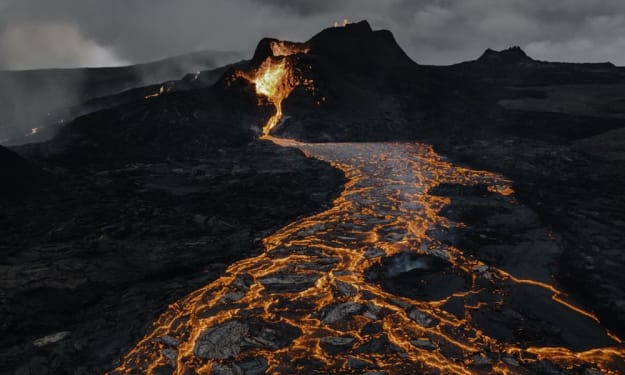
Introduction: Millions of years ago, the American landscape bore witness to an extraordinary geological phenomenon - the "ignimbrite flare-up," a series of super volcanic eruptions that shaped the course of history. These catastrophic events unleashed unimaginable power, dwarfing even the colossal eruption of Yellowstone. Surprisingly, these massive eruptions occurred relatively frequently, approximately every 10,000 years, engulfing North America in a thick layer of ash. However, life endured and thrived, leaving behind a remarkable fossil record. In this blog, we will delve into the astonishing resilience of ancient creatures and plants, exploring how they not only survived but also bounced back to shape the present-day world.
By Rohit Singh3 years ago in Earth
Legacy of Pollution
Pollution, like a shadow cast upon our planet, leaves a legacy that extends far beyond the immediate damage it inflicts. It is a legacy that touches every corner of the Earth, affecting ecosystems, human health, and the delicate balance of life itself. As we navigate the complexities of the modern world, we find ourselves grappling with the profound and often irreversible consequences of pollution, and the pressing need to forge a new path toward a cleaner and more sustainable future.
By dave dazzle3 years ago in Earth
AUTISM
In a quiet suburban neighborhood, nestled among the rustling trees and blooming flowers, lived a family of four – the Johnsons. Tom and Emily Johnson were loving parents to two young children, Alex and Mia. Their life was ordinary in many ways, but there was an extraordinary twist that set their journey apart.
By Delight Musukutwa3 years ago in Earth