
Soviet Spacecraft Kosmos 482 Crashes to Earth After 53 Years in Orbit
A Relic of the Space Race Meets Its Fiery End Over the Indian Ocean

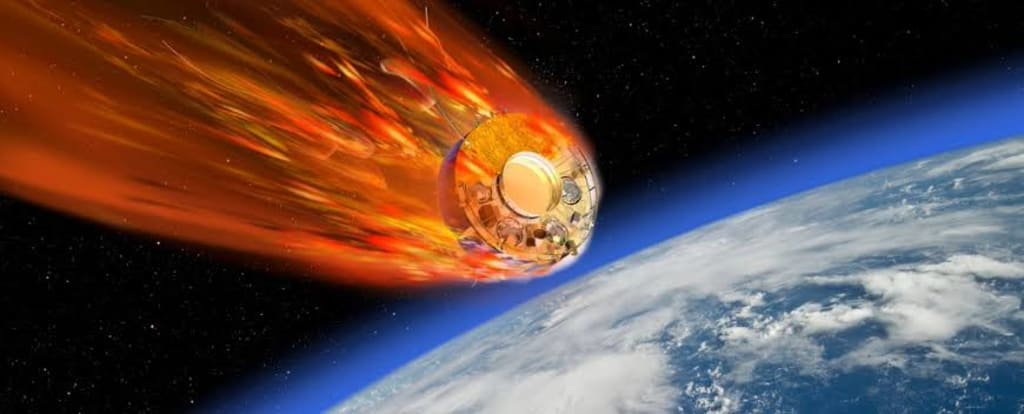
On May 10, 2025, a piece of space history came crashing back to Earth, ending a 53-year journey that began during the height of the Cold War. The Soviet-era spacecraft Kosmos 482, originally designed to explore Venus, made an uncontrolled re-entry into Earth’s atmosphere, splashing down in the Indian Ocean west of Jakarta, Indonesia. This event, confirmed by the European Union Space Surveillance and Tracking agency and Russia’s space agency Roscosmos, marked the dramatic conclusion of a mission that never fulfilled its purpose. Launched in 1972, Kosmos 482 was stranded in Earth’s orbit due to a rocket malfunction, a silent witness to decades of space exploration. Its return raises questions about space debris, the legacy of early space missions, and the challenges of managing our increasingly crowded orbital environment.The story of Kosmos 482 begins in March 1972, when the Soviet Union launched the spacecraft as part of its ambitious Venera program to study Venus. The mission was meant to send a lander to the scorching surface of the solar system’s hottest planet, where temperatures reach 477°C and the atmosphere is thick with carbon dioxide. However, a failure in the rocket’s upper stage left the spacecraft trapped in an elliptical orbit around Earth. Over the years, most of Kosmos 482’s components fell back to Earth, but its spherical lander—about 3 feet in diameter and weighing over 1,000 pounds—remained in orbit. Encased in titanium and built to withstand Venus’s extreme conditions, this lander was the last remnant of the failed mission. After 53 years of circling the planet, atmospheric drag finally pulled it down, leading to its fiery descent on May 10, 2025, at 2:24 a.m. EDT, as reported by Roscosmos.The re-entry of Kosmos 482 was a global event, closely monitored by space agencies and debris-tracking experts. The European Space Agency’s space debris office tracked the spacecraft’s path, noting its absence during an expected pass over a German radar station, which confirmed that it had already re-entered the atmosphere. Roscosmos reported that the lander fell into the Indian Ocean, 560 kilometers west of Middle Andaman Island, a relatively safe landing spot given the ocean’s vast expanse. However, not all experts agreed on the precise location, with some suggesting it could have come down over the eastern Pacific or even South Asia. This uncertainty highlights the difficulty of predicting uncontrolled re-entries, a challenge compounded by factors like solar activity and the spacecraft’s deteriorating condition after decades in space. The U.S. Space Command, which monitors dozens of re-entries each month, had yet to confirm the spacecraft’s fate as of Saturday afternoon, still analyzing data from orbit.What made Kosmos 482’s re-entry noteworthy was its potential to survive the fiery plunge through Earth’s atmosphere. Unlike most space debris, which burns up during re-entry, this lander was designed to endure Venus’s harsh environment, raising concerns that it might reach the surface intact. Experts like Marco Langbroek, a Dutch scientist at Delft University of Technology, estimated that if it survived, it could have hit the ground at speeds of up to 150 mph. While the odds of it striking a populated area were slim—comparable to the risk of a random meteorite fall—the possibility couldn’t be entirely ruled out. Fortunately, no damage or injuries were reported, and the spacecraft’s ocean landing was a relief. Under a United Nations treaty, any surviving wreckage belongs to Russia, though it’s unclear if recovery efforts will be made given the remote location.The historical significance of Kosmos 482 lies in its origins during the Space Race, a time when the Soviet Union and the United States competed to dominate space exploration. The Venera program was a cornerstone of Soviet space efforts, successfully landing multiple probes on Venus between 1961 and 1984. Venera 8, launched just days before Kosmos 482, reached Venus and transmitted data for 50 minutes before succumbing to the planet’s harsh conditions. Kosmos 482, however, became a footnote in this legacy, its failure masked by the Soviet Union’s practice of reclassifying failed missions as “Kosmos” satellites to avoid public embarrassment. For 53 years, it orbited Earth, a relic of a bygone era, until gravity finally claimed it. Its return serves as a reminder of the risks and uncertainties of early space exploration, as well as the enduring impact of those pioneering missions.Beyond its historical context, the re-entry of Kosmos 482 underscores the growing issue of space debris. The European Space Agency estimates that over 14,000 satellites orbit Earth, with more than 30,000 pieces of trackable debris larger than 4 inches. As space traffic increases—with companies like SpaceX launching thousands of satellites for projects like Starlink—the risk of uncontrolled re-entries is rising. Kosmos 482 was a relatively small object, but larger spacecraft, like China’s Long March 5B boosters, have caused concern in recent years by raining debris over populated areas. The Kosmos 482 event highlights the need for better debris management, such as controlled re-entries targeting remote ocean areas, a practice that modern space agencies often employ but which wasn’t possible for this Soviet relic.The incident also prompts reflection on the future of space exploration. While Kosmos 482’s re-entry posed little danger, it serves as a warning of what could happen as more objects crowd Earth’s orbit. Scientists are calling for international cooperation to develop sustainable practices, such as designing satellites to burn up completely upon re-entry or ensuring they can be de-orbited safely. The Kosmos 482 lander may have fallen harmlessly into the sea, but the next piece of debris might not be so benign. As we celebrate the achievements of the Space Race, we must also address its lingering consequences, ensuring that the final chapters of these historic missions don’t pose risks to future generations.The crash of Kosmos 482 is a fitting end to a mission that never reached its destination, a dramatic finale for a spacecraft that outlasted the era that created it. It’s a story of failure and resilience, of human ambition and the relentless pull of gravity. As we look to the stars, Kosmos 482 reminds us to also look down, to the debris of our past, and to plan carefully for the future of space exploration.
About the Creator
Ahmed Jubayer
Amplifying untold stories with a bold, authentic voice. Passionate about weaving words that resonate, provoke, and inspire.
Enjoyed the story? Support the Creator.
Subscribe for free to receive all their stories in your feed.
Comments
There are no comments for this story
Be the first to respond and start the conversation.