
Rising from the Depths: Archaeologists Lift Massive Stones from the Legendary Lighthouse of Alexandria
New underwater discoveries from the ruins of the ancient Pharos offer fresh clues about one of history’s greatest architectural wonders
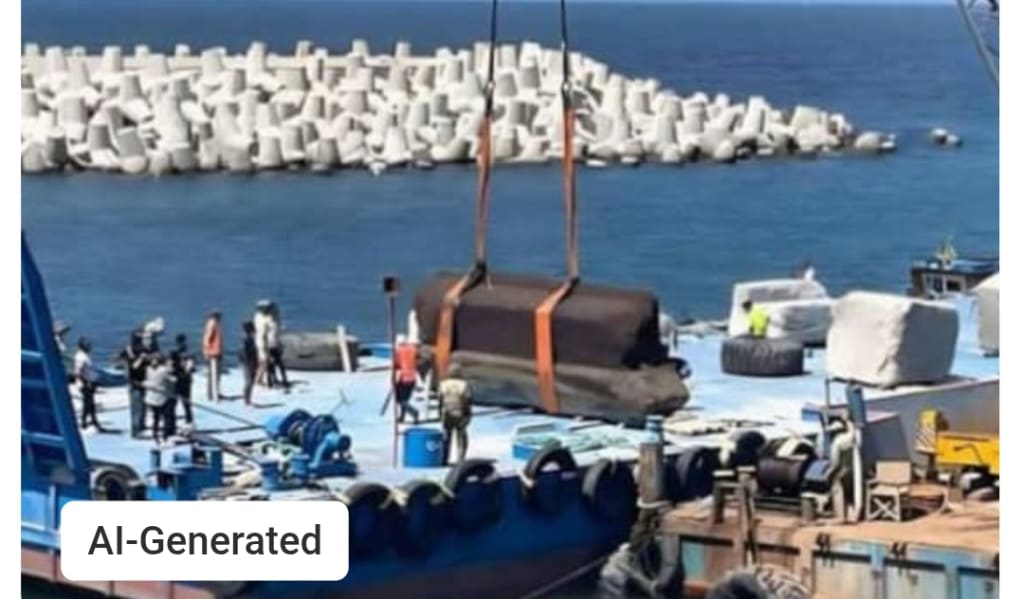
For centuries, the Lighthouse of Alexandria — also known as the Pharos — has lived in our imaginations as one of the Seven Wonders of the Ancient World. It towered over the Mediterranean coast for more than a thousand years, guiding sailors safely into Egypt’s most important harbor. But after a series of earthquakes between the 10th and 14th centuries, the lighthouse collapsed and slid into the sea. For a long time, many assumed the remains had scattered into unrecognizable fragments. But recent breakthroughs by underwater archaeologists have changed that belief entirely. In a remarkable scientific effort, researchers have lifted massive carved stones from the seafloor — stones that once formed the structure of the legendary Pharos. These discoveries are reshaping what historians know about the lighthouse, its engineering, and its symbolic power. And they are bringing the ancient wonder back to life in ways once thought impossible. A Wonder Lost Beneath the Waves The Lighthouse of Alexandria was more than just a navigational tool. It was a declaration of power from the early Ptolemaic rulers of Egypt, especially Ptolemy I and his son Ptolemy II. Built around 280 BCE on the island of Pharos, it stood between 100 and 130 meters tall, making it one of the tallest man-made structures of the ancient world. For centuries, ancient writers described the lighthouse as extraordinary, with its gleaming white stone towers and a giant statue crowning its top. Yet those descriptions came from people who saw it long before it fell. Because of this, our understanding of its design has always included a mix of fact, imagination, and educated guesswork. But that is beginning to change. Modern underwater archaeology — especially the exploration of Alexandria’s eastern harbor — is revealing the truth that lay hidden beneath the sea for nearly seven centuries. The Underwater Treasure Field For the last few decades, teams of archaeologists have mapped thousands of blocks, granite columns, sphinxes, and architectural pieces resting on the seafloor near the fortress of Qaitbay, which was built partly on top of the lighthouse ruins. But only recently have excavation teams begun lifting the largest and most significant blocks from the water. Some weigh more than 50 metric tons. These colossal stones are believed to have formed the lighthouse’s: foundational platform mid-section support and possibly parts of its ramps and inner chambers The sheer size of these pieces suggest the Pharos was even more robust and ambitious than earlier models proposed. As each block is raised to the surface, archaeologists document every curve, inscription, and tool mark. Many stones include decorative carvings and details that help experts determine their original placement. One researcher described the moment a block emerged from the water as “watching history rise from the depths.” What the Stones Reveal About the Lighthouse The newly raised blocks are changing long-held assumptions. Some key findings include: 1. The Lighthouse Was Built from Far-Travelled Stone Some blocks are composed of granite not native to the Alexandria region. This means the Ptolemies transported heavy stones from quarries far to the south. The lighthouse was not only a marvel of architecture — it was a logistical triumph. 2. Its Design May Have Been More Complex Than Expected Architects once assumed the lighthouse had three simple stacked sections: square, octagonal, and cylindrical. But the carvings on the retrieved stones reveal decorative features suggesting additional chambers, internal hallways, or possibly ceremonial spaces. 3. The Pharos Served More Than a Practical Purpose The lighthouse was not just a guide for sailors. It was a political and cultural symbol — a statement that Alexandria was the heart of the Mediterranean world. The new discoveries show high levels of craftsmanship, indicating the lighthouse was built to impress both citizens and visitors. Challenges of Working Beneath the Sea Lifting stones that have been underwater for centuries is extremely difficult. The process involves: careful mapping 3D scanning harnessing blocks with underwater airbags slowly raising them using cranes stabilizing the stones in desalination tanks They must be treated carefully; once removed from the sea, ancient stone can crack or decay rapidly. Archaeologists and conservators work together so that each piece is protected the moment it leaves the water. The process is slow, expensive, and extremely delicate — but the reward is invaluable. Reconstructing the Ancient Wonder As more blocks rise from the seafloor, the possibility of digitally reconstructing the Lighthouse of Alexandria becomes increasingly real. Using 3D modeling, archaeologists are beginning to: rebuild the lighthouse virtually test past theories about its height and shape explore how its interior might have functioned calculate how far its fire-lit beacon could have been seen And someday, if Egypt approves large-scale reconstruction projects, these discoveries may even support the creation of a physical replica or museum-level reconstruction. The idea of walking beside a rebuilt Pharos — even at a reduced scale — is one that excites both historians and the public. A Connection to the Ancient World Renewed The stones raised from Alexandria’s harbor offer more than historical facts — they offer emotional connection. They remind us that ancient structures were not myths or abstractions. They were real, enormous, and carefully built by skilled hands. People living 2,300 years ago carved these stones, lifted them, and placed them into one of the most ambitious buildings ever imagined. Today, as they rise again from the water, we witness the perseverance of human creativity. Even in ruins, the Lighthouse of Alexandria stands as a symbol of knowledge, innovation, and the relentless urge to reach higher.
About the Creator
Enjoyed the story? Support the Creator.
Subscribe for free to receive all their stories in your feed.
Comments
There are no comments for this story
Be the first to respond and start the conversation.