
Research on wildflowers challenges presumptions about their capacity to adjust to warmer conditions.
At the warm edge of life

Stories about climate change frequently center on loss. Fragile systems disintegrate, environments diminish, and species migrate. Our understanding of how to survive in a warming environment is shaped by this story. Not all species, however, adhere to this script. Some stay put and change in ways that go against conventional wisdom.
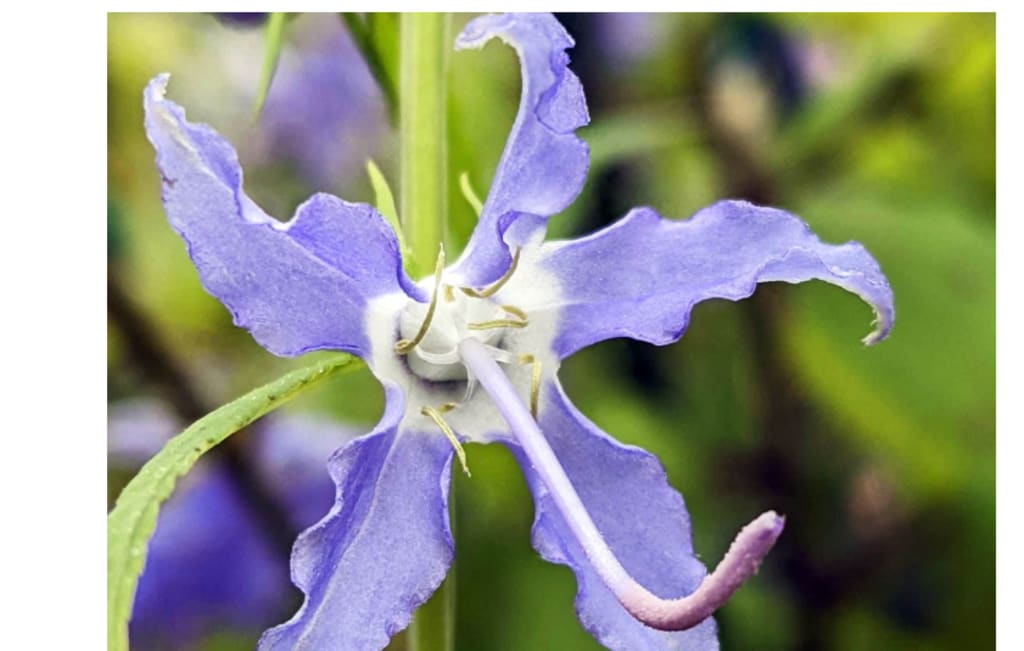
One such instance is highlighted in a recent study. Campanula americana, also known as the American bellflower, is a modest plant that it follows. This species demonstrates that it's not always a steady march toward extinction to survive at the warm limit of a range.
At the warm edge of life
Scientists create zones within the ranges of different animals. Areas where species spread into new territory are shown by the leading edge. As conditions deteriorate, the rear-edge indicates areas where populations persist.
Rear-edge populations were thought to be in decline by researchers for many years. It was anticipated that rising temperatures will push them to their limits. These organisations were frequently viewed as archaic and unlikely to change.
This study casts doubt on the theory. It poses a straightforward query. Are these populations actually struggling, or are they making adjustments?
Plants that have already withstood global warming
In the eastern United States, Campanula americana thrives throughout woods. The populations in the south are located below a latitude of 35 degrees north. Ancient refuges from the last ice age can be found in these warmer regions.
These southern groups were thoroughly examined by University of Virginia (UVA) researchers. Their goal was to learn how these plants reacted to sustained warming.
"These populations have experienced warming in the past because they have existed since the last glacier," stated Laura Galloway, a biology professor at UVA and the study's principal author. "They can serve as models for potential reactions to future global warming."
Plants' prospects at the warm edge
Three key concepts were investigated by the group. First, a high level of genetic variety may be maintained in these populations. Secondly, they may experience detrimental mutations and genetic drift. Third, they may exhibit indications of climate adaptability.
According to Antoine Perrier, a postdoctoral research fellow at UVA, "we often think that populations at the warmer edge are the ones that will go extinct." "However, it turns out that we don't know a lot about these populations." Different techniques, such as controlled tests and genetic research, were needed for each concept.
Emergence of genetic patterns
The initial findings appeared to support preconceived notions. Compared to groups in the center, those in the south displayed less genetic variety. Additionally, their genetic differences were greater.
This initially appeared to be genetic drift. Over time, small populations frequently lose their diversity. Additionally, they frequently differ from one another. However, the researchers didn't end there. They questioned whether decline was indeed reflected in these patterns.
Plant populations that are genetically healthier
The team measured drift load to check for genetic drift. This is a reference to detrimental mutations that accumulate in tiny populations. They experimented with cross-breeding. Crossing a population with another population that has a high number of detrimental mutations should result in stronger progeny.
The team was taken aback by the outcome. The drift burden was lowest among populations in the South. On the other hand, groups in the north exhibited significantly greater levels of detrimental mutations. The expected pattern was reversed by this discovery. In actuality, the communities that were perceived as the weakest had better genetic health.
More is revealed by field experiments
Common garden experiments were the next stage. Three locations—from the warm southern edge to the middle regions—were used by the researchers to plant populations. They monitored growth, reproduction, and survival. This made it possible for them to assess each population's performance in various scenarios. Clear local adaptation was seen in the results. Plants thrived in conditions that were comparable to those in their native areas.
In the south, strong adaption
Southern populations showed the strongest adaptation. Warm weather was ideal for these plants. They also have trouble in colder climates. Perrier stated, "We discovered patterns of local adaptation throughout the range." "But what was really intriguing is that only populations from extremely similar environments were able to actually grow and reproduce in the deep south."
In gardens in the south, northern plants did not thrive. Many were unable to reproduce or even survive. Their typical growth cycles were not triggered by the mild winters.
Selection has a long history
History holds the key to this adaptation. Following the previous ice age, inhabitants in the South stayed put while the environment warmed. They were under constant pressure to adapt for almost 20,000 years.
Their biology changed as a result. Vernalization—the requirement for exposure to cold before flowering—was one significant change. According to Perrier, "populations are expected to experience a loss in reproduction as winters get warmer." "However, this did not apply to the rear edge." Southern plants adapted to flowers without strong cold signals. Because of this, they were able to procreate during mild winters.
Reevaluating genetic signals
A significant issue about genetic data is also brought up by the study. Decline is not necessarily indicated by low diversity and high divergence. Strong selection may also produce these patterns. Over time, adaptation can increase differences across populations while decreasing variety within them. Thus, scientists need to exercise caution. The whole tale cannot be revealed by genetic data alone. Ecological settings and experiments are crucial.
Climate model implications
Our ability to forecast how species will react to climate change is impacted by these discoveries. Species are treated as homogeneous groups in several models. They make the assumption that every population reacts similarly.
This study demonstrates that this isn't always the case. Various populations are able to adjust to local circumstances. Some might already be appropriate for climates in the future.
Campanula americana populations in the south might be more equipped to withstand warmer winters. As conditions change, residents in the north can face more difficulties. Galloway said, "It's almost the opposite of what we expect."
A fresh viewpoint
It's possible that rear edge populations are not feeble remnants. They might be long-term adaptation experiments. Future climate conditions have already been experienced by some groups.
This view alters our appreciation of them. Losing these populations could result in the loss of special adaptations made According to Perrier, "we don't often think of these populations as the ones that might be the best adapted to future conditions." "However, they might endure and alter our understanding of how species react to climate change."
Surviving on the periphery
A change in perspective is provided by the Campanula Americana narrative. Moving to new locations isn't always necessary for survival. Sometimes it's about remaining where you are and making adjustments over time.
These plants demonstrate how resilience may appear in unexpected settings. Evolution may be most active at the boundaries of a range, when survival appears least likely. The southern border's bellflower is not disappearing. It involves adjusting, persevering, and rewriting our expectations of life in a world that is changing.
About the Creator
Enjoyed the story? Support the Creator.
Subscribe for free to receive all their stories in your feed.
Comments
There are no comments for this story
Be the first to respond and start the conversation.