
Precision Irrigation Market 2025-2033: Smart Water Management Turns into a Core AgriTech Priority
With water scarcity, climate pressure, and digital farming on the rise, precision irrigation is moving from a niche upgrade to an essential farm productivity tool.

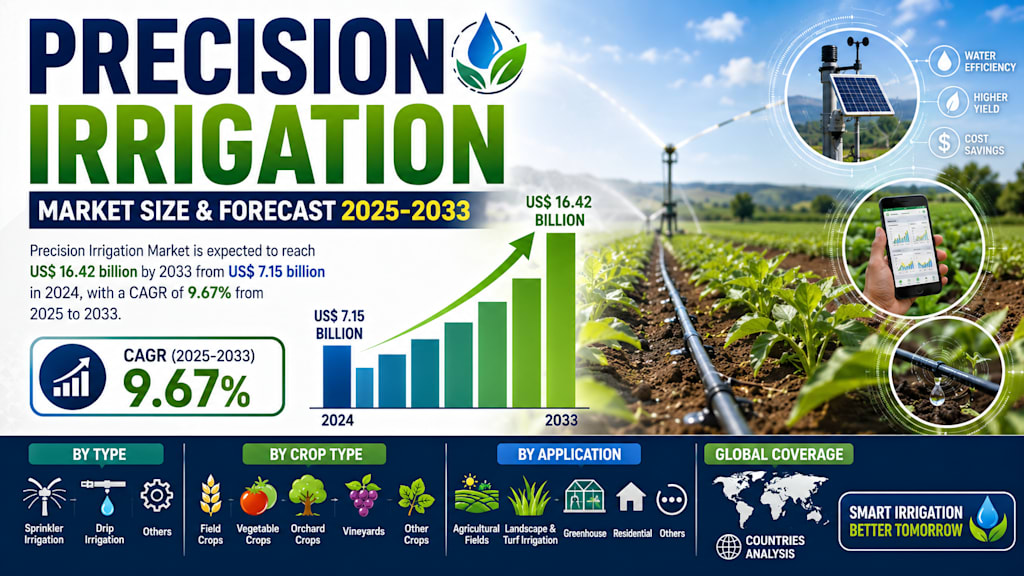
Precision irrigation is no longer just about saving water. It is becoming one of the clearest examples of how agriculture is adapting to a harsher climate, tighter resource limits, and a more data-driven future. According to Renub Research, the global precision irrigation market is expected to rise from US$ 7.15 billion in 2024 to US$ 16.42 billion by 2033, expanding at a CAGR of 9.67% between 2025 and 2033. The report covers sprinkler irrigation, drip irrigation, and other systems across agricultural fields, landscapes, greenhouses, residential use, and more.
What makes this market especially important is that it sits at the intersection of food security and sustainability. Farmers are being asked to produce more with less water, less land, and less room for waste. That pressure is pushing precision irrigation from a “nice to have” technology into a practical necessity. Renub Research’s overview also highlights how smart irrigation, soil moisture sensing, weather monitoring, and Internet of Things-enabled control systems are changing the way farms manage water at the field level.
Why precision irrigation is gaining momentum
The strongest demand driver is simple: the world needs more food, and agriculture must deliver that output without exhausting natural resources. Renub Research notes that by 2050, the global population is expected to exceed 9 billion, which will put even more strain on food production systems. Precision irrigation helps farmers apply water and nutrients more accurately, improve yield, and reduce waste at the same time.
Sustainability is another major force behind the market’s growth. Farmers, governments, and agribusinesses are increasingly aware that traditional irrigation methods can lead to runoff, nutrient loss, soil degradation, and unnecessary energy use. Precision irrigation supports cleaner and more efficient farming by delivering water where and when it is needed. That makes it attractive not only from an environmental standpoint, but also from an operational one, because farms can improve long-term resilience while meeting changing regulatory and customer expectations.
Technology is accelerating adoption as well. Smart agriculture now includes IoT, AI, GPS, drones, and analytics, and irrigation is one of the most practical entry points for digital farming. Automated watering decisions, real-time monitoring, and remote control tools are helping farmers reduce labor pressure and make better use of water resources. In many ways, precision irrigation has become the “visible” part of digital agriculture because the return on efficiency is easier to measure than in many other farm technologies.
What is slowing the market down
Even with strong demand, the market still faces real friction. The most obvious challenge is the lack of technical knowledge. Many farmers, especially in smaller or less digitized markets, still need training to operate sensors, software platforms, automated controllers, and connected irrigation systems. Without support, even a strong technology can feel too complex to adopt.
Cost is the other major barrier. Precision irrigation often requires a meaningful upfront investment in drip lines, sprinklers, weather stations, sensors, controllers, and software integration. That can be hard to justify for small and mid-sized farmers, particularly when financing or subsidies are limited. The long-term economics may be attractive, but the initial capital burden remains one of the sector’s biggest obstacles.
Regional picture
The United States remains a leading market because of its advanced irrigation ecosystem, strong farming technology base, and large set of established players such as Valmont Industries, Netafim, Hunter Industries, The Toro Company, and Rain Bird Corporation. The UK market is also moving toward smarter water use as sustainability becomes more central to farming practices. India stands out because government support, micro-irrigation incentives, solar pump programs, and mobile-enabled farm tools are helping push adoption. In the UAE, precision irrigation is closely tied to water scarcity, desert agriculture, and food security goals.
From a product standpoint, the market is broad and still expanding. Renub Research segments it by type, crop type, and application. That matters because adoption is not happening in just one farming model. It is spreading across field crops, orchards, vineyards, greenhouse systems, and even landscape irrigation. This makes precision irrigation one of the most flexible growth stories in agriculture technology.
Competitive landscape
The report’s company coverage shows that the market is being shaped by a mix of global irrigation specialists and broad agricultural technology firms. Key names include Jain Irrigation Systems, Lindsay Corporation, The Toro Company, and Valmont. In the US market discussion, Netafim, Hunter Industries, Rain Bird, Valmont, and Toro are also highlighted as major forces in innovation and accessibility.
What stands out in 2024 and 2025 is that the competitive race is no longer only about hardware. Companies are building ecosystems that combine irrigation, digital monitoring, sensing, automation, and even climate-linked services. That shift is helping precision irrigation evolve from equipment selling into solution selling.
recent company developments
Netafim launched its Hybrid Dripline in February 2025, describing it as a patented system that combines an integral dripline with a built-in outlet to improve irrigation performance and operational efficiency.
Netafim and Virridy introduced a carbon credit program in Turkey in March 2025, beginning with more than 1,000 hectares and linking precision irrigation with emissions reduction and farmer income support.
Netafim Italia acquired Tecnir S.r.l. in November 2024, strengthening its precision irrigation service and installation capabilities in Italy.
Netafim partnered with Phytech in October 2024 to optimize digital farming through plant- and tree-based irrigation recommendations.
Rain Bird acquired the Jordanian and Mexican assets of Adritec Group International in August 2024, expanding its irrigation footprint in key international markets.
Rain Bird acquired OtO Inc. in April 2025, adding a smart lawn care company to deepen its connected irrigation offerings.
Rain Bird and Centaur Asia Pacific expanded their golf irrigation partnership into Malaysia and Brunei in March 2026, showing continued geographic expansion in premium irrigation segments.
The Toro Company introduced Aqua-Traxx Azul REvive through its agriculture division, extending its precision irrigation leadership with a drip tape designed using recycled resins to support circularity.
Lindsay completed its acquisition of a minority interest in Pessl Instruments in January 2025, strengthening its position in irrigation management and scheduling solutions.
Valmont acquired the remaining 80% of Rational Minds in January 2026, adding advanced irrigation controls and connectivity expertise to the Valley Irrigation platform.
Final thoughts
Precision irrigation is entering a stronger, more strategic phase. The market’s growth is being supported by a rare combination of factors: water scarcity, food security needs, sustainability pressure, and the rapid rise of digital farming. Renub Research’s forecast of US$ 16.42 billion by 2033 is not just a market number; it reflects a structural shift in how agriculture is likely to manage one of its most critical inputs.
The next few years should reward companies that can do more than sell irrigation hardware. The winners will likely be the ones offering complete, connected, and farmer-friendly systems that reduce waste, improve yield, and make smart irrigation easier to adopt at scale. For agriculture, that is not just innovation. It is resilience.
About the Creator
Enjoyed the story? Support the Creator.
Subscribe for free to receive all their stories in your feed.
Comments
There are no comments for this story
Be the first to respond and start the conversation.