
OUR SUN LOOK DIFFERENT
Our sun looks different from what you may have imagined. Contrary to popular belief, it's not a bright yellow ball of fire. In reality, it appears more like this:
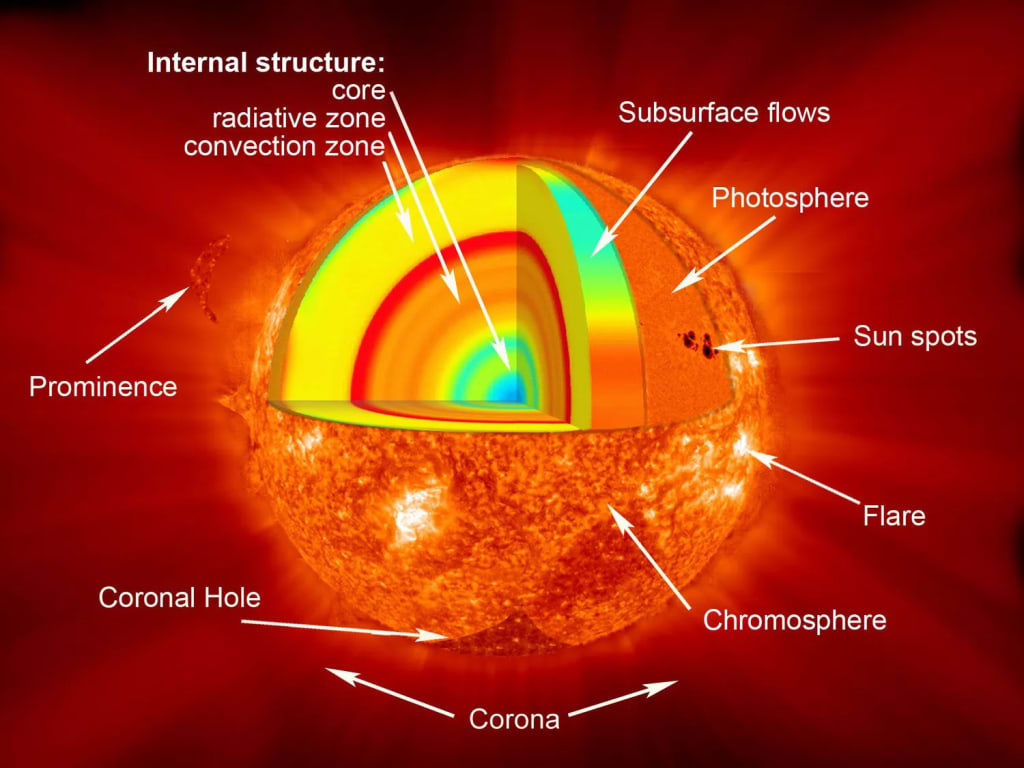
Scientists determine a star's temperature by analyzing the color spectrum it emits. Each color corresponds to a specific wavelength, and astronomers use these wavelengths to gauge a star's heat. Cooler stars appear red, while the hottest ones emit a blue hue. Our sun primarily emits energy at a wavelength close to green. However, due to the presence of other wavelengths, the combination of colors appears vibrant and white when viewed from the International Space Station.
When observed from Earth, our atmosphere scatters blue light effectively, resulting in the sun appearing yellow. If the sun were actually yellow, it would be around 800 degrees Celsius cooler. This temperature change would cause our Solar System's habitable zone to shrink, transforming Earth into a frozen and lifeless planet.
The sun is indeed hot, but it's not burning like a fire fueled by oxygen. Unlike many stars, our sun is primarily composed of hydrogen and helium gases, with minimal oxygen. It operates as a massive nuclear reactor, continuously fusing hydrogen atoms in its core to create helium. This fusion process releases an enormous amount of energy, contributing to the sun's scorching temperature.
Explosions in space, as depicted in movies like Star Wars, are fictional. In reality, space lacks the necessary air for combustion. Since there is no oxygen, there can be no fire. Hence, spaceships cannot explode in the traditional sense.
Contrary to popular belief, it is possible to count the stars visible to the naked eye. According to the Yale Bright Star Catalog, there are 9,110 stars that can be seen from Earth without optical aids. Try counting them yourself!
Movies often depict navigating the asteroid belt as a dangerous task requiring exceptional piloting skills. However, this portrayal is misleading. The asteroid belt consists of trillions of space rocks ranging in size from dust particles to those roughly a quarter the size of the Moon. Despite its vast number of asteroids, the belt spans a distance of 225 million kilometers between Mars and Jupiter, resulting in significant spacing between the rocks. Spacecraft rarely encounter asteroids since the distances between them are vast.
If someone were to be expelled into space, they wouldn't freeze instantly. Heat transfer occurs relatively slowly in the vacuum of space. While their body would eventually freeze, it would take hours to happen. However, the lack of oxygen would be the primary cause of death, leading to unconsciousness within 15 seconds and the shutdown of vital organs within two minutes.
Contrary to popular belief, space itself does not have a temperature. Temperature is defined by particle movement and energy, which are absent in the true vacuum of space. However, space is not a perfect vacuum, and areas with dense gas clouds can be extremely cold, reaching temperatures as low as minus 263 degrees Celsius.
Despite Mercury's proximity to the Sun, it is not the hottest planet in our solar system. During the day, Mercury's surface temperature can reach 430 degrees Celsius, while at night, it drops to minus 180 degrees Celsius. Venus, on the other hand, holds the title for the most hellish planet. Its thick atmosphere creates a greenhouse effect, resulting in a scorching surface temperature of about 475 degrees Celsius.
Our solar system is not stationary; it is constantly moving through space. It travels at a speed of 220 kilometers per second, which is seven times faster than Earth's orbit around the Sun. A complete orbit around the Milky Way, known as a galactic year, takes approximately 230 million years. The last time we were in our current location, Earth had a single supercontinent, and dinosaurs
About the Creator
Enjoyed the story? Support the Creator.
Subscribe for free to receive all their stories in your feed.
Comments
There are no comments for this story
Be the first to respond and start the conversation.