
Oil Sludge Pyrolysis: Recovering Crude Oil From Industrial Hazardous Waste
Resolve The Billion-Barrel Headache
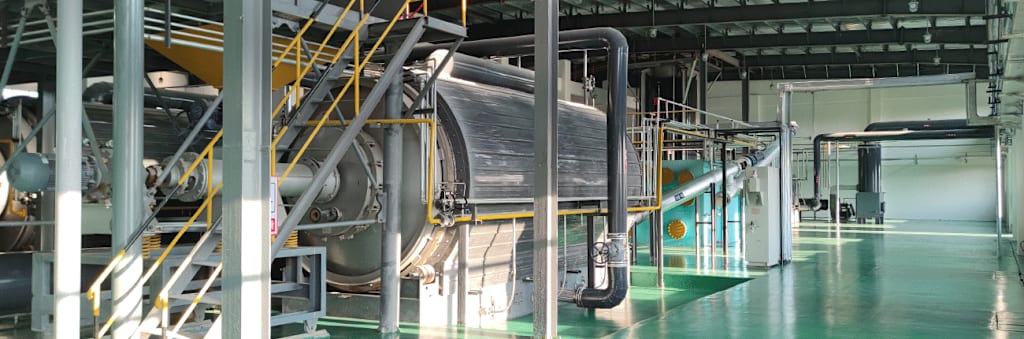
Refineries, petrochemical plants, and oil storage farms share a dirty secret. For every million tons of crude oil processed, a significant percentage ends up not as fuel or plastic, but as something far less glamorous: oil sludge.
This sticky, emulsified cocktail of crude oil, water, heavy metals, sand, and volatile organic compounds (VOCs) sits at the bottom of storage tanks, clings to pipelines, and accumulates in lagoons. Globally, the oil and gas industry generates an estimated 60 million to 80 million metric tons of oil sludge annually.
For decades, the solution was simple: dump it in a hazardous waste landfill or burn it in incinerators. But landfills are filling up, incineration releases toxic dioxins, and regulators are cracking down.
Enter Pyrolysis.
Unlike incineration, which burns the carbon away, pyrolysis uses heat in an oxygen-free atmosphere to cook the sludge, separating the water, vaporizing the hydrocarbons, and leaving behind inert solids (char). The result? You recover up to 80% of the trapped crude oil as a valuable fuel source, turning a massive liability into a liquid asset.
Here is the engineering deep dive into how industrial pyrolysis is solving the oil sludge crisis.
Part 1: What Exactly Is Oil Sludge?
Before we fix it, we must understand the enemy. Oil sludge is not one thing; it is a complex, unstable mixture.
- Wastewater Treatment Sludge: The gunk left over after separating oil from produced water.
- Tank Bottom Sludge: Heavy paraffins, asphaltenes, and rust settled in crude oil storage tanks (3–5 years of accumulation can fill 30% of a tank).
- Drilling Muds & Cuttings: Sludge contaminated with drilling fluids.
The Chemical Profile:
- Oil Content: 10% – 70% (Highly variable).
- Water Content: 20% – 60% (Often emulsified, hard to separate).
- Solids: 5% – 40% (Sand, rust, clay, heavy metals like Vanadium and Nickel).
The challenge is the emulsion. The water holds onto the oil, and the solids stabilize the mixture. Traditional centrifuges or settling tanks struggle. Pyrolysis breaks this emulsion at a molecular level.
Part 2: The Science – How Pyrolysis Works on Sludge
Imagine a massive, rotating steel tube shaped like a giant cigar, heated from the outside to 400°C – 600°C (752°F – 1112°F). As the sludge enters this reactor, three things happen in sequence:
Stage 1: Evaporation (100°C – 200°C)
Free water evaporates first. Bound water (the emulsified water) begins to break surface tension. This steam carries light volatile hydrocarbons (C5-C10) with it.
Stage 2: Thermal Cracking (300°C – 500°C)
The magic happens here. In the absence of oxygen, the long hydrocarbon chains in the sludge cannot burn. Instead, they crack. Heavy asphaltenes break into medium-weight diesel-range chains (C10-C20). The sulfur and nitrogen atoms are stripped off, partitioning into the gas phase.
Stage 3: Condensation
The hot vapors leave the reactor and enter a series of cooling towers (condensers).
- Heavy Oil: Condenses first (used as industrial fuel).
- Light Oil / Pyrolysis Oil: Condenses next (close to crude slate).
- Non-condensable Gas (Syngas): Mostly methane, hydrogen, and light VOCs. This gas is routed back to the burner to heat the reactor, making the process self-sustaining.
The Output:
- Recovered Crude Oil (30% – 80% of input): Low sulfur, low wax, high calorific value.
- Pyrolysis Water (15% – 50%): Contaminated, requiring treatment, but much less volume than raw sludge.
- Solid Char / Slag (5% – 30%): Inert, dry, often used as asphalt filler or construction aggregate.
The Future: Zero-Waste Refineries
The narrative is shifting. Oil sludge is not "waste"; it is misplaced crude.
With rising oil prices ($80+ per barrel) and tightening environmental regulations (e.g., China’s "Zero Waste" policy, EU’s Landfill Directive), pyrolysis has crossed the line from "green technology" to "financial necessity."
Refineries that adopt oil sludge pyrolysis plant aren't just avoiding fines—they are becoming closed-loop systems. They clean their own tanks, generate their own fuel for heating, and sell recovered oil back into the market.
Bottom Line
If you operate a refinery, a petrochemical plant, or an oil terminal, look at your sludge pond not as a problem, but as a low-grade oil field.
Industrial pyrolysis gives you the alchemy to turn hazardous mud into sweet crude. It is high-tech, it is profitable, and in a decarbonizing world, it may be the only way to keep heavy industry heavy.
The question is no longer "Should we pyrolyze our sludge?" but "How fast can we retrofit?"
About the Creator
Enjoyed the story? Support the Creator.
Subscribe for free to receive all their stories in your feed.
Comments
There are no comments for this story
Be the first to respond and start the conversation.