
Off the coast of South Korea, winds produce stunning cloud vortex streets.
The sky is shaped by a volcanic summit.

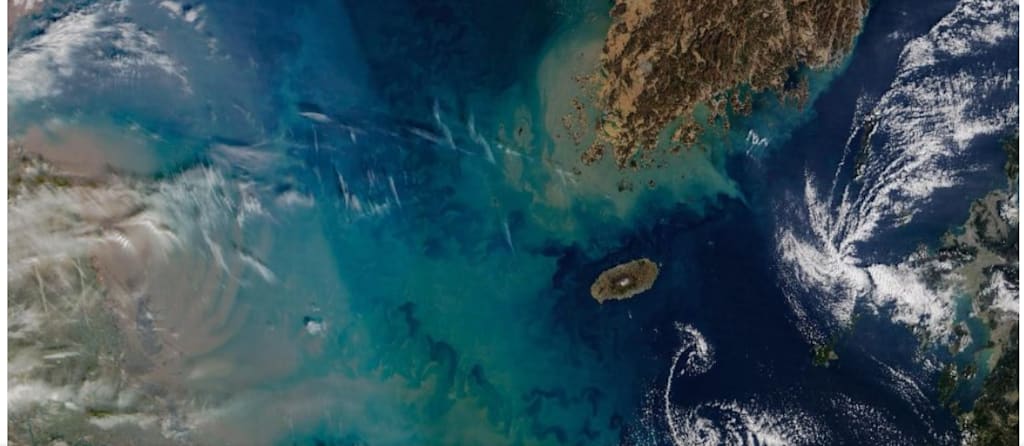
The NASA Earth Observatory's Image of the Day for today shows a swirl of clouds and colour off the coast of South Korea that appears to have been painted onto the ocean. The winds were perfectly aligned over Jeju Island on February 19, 2026. What came next was a breathtaking show of water churning and clouds twirling, all filmed from orbit. While the sight is stunning, it also serves as a real-time physics education.
The sky is shaped by a volcanic summit.
The Taebaek Mountains on the eastern coast of South Korea are not the country's highest peak. Instead, it rises from Jeju Island, which is located roughly sixty miles south of the Korean Peninsula. At roughly 6,400 feet above sea level, the island's central peak is high enough to obstruct airflow.
Hallasan, a shield volcano that last erupted in the eleventh century, is located at its heart. The mountain is well-known for its wide, sloping slope and numerous lava tunnels. It is the ideal barrier for migrating air masses because of its height and seclusion.
A spinning cloud
The whirling cloud patterns were captured in astounding detail on that February day by NASA's Terra satellite's Moderate Resolution Imaging Spectroradiometer (MODIS).
Staggered spirals may be seen in the picture following downwind of the island. Von Kármán vortex streets are the name given to these patterns. They are created when a tall, solitary, motionless item is passed by a fluid, such water or air. Clouds pass by with little fuss if the breezes are too weak. When winds are too high, the whirling eddies
However, the flow splits into alternating, counterrotating vortices that follow the air's motion in a small sweet area with winds between 11 and 34 miles per hour. Though the shapes can change, the fundamental physics is always the same.
At times, the vortices resemble brushstrokes, appearing thin and wispy. On other days, they form rows that are more parallel and crisp. Just the day before, a similar but more distinct pattern emerged close to Jeju.
Why wind speed is important
Theodore von Kármán, a Hungarian-American physicist, originally explained the science underlying these spirals in the early 20th century. The idea holds true for everything, including airflow around skyscrapers, river currents, and clouds in the sky.
Conditions must be balanced for vortices to remain cohesive. In this instance, the winter winds sweeping past Hallasan were both powerful enough to cause airflow instability and mild enough to allow the eddies to form recurring patterns.
Motion that would otherwise be invisible is shown by the clouds, which serve as visible markers. Although it does not occur frequently, this is not an uncommon occurrence near islands and mountain tops. It is dependent on moisture, wind speed, and atmospheric stability. The sky creates its own imprint when those elements come together.
The sea below is turbulent.
There was motion elsewhere except the atmosphere. In mid-February, the waters surrounding Jeju Island were likewise unstable. The water turned hazy brown to the west as a massive plume of sediment swept from Jiangsu province in China.
In shallow coastal seas, sediment is always present, although winter frequently produces very large plumes. Material from below may be stirred up and carried outward by seasonal changes in ocean currents and enhanced vertical mixing of the water column. As a result, the surface is covered in a wide fan of murky water.
A breathtaking view from space
The contrast is startling when viewed from space. Brown sediment fans forth below, as wispy white spirals twist above. Despite moving at different speeds and scales, air and water obey the same fundamental laws of motion.
Earth's shifting systems are steadily monitored by satellites like Terra. They make it possible for scientists to keep an eye on sediment transport, study atmospheric dynamics, and gain a better understanding of how seasonal factors affect the sea and sky.
In the center of it all is the silent volcanic summit of Jeju Island. However, on the correct day, winds ranging from 11 to 34 miles per hour can cause the air to spin in beautiful, miles-long arcs. From orbit, it transforms from a straightforward mountain-wind interaction into something remarkable.
About the Creator
Enjoyed the story? Support the Creator.
Subscribe for free to receive all their stories in your feed.
Comments
There are no comments for this story
Be the first to respond and start the conversation.