
Not Bangladesh's Problem Alone
A flooded street in Dhaka, 138 angry Reddit replies, and the cardboard box sitting on your balcony right now.
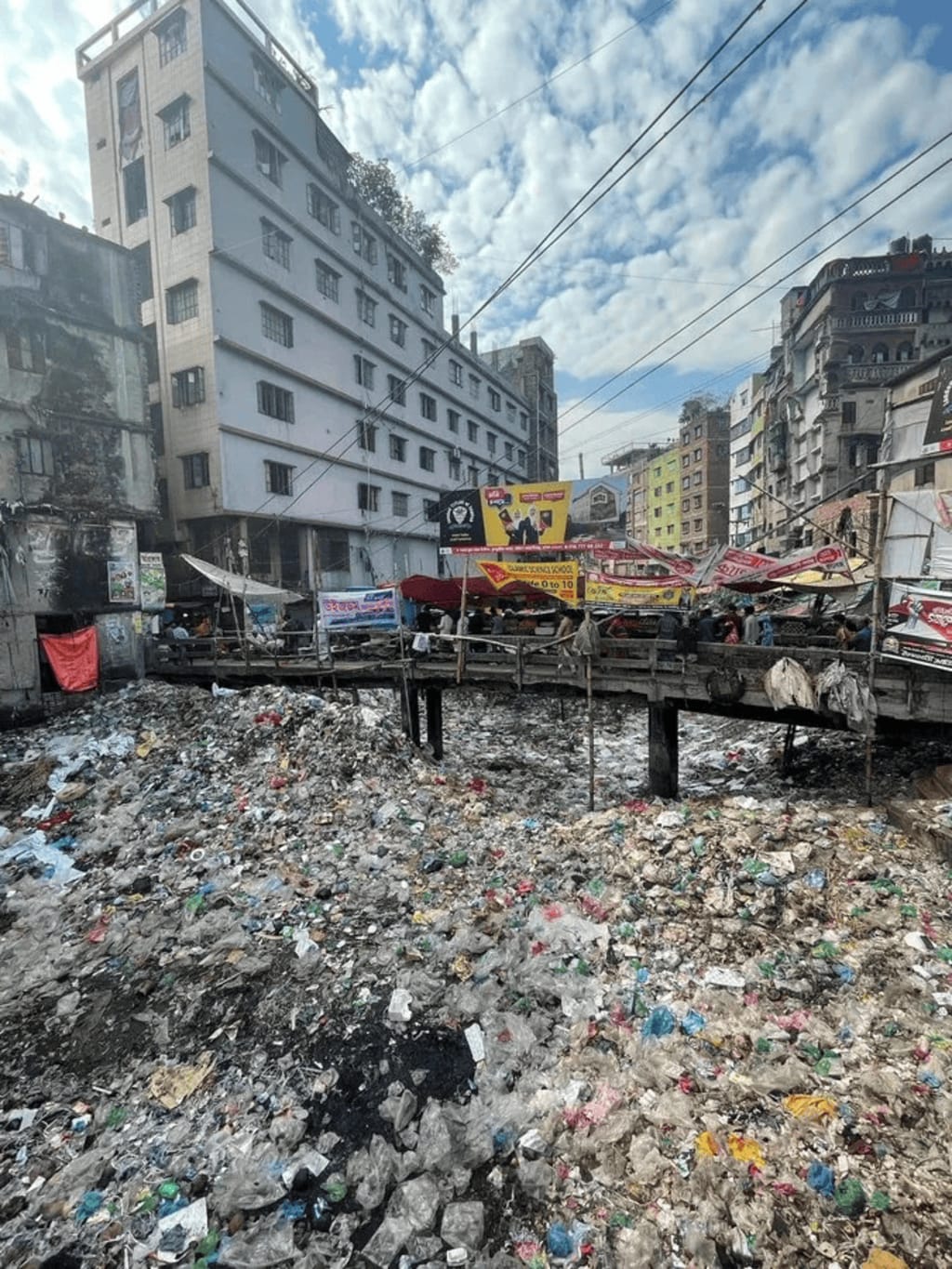
The plastic bags on that street are not Bangladesh's problem alone.
In that photo, the alleys of Dhaka are choked with waste, a jumble of colors. The stench is lost through the screen, but the comment section already smelled of gasoline. Some said, “It’s their culture.” Others said, “Government corruption.” Still others: “They deserve to be looked down on.” Then an account claiming to be Bangladeshi wrote four hundred‑odd words describing a specific scene: in the corner of a neighborhood, a concrete pit, ten feet long, six feet wide, and six feet deep, where three hundred households dumped their garbage. The collection truck came once a month. When it did, the driver took two hundred taka from a roadside vendor, scooped up the top few bags, and left the rest where they lay. Stray dogs and crows tore the bags open; scraps and plastic chips rode the wind into the next block.
The real problem is the lack of disposal infrastructure. Even when trash is dumped, it stays there.
Eighty percent of the world’s ocean plastic comes from a handful of major rivers. The Ganges and the Brahmaputra are on that list. Dhaka’s plastic bags wash into the river, flow to the sea, and months later may surface on the tidal line of Malaysia’s east coast. A tourist vacationing there said he recognized the labels, Thai, Vietnamese, Chinese, as if the planet had rinsed all nations’ signatures onto one beach. But what doesn’t rinse away are the brand names on those plastics. Most of them are not made in Dhaka.
One voice rang loudest in the comments: “It’s their habit—they don’t change when they move.” The conversation shifted from trash to borders. Someone brought up Tokyo’s “Little India” neighborhood, claiming it’s dirtier than the rest of the city. Another said that in America’s national parks, it’s always the same type of tourist leaving bottles behind. These observations may not be false. But they omit a few things: that the person dropping the bottle may have never seen a trash can that wasn’t overflowing where they grew up; that their elementary textbooks had no pictures of waste sorting; that when their father threw garbage into the river, the neighbors all said, “Everyone does it.” That’s shaped by environment, not manners.
But environment is not an excuse. The same Bangladeshi commenter added: the younger generation in Dhaka is picking up trash with bamboo tongs on weekends, loading it onto tricycles, selling it to private recyclers by the kilo, for five taka per kilo. They do this on Saturdays. At school, they tell their classmates, “Don’t throw it on the ground.” They’ve realized that concrete pit won’t clean itself, that the collection truck won’t come on its own unless someone forces it to come. And forcing it to come takes money, takes votes, takes turning “trash” into a line item on a ledger.
But where did that money go? The government budget listed environmental spending, but the number of garbage trucks didn’t increase. Someone who had lived in Dhaka said he saw the most ironic scene there: a brand‑new garbage compactor sitting in a yard, rusting, because no one knew how to fix it, and no one dared ask why it was bought without a driver assigned. You can’t chalk that up to “culture.” That’s administration. That’s corruption. That’s someone taking the money and not intending to do the job.
If we only curse “they’re so dirty,” we get to pretend we’re clean. But the truth is, the cardboard box in your hands, the water bottle you just drank from, the phone you replace every year: their final destinations are not necessarily more dignified than that street in Dhaka. The global waste trade ships garbage from rich countries to poor ones, to be landfilled, incinerated, or poured into the ocean. Dhaka’s photo is just the most jarring link in that chain, not the source, and certainly not the end.
That Bangladeshi commenter said the trash piles on his hometown streets had been there for generations. His father’s generation took it for granted. His children are starting to frown. When enough people frown, maybe one day someone will knock on the city hall door and keep knocking until someone inside answers. Until then, when you see that photo, you can mutter “disgusting,” or you can think: if we’re not willing to handle what we produce, it will always drift to some place you can’t see, and pile up into a mountain.
Like the delivery box on your balcony right now. If you put down your phone, walk to the balcony, flatten it, drop it into the recycling bag, it won’t end up in Dhaka. But if you casually toss it into the general bin downstairs, it may appear somewhere you don’t know, pulled out by someone you don’t know, baking in a sun you don’t feel.
The plastic bags on that street are not Bangladesh’s problem alone.
About the Creator
Jin
Writer of reamstories
https://reamstories.com/jin
Enjoyed the story? Support the Creator.
Subscribe for free to receive all their stories in your feed. You could also become a paid subscriber, letting them know you appreciate their work.
Comments
There are no comments for this story
Be the first to respond and start the conversation.