
Nobel Prize winner Simon Johnson: Whether AI will exacerbate polarization depends on whether we develop "artificial intelligence that supports workers"
Nobel Prize winner Simon Johnson: Whether AI will exacerbate polarization depends on whether we develop "artificial intelligence that supports workers"
Capital and talent are pouring into artificial intelligence, and artificial intelligence technology is advancing by leaps and bounds. However, the relationship between technological progress and economic prosperity is close and complex, especially the impact of technological progress on the labor market. Will the development of artificial intelligence benefit the general public or aggravate the gap between the rich and the poor? What kind of system can guide technology for good?
On December 6-7, the 2024T-EDGE Innovation Conference and Titanium Media Financial Annual Meeting were held in Daxing District, Beijing. In the closing speech, Simon Johnson, the 2024 Nobel Prize winner in Economics, MIT Professor of Economics, and former Chief Economist of the International Monetary Fund (IMF), shared a speech on "How Artificial Intelligence May Affect Our Economy".
Simon pointed out that there are currently two polarized views on the impact of artificial intelligence on the economy in the United States. Technological optimists believe that artificial intelligence will have an amazingly positive impact, while technological pessimists believe that artificial intelligence may eliminate many jobs, destroy your life, hollow out the middle class, and cause major political and social problems.
Simon showed everyone that since 1960, technological progress has kept the income of highly educated people in the United States growing, while the income of people with low education has stagnated, and people with medium education have also been squeezed and fallen to the bottom of society. But Simon said that he is not against technology, and he knows that the trend of technological development is unstoppable. He believes that the development of artificial intelligence should be in the direction of "artificial intelligence that supports workers", creating new jobs and new capabilities, and expanding human capabilities, rather than the development of automation that emphasizes artificial intelligence dominated by capital, but these two technical paths will have a tough battle.
Technology will polarize, causing income growth for the highly educated and stagnation for the less educated
Hi, everyone. I'm very happy to be here with you. My name is Simon Johnson, and I'm a professor at the MIT Sloan School of Management and co-director of the MIT Shaping the Future of Work Project. Next, I'm going to spend about 15 minutes sharing how artificial intelligence may affect our economy. The economy here includes the US economy, the European economy, and even the global economy. I think there are a lot of interesting questions to discuss here.
We know some of the situation, but there is still a lot that we don't know, and I will try to be clear and honest with you about what we don't know. This is a summary slide because I want to convey the main points to you first and then elaborate on them in the following speech.
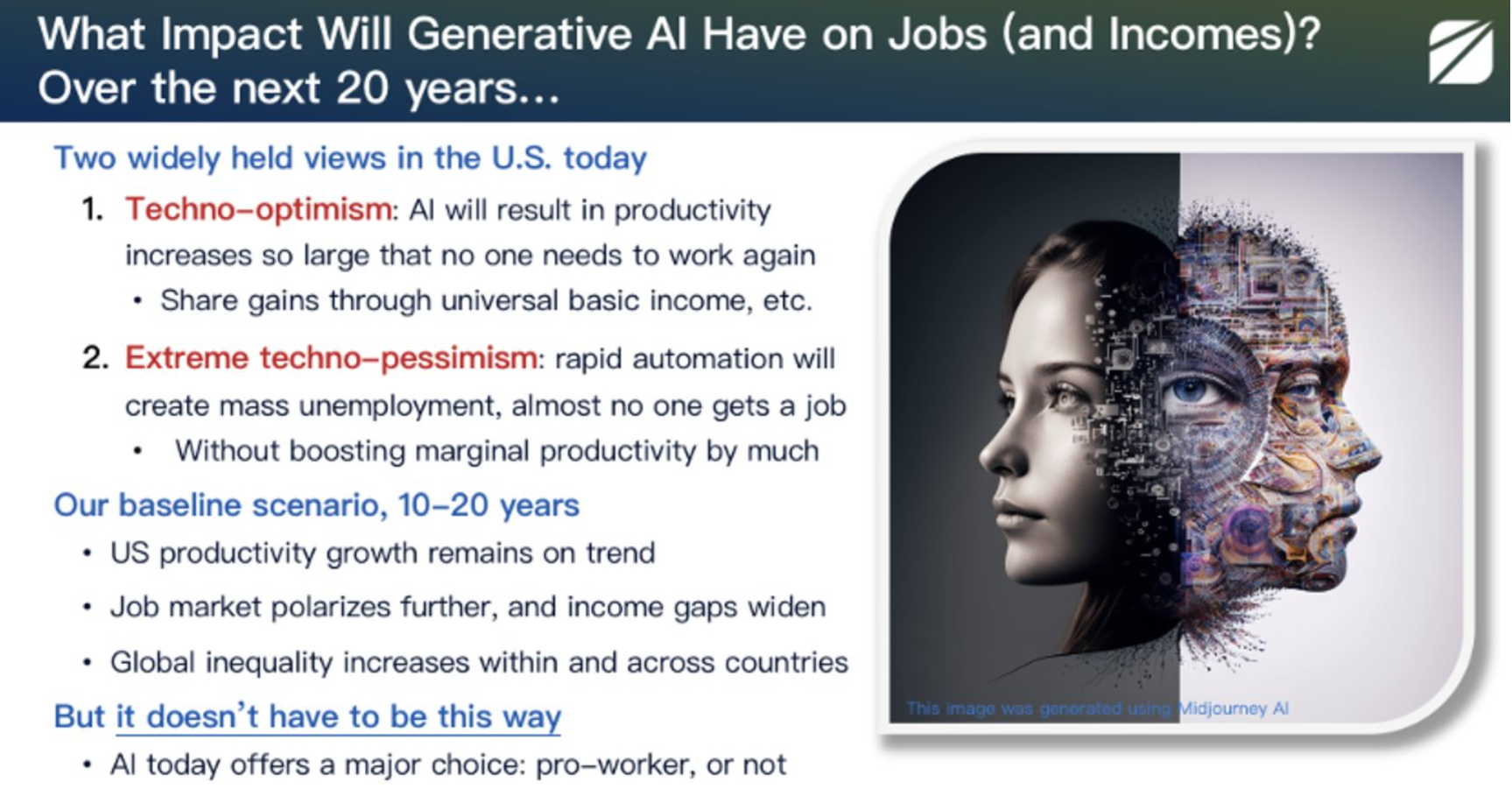
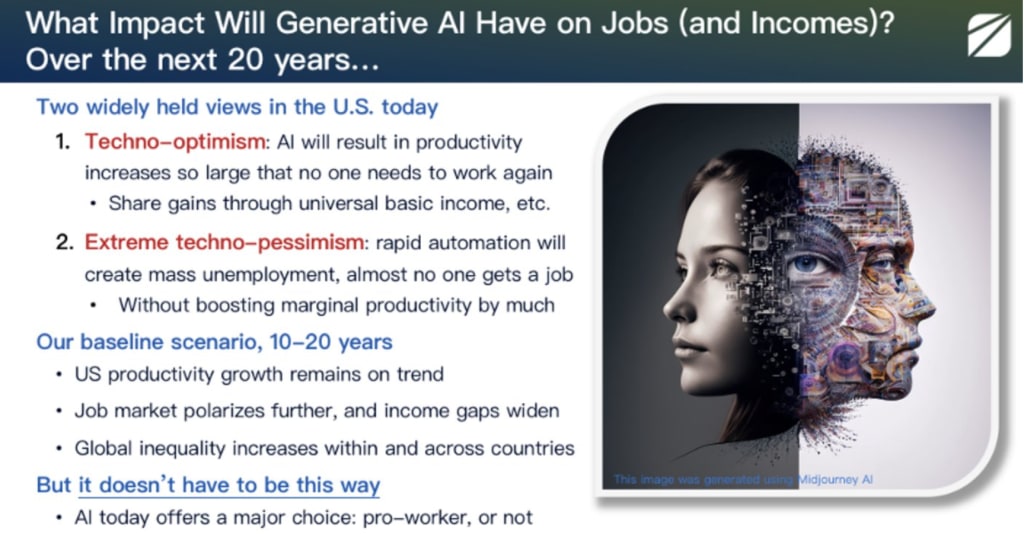
The discussion about this topic in the United States right now, in the field of AI and other areas, is really polarized, with some people who are convinced that this technology will have an amazingly positive impact. For this reason, these people are sometimes called "techno-optimists." Some of the techno-optimists believe that in the future, people will no longer need to work, and many countries can easily afford a universal basic income.
On the other hand, there is a view that I think we can reasonably call "techno-pessimism," which says, no, if so many jobs are eliminated, it will probably destroy people's lives, completely hollow out the middle class, and cause major political and social problems. It is possible that what is called "hyper-automation" (I will talk more about this later) will tilt the balance of power within the company toward the company's owners and senior management. This situation may not necessarily greatly increase marginal productivity, or the productivity that comes from additional labor. In this case, the decision-makers can implement a lot of automation initiatives through AI, but if national and global productivity does not increase significantly, then a universal basic income cannot be afforded, and many people will fall into poverty.
Of course, our views are constantly changing as new data becomes available, and right now our views are somewhere in between these two extremes. We think that productivity growth in the U.S. will remain roughly at its current pace over the next 10-20 years, and we are not extreme. We think that productivity growth in the U.S. will remain roughly at its current level, which is basically the same trend, for the next 10-20 years or so. However, although the impact is relatively mild in terms of overall macroeconomic growth levels, on the current trajectory, we are likely to face a more polarized labor market, with more benefits to those at the top and more people being pushed to the bottom.
Again, I think this potential picture is clearer in the U.S., but we can also see some clues in other countries and regions. This polarization of the labor market will increase income disparity, which is definitely a feature of this phenomenon. We expect global inequality to increase as well as inequality within countries. Of course, inequality also exists between countries, and this is a major issue for all of us to consider.
We have found through our research, work with industry, policy analysis, and conversations with policymakers that this is not the only case. Artificial intelligence brings us to a major decision moment. All technology involves choice, and all technology decisions mean that someone has to decide whether this technology will benefit one group or another. Because AI is so impactful, especially for cognitive workers who do mental work, it is particularly likely to move in a direction that favors higher-income groups, but it can also benefit less educated people. We coined a term that we try to use and explain in various contexts, which is "worker-supportive AI." We are advocating for AI that can improve the productivity of workers who have not attended college (for example, four-year colleges in the United States).
We think there are many ways that AI can be beneficial to productivity. So for workers who have lower incomes, lower education levels, and less favorable living conditions, their wages will also increase. But the key question is, especially in the United States, who decides which technology path to choose and why they make such decisions?
I co-authored a book last year with Daron Ajemoglu called Power and Progress: Our Millennial Struggle over Technology and Prosperity. There are a lot of grand statements about the impact of AI on human capabilities, and one of the leading entrepreneurs in the field said that we will all become gods, which is an interesting statement that we can discuss.
Our work is more practical and more focused on jobs, because we think a lot of the impact of AI will be felt through jobs, but we're also very concerned about the impact of AI on social media, on information and disinformation, and on the way our society makes decisions, because that's really important for the path we take in terms of technology development.
So before I go further into AI, I want to focus on the United States and make a few points about the current situation. The United States has a huge impact on the world economy, especially on AI, because AI was developed primarily in the United States. The key point is that since the 1980s, the labor market in the United States and other industrial countries has been very polarized.
Look at the picture below, which shows the change in real weekly earnings since the 1960s, with men on the top and women on the bottom. This picture is based on research by Daron and David Autor, who co-lead the MIT Shaping the Future of Work project with Daron and me.
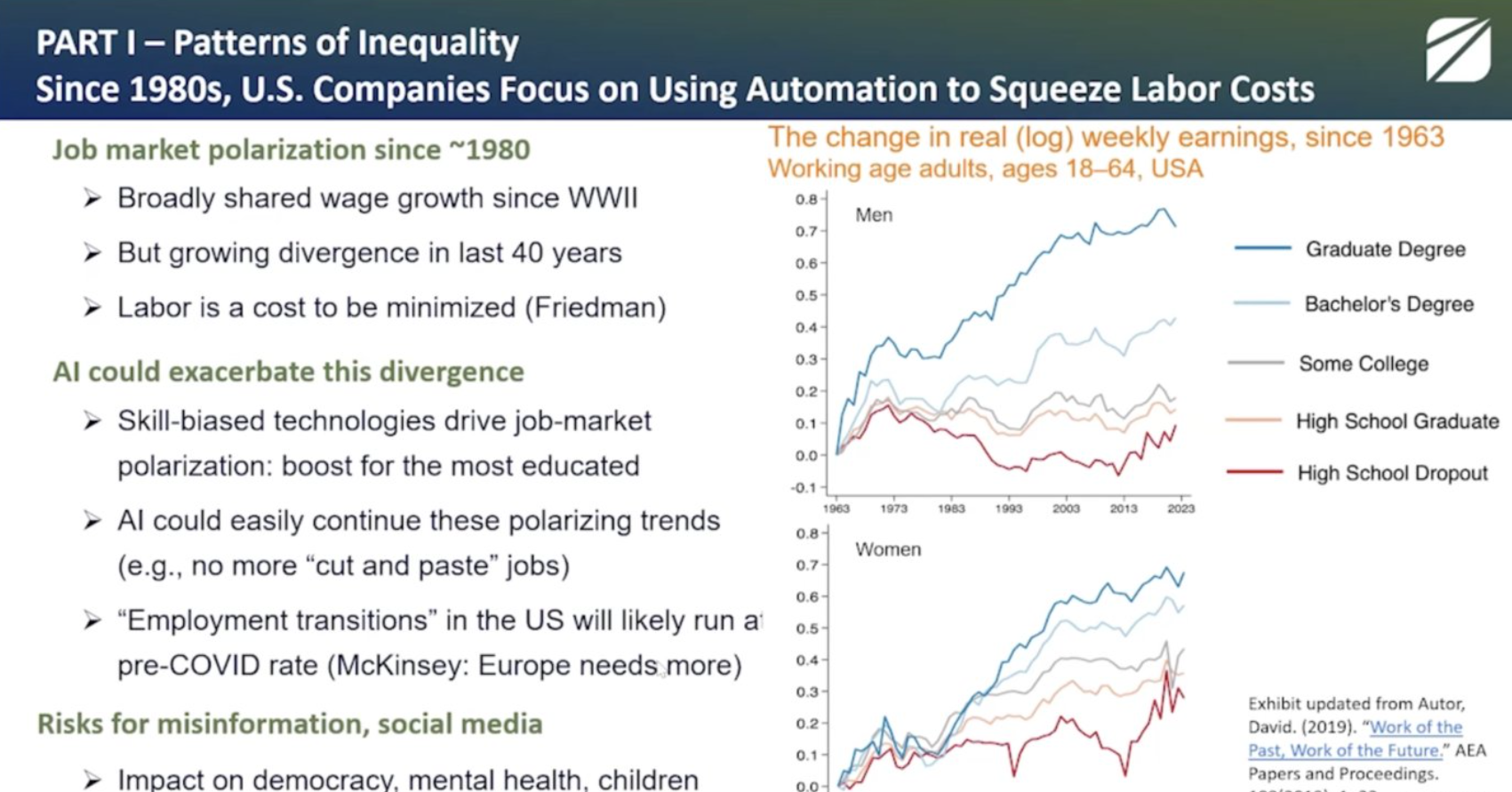
As you can see from the picture, a dark blue line is rising steadily, which is the income of people with higher education, and their income has changed well. The middle line is the income change of people with secondary education, which is not as good as those with higher education. However, if you look at the bottom line, which is the lowest educated people in the data, their real wages have hardly changed since the 1960s, which is obviously a very unfortunate result.
Given the rapid development of technology, their income has stagnated. We have made a lot of progress during this period, but this progress has not benefited everyone. In addition to the difficulties faced by the lowest educated people, those with secondary education have also been squeezed and their numbers are decreasing. In the middle-income class, we have lost a lot of jobs that require intermediate skills and secondary education backgrounds, which has pushed many people to the bottom of society.
Whether AI will exacerbate polarization depends on whether enough new tasks are created at the same time
Why talk about this first, because I think the question that should be focused on is whether artificial intelligence will strengthen this trend of polarization, or can reverse it. A US CEO once expressed his view to me, and although it is not my term, I don't like it, and I believe we all don't like it. However, it may be a vivid description of how a CEO sees the current issues. He said that AI will eliminate what he called cut and paste jobs, which are routine, repetitive cognitive tasks that AI can handle quite easily.
Now I want to talk in more detail about where we think AI is at right now. Obviously, it is changing very quickly and the amount of money invested is extremely large. Not only in the United States, many people (including university faculty) are leaving school to work in AI, but also globally, talent is being attracted to AI innovation in the United States. So the capabilities of AI are going to increase significantly in this area.
I think we have to see the transformation of jobs in the United States, such as McKinsey's subtle wording, which will accelerate rapidly. And in Europe and other regions, the transformation of job markets may also accelerate, perhaps returning to the speed of their transformation during the new crown epidemic, which is quite rapid.
Discussions about these issues and thinking about this technology are all over the existing communication platforms in our society. The problem is that AI is affecting social media at the same time as it affects jobs. It's affecting digital advertising, and the impact on mental health is negative, and it actually undermines our ability to make democratic, inclusive decisions in different contexts around the world.
Now, in addition to concerns about economic inequality in the United States, I think we should also be concerned about inequality around the world. Obviously, over the last 40 years, what we've seen in some countries, including China, is very impressive growth in per capita GDP. I personally hope that this continues, and that people around the world continue to share in prosperity and increase productivity.
But if the current impact of AI on cognitive workers also spreads to a lot of manufacturing jobs, although this has not yet happened, there are already a lot of smart people working to get AI into manufacturing. Then I think it will become difficult for the world's middle-income countries to continue to grow, and even through the impact of global supply chains, middle-income countries will face downward pressure, and current technical jobs may decline or disappear, and automation may replace manual work in many economic activities. We're not there yet, but if we think about 10-20 years, I think there is such pressure.
Next, I want to talk about what we can do to deal with this situation, because none of our plans should be interpreted as being pessimistic or negative. Quite the contrary, we are trying to make and provide you with an honest assessment so that the private sector, governments, and everyone in between can think about policies, approaches, and strategies to deal with those unwelcome trends.
To understand this better, we look back a little bit at history, and this is what we did in the book Rights and Progress, and we asked the question: How did this happen when technological change led to shared prosperity, when technological change had a positive impact? How did this happen? Especially since the Industrial Revolution 250 years ago, and perhaps before that, a lot of innovation and machines have focused on automating work.
What is automation? Simply put, we are replacing work done by humans with machines, which are obviously made by humans and operated by humans, but it takes less human labor to run that machine than it did to do the manual labor that was done before.
So if modern innovation requires and involves automation replacing human labor, how can wages rise? The answer, of course, is that it requires an increase in labor demand in other sectors. And these are sectors that are not automated, these are new economic activities, and these economic activities are complementary to the industries that are automated.
One of the key words we focus on is "job tasks," as mentioned in David Autor's research. Any job is a collection of tasks, and you can break down a job into the basic tasks it contains. Most of us have jobs that contain 20 to 30 tasks, and we get paid for completing these tasks. So who will take the new jobs, especially those new tasks that require professional skills, after all, professional skills are the basis for our compensation.
Looking back at history, you can see some important moments. I want to emphasize that including in the United States, at the beginning of the 19th century, when the entire country had a relatively low level of education, the United States accepted a large number of immigrants in the 19th century. They were uneducated and did not even speak English, but they found jobs, actually worked in factories, and employers and managers found ways to make full use of their talents and increase the productivity of these workers who did not have much formal education. Historians call it the "American manufacturing system."
This system was a huge success, and it also gave rise to some technologies that spread around the world (of course not all at the same time, and not evenly), and the result was that the United States went from being an agricultural country with very little industrial production (you can see this in my chart) to leading the world in industrial production by the 1890s.
At the same time, wages in the United States began to rise as marginal productivity increased, and the marginal productivity of hiring one more person combined with the rise of labor unions in the United States was a big part of the American story.
If you look at the success stories around the world, I think Japan stands out as having made a remarkable transformation. If you look at real wages after World War II, Japan started out much lower than the United States, and then had decades of rising productivity that translated into high wages. So we can't expect wages to rise immediately as productivity increases, but we can expect some degree of convergence in real wages through the creation of new tasks. Remember, Japan also led the world in automation, and it led for a while.
So our work and what we propose is by no means anti-technology, after all, we work at MIT, we are not anti-technology, and certainly not anti-automation. I think automation cannot be stopped, and it should not be stopped. The key is whether enough new tasks are created as automation is promoted.
Let's talk about artificial intelligence and think about what it will be like. Obviously, artificial intelligence means automation, there is no doubt about that, in this case, replacing humans with algorithms. We should note that the process of simply replacing humans with machines does not necessarily lead to higher wages. For example, in the early days of the British Industrial Revolution, there was a 60-year lag between major productivity changes and higher wages. 60 years is a long time, and I don't think we want to wait that long now. And we should also know that in all economies, we always create new tasks, which has been well documented in the United States.
David Autor has done a really good job on this. We created enough new tasks to keep pace with automation from 1940-1980 to keep the demand for labor, including for workers without a lot of education, and we kept it pretty dynamic, and real wages went up. But we haven't done a very good job on this since 1980.
Now, AI can be used to improve worker skills, and there's some really interesting research, like ChatGPT (and there are other competitors, of course), which can help people write better, help improve customer service, including making lower-skilled workers happier at work and making customers happier, which is a pretty good combination of effects. For example, GitHub Copilot is really helpful for writing software, and I think improving the productivity of coders is one of the most definitive and powerful results we've seen so far in this area.
But even in this more optimistic, positive scenario, there are still skills gaps, and there's some really interesting research that's identifying these gaps, and I encourage you to look at the underlying research. I think the key is that we don’t know exactly what skills are going to be needed, we need to strongly encourage people to acquire those skills, we need to track which skills actually pay off when people are looking for jobs, and then feed that information back so people can make better choices.
I don’t think that what I, my co-authors, governments, or anyone else are suggesting from the top down is the answer, what we need is an understanding of the skill acquisition process and what skills are going to be in demand in an AI-driven economy. That may not be a completely satisfying answer, but I think it’s reasonable, and I think we should build on that work.
Now we can ask, what about potential skills mismatches? Or more directly, who is most at risk? Again, if we break down all jobs into tasks, we can see what people are hired to do, and we know what tasks AI is good at (although as I said, this is changing rapidly), but at least at a certain point in time, we can see that certain groups of people are most at risk of losing their jobs, and where we have data (primarily in the United States), women and young workers are most at risk of losing their jobs.
Now, I want to stress that this is just the negative impact of automation, and these studies don't look at who is better able to do new tasks. And if women and young people are better able to master the skills that are needed, acquire skills, and seize new opportunities, that's a very important equalizing factor. All of this is a snapshot of a point in time, and all of this research is dynamic because the technology itself is constantly changing, but this is what the data shows right now, and I think we should be honest about it and then continue to track who is better able to make the transition in the labor market and what the outcomes are, whether they are getting higher incomes when they change jobs, or lower incomes, or even pushed to the bottom of the labor market.
Now, there are some very optimistic predictions about the impact of artificial intelligence on the macroeconomy in the United States and around the world. My colleague Jonathan Aggarwal has done a great job of evaluating these predictions and trying to relate what we know about tasks, the creation of new tasks, and the elimination of tasks through automation to the macroeconomy.
He finds that the overall impact of artificial intelligence on total factor productivity, which is a standard economic measure of how efficiently resources are used, will be relatively modest. I think on the policy side, you can look at the writings and speeches of John Williams, the president of the Federal Reserve Bank of New York, who I've talked to about this, and I think his view is very reasonable, which is that "U.S. productivity growth will remain roughly the same, and artificial intelligence will be a factor that drives growth." In this sense, artificial intelligence is important, but it's not a miracle, and it's not going to be a huge boost, so something like an extremely generous universal basic income program is a bit unrealistic because the total economy is not growing significantly, or the growth rate is not accelerating.
I think it's also important to emphasize that, as I just mentioned, while there are opportunities to upskill, such as in customer service, the productivity of existing workers is increasing, which is good for wages and labor demand, but there are also plans, and some companies have not been shy about saying that they intend to replace all these workers with artificial intelligence. The technology is not there yet, but how long will it take? I don't know, one year, two years, 10 years, it's hard to say. Or maybe just a few people will be needed to oversee a lot of customer service work that has been automated. Regardless, teaching algorithms to better assist workers is a step toward having algorithms replace workers, which is why we really need to speed up the creation of new tasks.
AI is currently more about automation than about creating new jobs and new capabilities
Now, we have done a lot of research work in the policy space, including in the United States. I have to say that the policy space in the United States is changing. You are learning about this change every day in the newspapers, and we will see what the new administration led by Mr. Trump is interested in doing and what he is willing to do.
Artificial intelligence obviously has a major impact on national security, and the United States also attracts most of the global investment in artificial intelligence, excluding China. In the United States, we don’t know much about what is happening in China, so all these statements do not include China. But what we do know is that sovereign wealth funds around the world, as well as private investors, are investing a lot of capital in the United States.
It is estimated that 95% of the capital invested in basic training models for artificial intelligence, excluding China, is in the United States, 3% is in Europe, and the remaining 2% is in other countries. It’s hard to say whether this is correct, but if you think that if you follow the talent and see where people are working on artificial intelligence, it seems to be consistent with the flow of capital. So we think the US government can do a lot to move technology in a direction that is beneficial to workers.
I can share with you some of these specific recommendations, and they are based on the U.S. context, but I think the U.S. is the epicenter of AI R&D, and so these recommendations are appropriate. I honestly don't think the Trump administration is going to prioritize pro-worker AI R&D. So the conversation is going to turn to the private sector and what philanthropy can bring. What can be done on a foundational basis in private companies, especially large companies, they are open to these ideas. I have to say, we have had very good conversations with senior executives. But I think the pro-worker AI path is not going to be seen as the dominant strategy or the best path to get them the return on capital that their shareholders and creditors want.
So, frankly, it's an uphill battle. I think unfortunately, we're going to see a big emphasis on the automation aspects of AI, rather than the greater emphasis that we would like on creating new jobs and new capabilities, extending human capabilities.
But this country is big, it's a huge technology space. MIT plays an important role in helping people think about technology and helping people create technology, and we deal with these issues every day, and I think this is a shared moment for humanity. We can't help but ask whether technology is going to help all of us, or whether technology in its current iteration, in its next iteration, in this very powerful, important new iteration, is going to help just a few people, and the impact of technology on income inequality and employment, and the impact of technology on the global economy in the future.
About the Creator
Enjoyed the story? Support the Creator.
Subscribe for free to receive all their stories in your feed.
Comments
There are no comments for this story
Be the first to respond and start the conversation.