
Nine Geological Names That Look Chinese but Aren’t
How Cambrian, Ordovician, and Permian traveled from Welsh hills, English counties, and a Russian city into Chinese textbooks
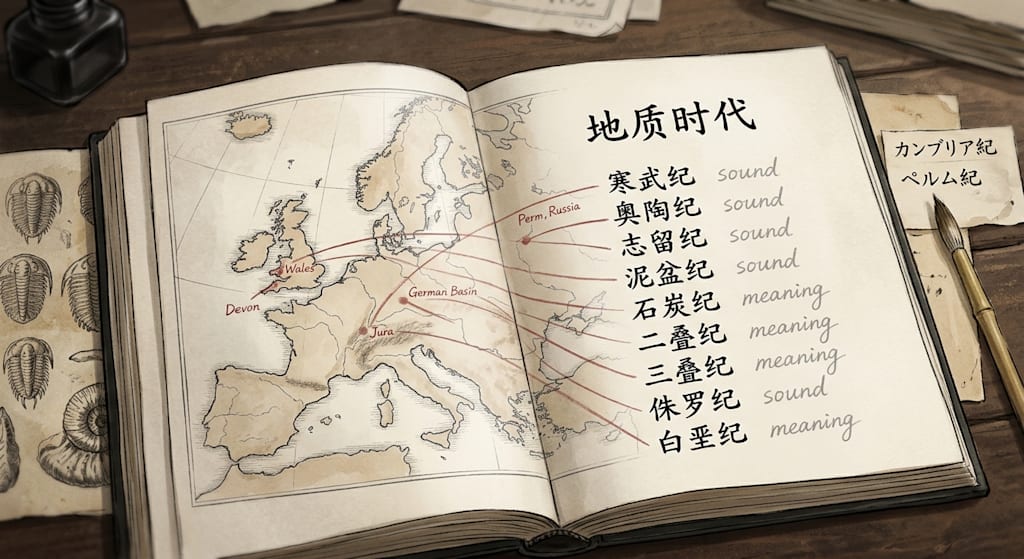
Open an old geology textbook. The contents page lists nine terms: 寒武, 奥陶, 志留, 泥盆, 石炭, 二叠, 三叠, 侏罗, 白垩. They use Chinese characters. They do not read like everyday Chinese. Some readers take 寒武 as “cold” plus “martial force,” picture 泥盆 as a basin made of mud, or treat 二叠 as a kind of stacking. Those guesses make sense. The terms were not coined in Chinese. Most followed one route: nineteenth-century European geologists named rock layers after places, ancient tribes, or features of the rock; Meiji-period Japanese scholars translated the names into Chinese characters; late Qing and early Republican Chinese scholars brought the terms into Chinese through Japanese textbooks, students who had studied in Japan, and compiled works. The Chinese names carry two kinds of traces. Some characters record sound. Some carry meaning. Some readings lead back to old Japanese translations. Others lead back to maps of Europe.
The contents page has pencil marks. Next to 寒武, 奥陶, 志留, 泥盆, and 侏罗, the former owner drew underlines and wrote “sound.” Next to 石炭, 二叠, 三叠, and 白垩, the owner wrote “meaning.” That division explains most of the puzzle. The transliterated Chinese characters are 寒武, 奥陶, 志留, 泥盆, and 侏罗. The semantic translations are 石炭, 二叠, 三叠, and 白垩. “Borrowed via Japanese” describes the transmission path. Transliteration and semantic translation describe the character-level strategy. Modern Japan translated Western geology systematically earlier than China did. Many Chinese-character terms took shape in Japan before entering Chinese. Once you know that, 寒武 stops looking like a Chinese coinage, and 二叠 stops looking like a transliteration of Permian.
寒武纪, the Cambrian, comes from Cambria, the Latin name for Wales. Wales was one of the places where geologists first studied Cambrian System strata. The British geologist Adam Sedgwick named the period in 1835. The old Japanese translation recorded the sound of Cambria as 寒武, read kanbu (カンブ). Chinese adopted 寒武纪. Modern Japanese more often uses カンブリア紀. 寒武 has no link to coldness or martial force. It is a Chinese-character transcription of the old name for Wales. In popular science, write “Cambrian System strata were first studied in Wales,” not “the bottom of the Cambrian Period was first studied.” A system is a stratigraphic unit. A period is a chronological unit. The two words cannot be mixed.
奥陶纪, the Ordovician, comes from the Ordovices, an ancient tribe in Wales and one branch of the Celts. The British geologist Charles Lapworth named the period in 1879. The old Japanese translation recorded the sound of Ordovices as 奥陶, with an old reading close to Ōtō, not “autau.” The modern standard Japanese name is オルドビス紀. Chinese 奥陶纪 follows the old Japanese kanji transliteration. Its pronunciation does not match English Ordovician. The common mistake is to use modern Chinese pinyin to infer the Japanese reading. The old reading of 奥陶 belongs to the history of Japanese kanji transliteration.
志留纪, the Silurian, comes from the Silures, an ancient tribe in Wales. The British geologist Roderick Murchison named the period in 1835. The old Japanese translation recorded the sound of Silures as 志留, read shiru (シルル). Chinese adopted 志留纪. Modern Japanese also commonly uses シルル紀. This name is a Chinese-character transcription. It does not mean “aspiration preserved.”
泥盆纪, the Devonian, comes from the English county name Devon. The British geologists Roderick Murchison and Adam Sedgwick jointly named the period in 1839. The old Japanese translation recorded the sound of Devon as 泥盆, read debon (デボン), not dēbon. Chinese adopted 泥盆纪. Modern Japanese commonly uses デボン紀. The characters 泥盆 can make a reader think of mud and a basin. They are only a Chinese-character transcription of the place name Devon.
石炭纪, the Carboniferous, takes its name from coal. The English word Carboniferous means “coal-bearing.” Japanese writers used the characters 石炭 because 石炭 means coal in Japanese. Most coal on Earth today comes from fern forests of the Carboniferous and Permian periods. Chinese 石炭纪 follows the Japanese 石炭紀. It is a semantic translation. The name records a geological period when coal formation was extremely important. The character 意 next to 石炭 on the contents page points to that meaning.
二叠纪, the Permian, comes from the Russian city of Perm in the central part of the country. The British geologist Roderick Murchison named the period in 1841. Permian is a place-name transliteration. A direct Chinese rendering could be 彼尔姆纪. The common Chinese term 二叠纪 borrows a semantic translation from the old Japanese name 二畳紀. The name reflects the twofold structure of Permian strata in Germany: limestone above and red sandstone below. Modern Japanese commonly uses ペルム紀. In an article, state the point plainly: 二叠 is a semantic translation of an old Japanese name, and Permian comes from Perm. The character 意 next to 二叠 on the contents page marks that fact.
三叠纪, the Triassic, was named in 1834 by the German geologist Friedrich von Alberti. He used Trias after the typical threefold rock structure in Germany. English, Japanese, and Chinese all use semantic translations. Japanese has 三畳紀. Chinese has 三叠纪. The modern standard Japanese name is still mostly 三畳紀. トリアス紀 can serve as a transliterated alternative. It did not replace 三畳紀 as the general main name after the Second World War. Chinese 三叠 is a semantic translation of the threefold structure. Keep “old name” separate from “modern standard name,” or readers may think Japan has switched entirely to a transliteration.
侏罗纪, the Jurassic, is a transliteration. It comes from the Jura Mountains in Switzerland. The old Japanese translation transliterated Jura as 侏羅, read jura (ジュラ). Chinese adopted 侏罗纪. Modern Japanese commonly uses ジュラ紀. This name is a typical Chinese-character transliteration. Like 寒武, 奥陶, 志留, and 泥盆, it cannot be understood through modern Chinese pronunciation.
白垩纪, the Cretaceous, is a semantic translation. The German term is Kreidezeit, named after chalk deposits of that period in western Europe. Japanese rendered it semantically as 白堊紀, now written 白亜紀 (haku-a ki). Chinese has 白垩纪. The name is a semantic translation. 白垩 is a white, loose calcium carbonate sediment. It corresponds directly to the Latin source of Cretaceous, creta.
Set the nine names side by side, and two translation logics appear. 寒武, 奥陶, 志留, 泥盆, and 侏罗 are Chinese-character transliterations. 石炭, 二叠, 三叠, and 白垩 are Chinese-character semantic translations. Most entered Chinese through Japanese kanji translations. That history explains why Chinese readers find the terms “like Chinese characters but not like Chinese.” The awkwardness comes from modern knowledge translation. Behind every name are nineteenth-century European geologists moving between Wales, Devon, Perm, the Jura Mountains, and the German Basin. Behind them are Meiji Japanese scholars searching for equivalents between Western terms and Chinese characters.
Before closing the book, look once more at the contents page. Next to Permian is a faint pencil note: “Perm.” The characters are small and squeezed beside the printed 二叠. The spine has a split. When you turn to this page, it gives a soft crack. Close the book. The split catches a corner of the page. The book does not close all the way.
About the Creator
Jin
Writer of reamstories
https://reamstories.com/jin
Enjoyed the story? Support the Creator.
Subscribe for free to receive all their stories in your feed. You could also become a paid subscriber, letting them know you appreciate their work.
Comments
There are no comments for this story
Be the first to respond and start the conversation.