
Nepal’s Devastating Flash Floods: What Went Wrong?
The most urgent need is for advanced monitoring technology

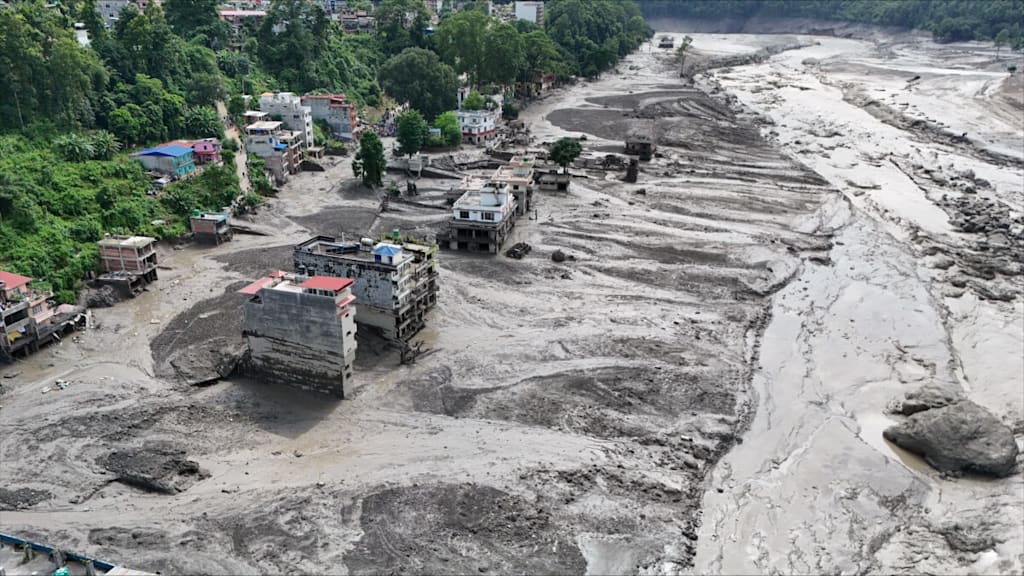
Several videos showing the Nepal disaster on August 26, 2026, are going viral online.
Among them, the first and earliest footage is CCTV footage from the Chinese border, capturing the tragedy at 8:42 (NST) that morning.
In the video, what we see is unbelievable and shocking.
At first, I thought it was AI-generated footage meant to depict the scale of what was happening there.
But no, I was wrong. The footage was real.
In a split second, we see structures being destroyed, people running to escape and parked vehicles being completely swept away.
The massive flood, carrying soil, sand, rocks and debris, caused widespread destruction downstream.
More than 1400 people were killed, while around 6150 are still missing.
They included foreign tourists and Hindu pilgrims travelling to Kailash, a sacred mountain in Tibet.
The disaster wiped out some 40 km of roads, 80 bridges, and 14 hydropower plants. This knocked out 10% of Nepal’s hydropower generation capacity.
The sheer scale of this destruction is devastating and, in many respects, irreparable.
The loss is enormous, with damage estimated at $2.5 to $7 billion.
This could rank among the biggest natural calamities in recent history.
What actually caused this calamity?
Scientists described the calamity as the result of a ‘massive glacier collapse’ in which a huge mass of ice (110m cubic metres) fell from an elevation of 5150 metres and crashed to the ground at around 3750 metres.
According to Basanta Raj Adhikari, director of the Centre for Disaster Studies at Nepal’s Tribhuvan University, the energy released during the landslide was greater than that of the atomic bomb dropped in Hiroshima, Japan.
According to Mike Searle, a professor of Earth sciences at the University of Oxford, that mass of ice could have dammed the river, causing water to build up behind the ice mass before it eventually burst, releasing a massive flood downstream.
The flood, carrying pulverized ice and boulders, accelerated to an estimated speed of 180 to 193 kilometres per hour, triggering a surge of water that caused water levels to rise by as much as 9 metres within 30 minutes.
However, such an event was not the first in the Himalayan region. In 2021, a similar kind of disaster in Chamoli in Uttarakhand, India, killed around 200 people and damaged two hydropower plants.
Who is to blame?
Scientists have directly blamed global warming for this disaster. Researchers identified unusually warm conditions before the glacier collapsed.
At high altitude, permafrost helps bind ice, soil and rock together, providing stability to steep slopes.
However, the recent rise in temperatures is causing permafrost to thaw. Himalayan region is warming faster than the rest of Earth.
A report by A Resilient Himalaya: Protecting a Region at Risk and Securing Future Prosperity mentions that Himalayan glaciers are now losing mass 65% faster than they were a decade ago.
Furthermore, the rate of ice melting has been accelerated in the region; consequently, glaciers are shrinking and may eventually disappear. In areas where glaciers disappear, landslides occur more frequently.
The Hindu Kush-Himalayan range consists of a large number of glaciers perched above very steep slopes, which makes the region highly vulnerable to natural hazards.
According to the International Centre for Integrated Mountain Development (ICIMOD), there are more than 63,700 glaciers, which cover approximately 55,782 square kilometres of area.
Nepal alone has more than 4,000 glaciers with 2,000 glacial lakes. Dozens of lakes among them are categorized as potentially dangerous.
In 2019, Simon Allen and an international team of researchers identified 210 highly dangerous glacial lakes that pose a threat of sudden flash floods to human settlements across the Hindu Kush Himalaya and Tibetan Plateau.
In November 2025, scientists in Sankhuwasabha counted 42 glacial lakes in Koshi province alone swollen beyond their capacity and held back by nothing but crumbling moraine.
Thulagi Glacial Lake (Dona), at the foot of Manaslu, was once relatively small, but it has been expanding in recent years. ICIMOD and the UNDP have now classified it as one of Nepal’s most dangerous glacial lakes due to the risk of a Glacial Lake Outburst Flood (GLOF).
Events known as Glacial Lake Outburst Floods (GLOFs) occur when fragile natural dams holding back meltwater, made of loose moraine debris, rocks, and ice, suddenly breach or collapse, causing a devastating effect downstream.
Downstream river valleys are now densely developed, with roads, buildings and other infrastructure. Unregulated urbanization and large-scale construction in these valleys can greatly increase the risk of catastrophic flooding.
Settlements in these valleys are not simply a matter of choice; they are often driven by economic forces. Historically, Nepali people tended to settle in the hills, partly because of the fear of malaria in the lowlands and river valleys.
However, life in the hills was often difficult and marked by considerable hardship.
In recent years, when roads passed along these valleys, the doors of economic opportunities were opened, and their choices became obvious in these newly urbanised areas.
How will disaster-prone Nepal cope with this increasingly risky situation?
Nepal is one of the most disaster-prone countries on Earth, as it lies within the active collision zone between the Indian and Eurasian tectonic plates, where one plate has always been pushing another plate up.
As mentioned above, the country faces multiple and interconnected hazards, including Glacial Lake Outburst Floods (GLOF), thawing permafrost, and the destabilization and melting of ice and snow.
At the same time, extensive construction is taking place in China close to the border, as well as on the Nepalese side downstream. Much of this construction requires drilling and blasting.
These activities can further disturb and destabilize already fragile terrain, including soil, rocks, ice and mountain slopes.
In this situation, Nepal’s major concern is to establish effective early warning systems for downstream communities for the years ahead.
To withstand the devastation that may unfold in the years to come, Nepal will need greater financial resources and far more cross-border transparency.
The most urgent need is for advanced monitoring technology, yet Nepal is woefully ill-equipped to deploy such systems and lacks the capacity to establish and maintain them.
Therefore, Nepal has to rely on resourceful neighbours such as China and India to equip the region with more advanced sensors and monitoring systems, as well as real-time data-sharing capabilities.
However, there are few scientific monitoring technologies established for early warning of evidence pointing to a glacial collapse in time.
Across the entire Himalayan region, there are only 38 monitoring stations, of which just seven meet global standards.
Question of climate justice and possibility of compensation
Scientists believe climate change played a role in causing floods of such devastating scale.
Dr Friederike Otto, a climate science professor at Imperial College London and her team at World Weather Attribution (WWA) claim that the disaster resulted from a compound crisis, with several contributing factors exacerbated by decades of atmospheric heating caused by greenhouse gas pollution.
The phenomenon is largely attributed to the increasing concentration of greenhouse gases, such as Carbon dioxide, Methane, and Nitrous oxides, which enhance the greenhouse effect and contribute to rising temperatures at Earth’s surface.
Nepal contributes less than 0.1% of global greenhouse gas emissions, a negligible share compared with those of its neighbours, India and China. Both countries are among the world’s largest greenhouse gas emitters.
The bitter reality is that all the bad consequences of climate change fall on the people of poor countries. They lack strong existing infrastructure for monitoring and early-warning systems to protect against climate-related disasters.
This is a clear example of the injustice faced by poorer countries in today’s world. It could reasonably be described as an intolerable form of climate injustice.
Recently, it has been reported that Nepal has sought $20m in compensation for climate-related losses and damage from the UN’s fund for responding to loss and damage (FRLD), which was established in 2022 under the framework of the Paris Climate Agreement.
For Nepal, the most important priorities will be establishing effective monitoring and early warning systems, as well as strengthening disaster preparedness.
It seems almost impossible to prevent flash floods triggered by glacial collapses in the whole Himalayan region. One thing, however, is certain: more disasters are likely to come in the near future, but nobody can predict exactly when or where they will strike.
The only way to avoid tragedies of this kind is to take urgent and decisive actions to drastically reduce greenhouse gas emissions.
(This story was originally published in ‘The Environment’ on Medium)
About the Creator
Krishna Babu Shrestha
Ecologist by training, nature lover by instinct. Trying—always—to live with empathy and ethics.
I write about personal growth, happiness, and human potential, as well as the environment and ecology.
Enjoyed the story? Support the Creator.
Subscribe for free to receive all their stories in your feed.
Comments
There are no comments for this story
Be the first to respond and start the conversation.