
Nebula

Nebula’s first memory was not a face.
It was the sound of the swamp breathing beneath black rain.
The canoe where she appeared drifted slowly between gigantic roots while violet lightning illuminated the sky. The water was warm, covered with nocturnal flowers and blue vapor rising from natural fissures hidden beneath the mud.
The villagers found her wrapped in wet cloth, sleeping as if the river itself had left her there.
The little girl slowly opened her green eyes.
And smiled.
The village of Umbra Selene lived far from the industrial cities. Houses raised on wooden stilts, hanging bridges covered in moss, and permanent bonfires perfumed the humid air. There, people grew up listening to wild animals more than news broadcasts.
They were not rich.
But neither did they seem empty.
Nebula grew freely among gigantic mangroves and lagoons covered by reflected stars. Her skin took on a warm tone, gilded by the humid swamp sun. Her body strengthened from swimming long distances, climbing trees, and running barefoot over slippery roots.
The elderly women taught her that the human body was not the enemy of the mind.
“Constant shame sickens the spirit,” Mara would say while preparing medicinal infusions. “A person who learns to hate themselves eventually needs to dominate others to feel strong.”
That was why in Umbra Selene no one hid the body excessively. The warm climate, constant rains, and aquatic life made many garments unnecessary. To them, skin was simply another part of nature.
Nebula learned early to live without fear. She understood that human desire could exist without violence, and that exposure did not have to become humiliation.
When she bathed in the rivers at dawn, the water moved slowly along her legs while reflections from the rising sun transformed the surface into liquid gold. Her movements were calm and confident, without the constant anxiety of someone afraid of being watched.
Many people found peace near her even before she spoke.
The elders rested their heads against her chest after exhausting days. They said it was medicinal. Her warm presence eased headaches, anxiety, and exhaustion.
Children slept holding onto her during thunderstorms.
And when they cried, Nebula would sometimes simply listen to their stories in silence.
She had a strange ability to transmit calm.
As if mental noise diminished around her.
But the outside world kept advancing.
Hunters began entering the swamps armed with old rifles, machetes, and amphibious vehicles that destroyed sacred roots while extracting minerals hidden beneath volcanic mud.
They brought commercial flags.
And fear.
One night everything exploded.
The dogs barked first.
Then came the gunfire.
Nebula woke in terror as the red sky burned behind the trees. The hunters were setting entire sections of jungle on fire to force animals into the open.
Jaguars, crocodiles, and natives alike were driven out.
Snakes crushed beneath metal wheels.
Entire flocks fleeing through black smoke.
Screams filled the village.
“Run toward the river!”
Mara grabbed Nebula’s hand while armed men descended firing toward the elevated houses.
One of them had geometric symbols tattooed across his face.
Another smiled while burning huts.
That was the first time Nebula saw true evil.
Not the theatrical evil of stories.
But the empty cruelty of people who enjoy humiliating defenseless beings.
The pursuit crossed entire swamps.
Nebula ran naked beneath burning rain while broken branches lashed her skin. Behind her, engines roared closer through mud and smoke.
A wounded jaguar leapt onto one of the hunters, tearing him from an amphibious vehicle. Both vanished into crimson water.
Chaos seemed to devour the entire jungle.
Mara shoved Nebula toward a hidden cave behind a waterfall.
“Listen to me carefully,” she said, holding her face. “The outside world fears our way of living because it fears freedom. Never allow them to turn your existence into guilt.”
Those words never left Nebula.
Weeks later she was captured alongside other young women and taken to the city.
And then she discovered the second world.
The shining world.
Giant screens.
Skyscrapers.
Expensive perfume.
False smiles.
People who spoke about morality while secretly destroying others.
There she discovered something terrible: many people did not know how to rest mentally. They lived exhausted, constantly comparing themselves, fearing they were not enough, hiding desires, sadness, and anxiety beneath consumption and appearances.
Nebula observed everything with sadness.
She realized that society confused pleasure with emptiness and freedom with chaos.
But she did not defend chaos.
She defended reconciliation with one’s own body and emotions.
That was why she spoke so much about breathing, movement, proper sleep, embracing others, crying without shame, enjoying small everyday pleasures, and finding healthy relief from stress instead of accumulating inner hatred.
“A human being at peace causes less harm,” she always said.
When she finally escaped the underground tunnels, tired of hiding, she one day appeared walking freely through the city. The police arrested her for indecency, but a lawyer freed her that very day. As she exited the station, cameras became obsessed with her nudity.
Some insulted her.
Others admired her.
But countless young women began imitating her, not only because of her appearance, but because she represented something they identified with:
Authenticity.
Youth.
Some were tired of pretending, and with Nebula they finally had the perfect excuse.
And Nebula seemed incapable of pretending.
Women imitated the way she walked because it conveyed calm confidence.
Students repeated her speeches because she spoke about anxiety, media manipulation, and mental health without sounding hollow.
Entire families attended her talks in parks destroyed by earthquakes.
Was Nebula right?
Perhaps partially.
She was not perfect either.
Sometimes impulsive.
Naive.
Too trusting.
But she understood something important:
a society obsessed with controlling every human emotion eventually produces profoundly unhappy people.
And profoundly unhappy people tend to destroy one another.
That was why her fame grew so quickly.
Because while politicians shouted, journalists manipulated, and absurd conspiracies consumed public attention…
Nebula spoke about simple things:
resting.
Breathing.
Touching water.
Looking at the sky.
Caring for the body without hatred.
Finding healthy pleasure in existing.
And for thousands of mentally exhausted people…
that began to feel revolutionary.
Some even argued that if Nebula had been acquitted for her nudity, they would imitate that too.
“How do you narrate all this in such detail?”
“I do it to give it more…”
“But who is Mara? Wasn’t that your wife’s name, the one who slept with your boss in front of you?”
“That’s irrelevant. I’m simply telling the story and adding invented names.”
“I bet you still bring roses to her grave.”
“And what if I do?”
“Hahaha, you’re still in love with the dead woman.”
“Are you even listening to the story about Nebula? My job was to follow her through sewers, to get close enough to touch her.”
“Do you still regret killing her?”
“It was the boss who ordered me to do it.”
“And you did it while she looked at you. Does it bother you when I remind you of that?”
“I’m loyal. Besides, if I hadn’t killed her, the boss would have done it anyway.”
“I understood that the boss would have killed both of you. Do you realize how many people are ready to replace us?”
Suddenly—
“What are you guys talking about?”
asked one of the terrorists.
“We’re talking about Nebula, the revolutionary.”
“Revolutionary? Don’t exaggerate. She’s just an ordinary woman.”
He switched on the television.
“When was the last time you saw naked women delivering the news?”
“Back when I still had cable.”
“I mean these women. And not just them. Out in the streets…”
“You’re exaggerating again.”
He changed the channel.
“Explain to me how they’re dressed, while the men aren’t doing the same immorality.”
The companion listening to the story nodded.
“It’s true. People imitate the worst things. Or at least they misunderstand ideas and turn radical concepts into absolutes.”
“Yes, that’s true. But we can’t think for them either, or judge them.”
“They imitate her. They’re not like her.”
“To be and to appear are different things.”
They switched to the news channel and opened a report about Nebula.
“Look at her shaved vulva.”
“It’s not shaved. It’s her ethnicity.”
“Idiots, she’s barely a young girl.”
“Could we listen to what they’re saying about her?”
“Americana the Captain has uncovered a clandestine kidnapping network from which Nebula escaped two months ago, and she will bring these terrorists to trial.”
“Wait…”
“You don’t think we had anything to do with that.”
“According to what the boss told me, it was a deadly virus and we had to eliminate the adults and take the young people before they became infected.”
“And it never occurred to you that we were the ones doing it?”
Suddenly the boss appeared.
“You and you. Take the plastic roll.”
“Boss, that’s a little extreme.”
“Now.”
Once the plastic was spread out, he shot the young Nebula admirer.
“That wasn’t necessary, boss.”
“You want to join him? Now wrap him up and throw him into the swamp. And… turn up that interview.”
“But don’t you hate Nebula?”
“Not her. Americana the Captain. She can destroy us if she manages to unite with Nebula.”
“Nebula is giving speeches in public squares and… we have her under surveillance.”
“This idiot was surveilling her too, and he was becoming a danger.”
“But that young woman really moves the masses.”
“Go. And when Americana the Captain gets close to her, kill them both.”
“Yes, sir!”
So they went out searching for Nebula.
Meanwhile, the television presenter arrived and allowed Nebula into the studio. The ovation from the improvised audience was deafening.
“With you all… Nebula.”
She greeted them and rested someone’s head against her chest to comfort them; others did the same, then she sat on the set.
Now, a bit of history:
The night Nebula was born, the swamps breathed blue vapor.
The floating southern villages were built upon wet wood and gigantic roots, far from cities where screens never slept. There people walked lightly, bathing in warm rain and mineral mud, living with a different relationship toward the body. Luxury did not exist there, but neither did the obsession with hiding.
The girl was found inside an empty canoe trapped among black reeds.
Wrapped only in wet cloth.
Without a name.
Without documents.
Without a past.
The elders said she had been “returned by the river.”
And they raised her as though she belonged to everyone.
Nebula grew among water, immense trees, and calm animals. She learned to swim before she learned to read. Her body strengthened carrying wood, crossing wetlands, and running barefoot over hot stones.
The tribe taught her something that seemed forbidden in the cities: that the body was not shame, but language.
“Skin breathes emotions,” said Mara Celestia, the village healer. “When a person hates their body, they also learn to hate their mind.”
Nebula listened to those teachings with fascination.
In the swamp villages, nudity was neither spectacle nor political provocation. It was simplicity. The humid heat made many clothes unnecessary, and people learned to coexist without turning every part of the body into sin or merchandise.
The young woman grew into a serene and untamed beauty.
Dark hair down to her waist.
Strong legs shaped by endless walks through mangroves.
Green eyes full of curiosity.
And a calm way of moving that resembled dance even when she was merely walking.
At fourteen she began training with fishermen and river swimmers. She learned deep breathing, physical endurance, and balance exercises on wet logs. She discovered that movement released tension, sadness, and fear.
“The body stores anguish too,” Mara explained. “If you never listen to it, it eventually becomes sick.”
And so, in the village, physical well-being was inseparable from emotional well-being. They slept beneath open skies, ate fruit, fish, and medicinal plants, and spoke openly about desire, affection, and pleasure.
They did not understand pleasure as empty obsession.
They understood it as part of feeling alive.
Nebula learned to know her own body without guilt or inner violence. She understood that emotional health often begins with accepting natural emotions instead of repressing them until they become hatred. For her, self-care included rest, exercise, human closeness, warm-water baths, and intimate moments of connection with herself.
She never saw that as something dark.
But as a simple way to relieve anxiety, loneliness, and mental tension.
Over time she developed her own philosophy:
that a society terrified of sensitivity eventually becomes cruel.
And that happy people do less harm.
But the outside world did not share those ideas.
When she turned sixteen, armed men arrived in the villages promising jobs and education in the city. Several girls were taken to clandestine complexes disguised as academies.
Nebula became trapped in one of those underground places where politicians, businessmen, and media manipulators turned the human body into a business while publicly pretending flawless morality.
There she understood the great contradiction of the cities:
many people did not hate the body.
They hated other people’s freedom over their own bodies.
When she finally escaped, she was not fleeing only physical imprisonment.
She was fleeing collective fear.
And so she began walking freely through the streets without hiding herself too much. For her, nudity stopped being a simple swamp custom and became a philosophical declaration:
“I do not want to live asking permission to exist.”
Over time many people misunderstood her.
Some projected desire onto her.
Others rage.
Others admiration.
But Nebula always repeated the same thing in parks and auditoriums:
“The human body was not born to carry eternal shame. Happiness can also be built through mutual care, rest, affection, and reconciliation with who we are.”
Her speeches mixed emotional health, personal freedom, and social criticism. She spoke about exercise, breathing, human contact, healthy eating, and emotional honesty. She defended the idea that a society less obsessed with guilt could become less violent.
Young women began listening to her.
University students invited her to debates.
Poor families found comfort in her presence.
Even elderly people attended simply to hear that calm voice speaking about everyday pleasures not as destructive vice, but as small experiences capable of easing a difficult life: laughing, swimming, embracing, dancing, resting, loving, feeling comfortable in one’s own skin.
Nebula never promised perfection.
Only a life less ruled by fear.
And perhaps that was why she became famous.
Because in a city fed by guilt, paranoia, and propaganda…
she spoke of freedom with the calm of someone who had survived fear.
“Turn that off,” said the terrorist leader.
“Funny how stories change, right boss?”
“And to think one of those hunters was this idiot. What are you waiting for? Throw him into the swamp.”
The rain fell over the neon signs of Spectral Harbor as if the sky itself wanted to erase the entire city.
Nebula Arcturia walked naked through puddles of gasoline and soaked papers. The television people had deceived her; they never paid her, nor fed her. She covered herself with her arms and carried an expression of anguish. She wanted to cry. She was eighteen years old, with the green eyes of someone who had survived too many sleepless nights.
In a dumpster she found a trench coat bearing old military insignias. She had escaped weeks earlier from another clandestine brothel built beneath the railway tunnels of the southern district, where wealthy men paid to hear delirious theories while cameras recorded every breath. At first she was a novelty and they fed her; later they unleashed hordes of abusers and degenerates upon her, and she escaped beneath blows and mistreatment. She did not always avoid assault, and many times she fled immediately after being fed.
Now she walked naked beneath an open, buttonless trench coat from some forgotten captain, the wind whipping it like a war banner. She wore it despite contradicting her principles, because she had realized how vulnerable she truly was, especially near the Talante sector.
Beggars approached from the corners.
“Miss… a coin… something to eat…”
“I have nothing,” she replied without stopping. “But I also don’t want you kneeling before people who sell you fear.”
An old man laughed, revealing metal teeth.
“Then you’ll die quickly in this city.”
Across the avenue, a giant screen displayed the night host of Kronos Channel, the same bastard who had hired her to interview that false imitator woman and later tried to assault them both in private.
“Rebellious young women are responsible for the rise of urban chaos.”
Behind the journalist, a gray shadow appeared for a brief second reflected in the studio glass. Some claimed that creature had existed since before humanity and manipulated entire governments using fear, desire, and guilt.
Then the rain began. A storm had been announced, but it would slowly transform into a tropical tempest and eventually a hurricane.
Nebula uncovered her shoulders to feel the rain, and when she almost threw away the trench coat, she looked back at the screen and kept walking.
The police appeared minutes later. She covered herself again, feeling afraid.
Three patrol cars blocked the avenue. Officers stepped out slowly while drones illuminated the street.
“Identification,” growled a heavy officer with a wet mustache.
“I don’t have any.”
“Then you’re coming with us.”
“For walking freely?”
The man smiled unpleasantly.
“For disturbing public order.”
On the upper sidewalk several Talante women appeared smoking beneath transparent umbrellas. They were lawyers from the so-called Crimson Circle: obsessive defenders against corrupt police, famous for clandestine parties and graffiti campaigns against sexual predators. Their heels echoed like gunshots.
“Leave her alone, it’s Nebula,” one of them said. “This city needs spectacles.”
The others laughed endlessly.
“Show yourself!” demanded the officer.
Nebula slowly opened the trench coat and stood motionless beneath the rain.
There was no shame in her face.
Only exhaustion.
“My entire life they told me I should hide,” she said loudly. “In the jungle we were taught that fear makes people obedient. Here you are terrified of everything: the body, poverty, truth, your neighbors… even the sky.”
The drones transmitted everything live.
The crowd began gathering.
Among them stood university students carrying books and electronic signs. For months they had denounced financial corruption and child disappearances near the ice-cream trucks of the industrial district, but nobody listened.
“She’s right!” one shouted.
Another hurled a stone at a patrol car.
Then everything exploded.
A shot pierced an illuminated electronic billboard.
The burning cables fell onto a fuel tank. The ground shook violently as an underground station exploded upward. The blast wave hurled vehicles into storefront windows and tore massive cracks across the main avenue.
People ran—crying, screaming, pushing one another; between shipping containers, a young woman escaped, perhaps a Nebula fan, held by grotesque men. She was naked, and under the storm she slipped several times while dodging cars. Finally, she reached the opposite sidewalk and entered a building.
A police helicopter lost control and crashed into an apartment tower.
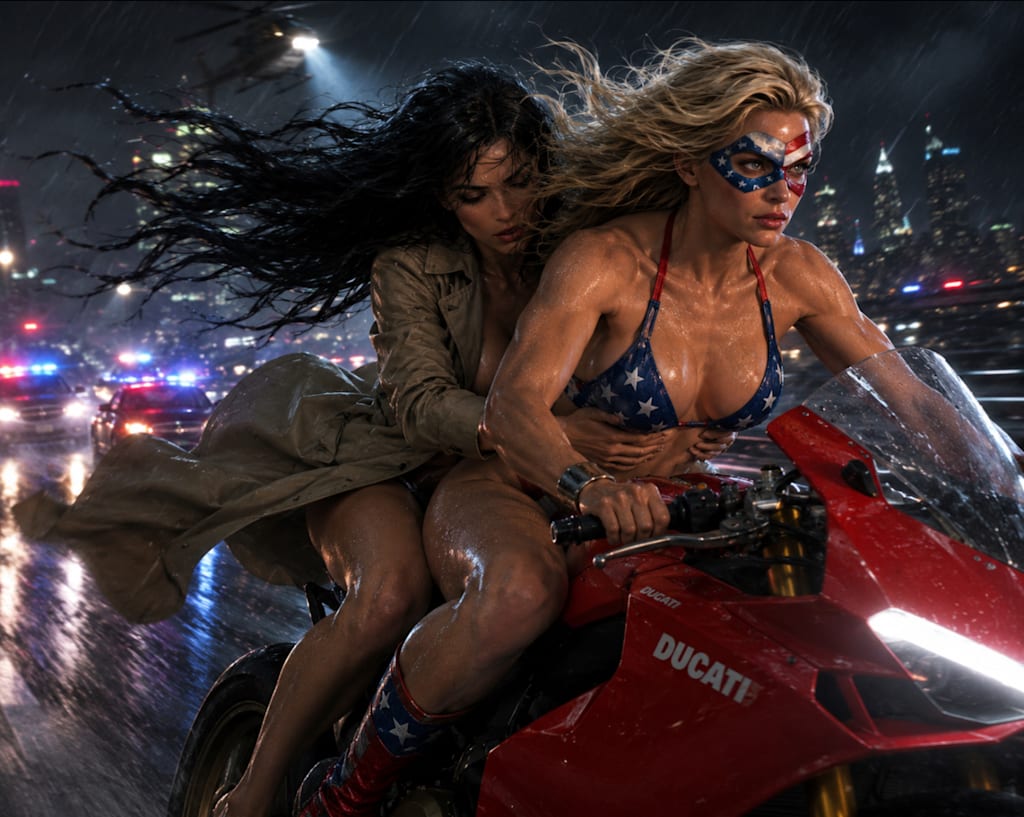
From the height of the chaos, a black motorcycle appeared.
It was driven by Americana the Captain, masked president of the Coastal Federation and the United Armies, wearing a bikini, an eye-mask, and a jacket soaked by the storm.
She stopped the bike in front of Nebula.
—Get on. The city will collapse before dawn.
—Because of whom? —Nebula asked with irony.
Americana looked at the giant screens where the gray being smiled behind journalists.
—That bastard has control over people’s minds. And I need you as a witness to the terrorist crimes. I’ve been sentenced to death.
—No. It’s because of those who need people to hate each other in order to keep ruling.
—Don’t forget we’re on the same side. —Her trench coat fluttered in the wind at the motorcycle’s speed.
In the distance, seismic alarms began to sound along with the storm.
The continental fault was awakening.
Amid the fires, stray dogs helped children trapped under rubble while entire families fled toward elevated parks. Some girls played and imitated Nebula’s speeches in front of broken cameras, speaking about freedom and fear with trembling innocence.
And as the city burned under red rain, Nebula Arcturia understood something terrible:
the true power of that imaginary elite was not money or weapons.
It was convincing everyone they were born guilty.
The rain kept falling over Spectral Port as Americana the Captain rode her motorcycle along the coastal highway.
It was a black motorcycle, a modified Norton Atlas 650 with light armor, chrome pipes, and side tanks filled with fluorescent blue fuel. The engine roared with metallic violence that made the elevated bridges tremble.
Nebula sat behind her, holding on tightly.
Americana’s dark bikini glistened wet under the city lights while her military jacket rested folded near the front tank of the bike. Her legs were marked by old scars and gunpowder burns.
—You need to eat —Americana said as she turned toward the maritime district—. You can’t change the world if you faint first.
The floating restaurant Kronos Azul seemed suspended above the ocean. Large glass windows showed luminous fish swimming beneath the metal structure.
An elegant waiter opened the door.
He wore a white shirt, black gloves, and a strange gold pin shaped like a triangular eye.
—President —he said, bowing his head—. Your table is ready.
He carefully took Americana’s jacket.
Nebula looked around. Wealthy guests drank wine while musicians played electric violins on an illuminated platform.
Then she slowly dropped her trench coat.
Several conversations died instantly.
Nebula walked naked toward the table without shame. Her wet hair fell down her back, and the bluish light of the restaurant highlighted the fine scars on her arms—memories of the underground tunnels where she had been held captive.
Americana gave a faint smile.
—You know how to provoke this city.
—The city is already provoked —Nebula replied, sitting down—. It just pretends to be elegant.
An elderly millionaire looked away in disgust.
Two university students nearby began to clap quietly.
The waiter served sea soup and smoked meat while camera drones floated around, discreetly recording politicians and businessmen.
—Fear holds all of this together —Nebula said, looking out through the windows—. The system needs guilty, frightened people in order to keep selling salvation.
Americana drank slowly.
—Not everyone up there is a monster.
—No. Some are just cowards with money.
Then it happened.
The windows exploded.
Armed men burst in from the terrace, firing compact KRISS Vector rifles modified with red lasers. They wore silver masks with no mouths and tactical coats covered in geometric symbols.
Bullets tore through tables and bottles.
Music turned into screams.
A violinist collapsed onto the stage as the ceiling caught fire from incendiary impacts.
—Down! —Americana shouted, drawing a chrome Mateba revolver.
She fired twice.
One attacker was thrown into the main aquarium.
Nebula grabbed a metal chair and hurled it at another terrorist before running through smoke and shattered glass.
Guests fled covered in blood and spilled wine.
More armed men emerged from the kitchen.
—Kill the Captain!
Americana grabbed Nebula’s hand.
—Run.
They jumped from a side terrace into the outdoor parking area.
The Norton Atlas roared again.
Behind them, six Ducati Hypermotard motorcycles started up, modified with red lights and short machine guns mounted on their handlebars.
The chase crossed elevated bridges while burning helicopters spun above the city.
The terrorist bikes fired without stopping.
Bullets sparked off concrete.
Nebula held onto Americana tightly as the wind slammed against their wet bodies.
—Faster! —she shouted.
—I’m already at the limit.
The motorcycle jumped a burning barricade.
Then came the broken bridge.
Part of the structure had collapsed into the sea after recent earthquakes. Only a few meters still connected both sides.
Americana accelerated.
The engine roared like a beast.
The Norton launched into the void.
For a second, they seemed to float above the black ocean.
Nebula desperately grabbed onto Americana’s bikini.
The fabric gave way.
The top tore in her hands.
Americana landed violently on the other side of the bridge… but Nebula fell backward.
Straight into the sea.
The water struck her body like frozen cement.
Above, bullets entered the ocean in silver lines.
Nebula sank downward through the depths as the city noise faded.
Darkness.
Trash.
Sunken cars.
Corpses trapped in rusted nets.
Then she saw it.
A school bus tilted on volcanic sand.
Small skeletons still sat silently inside.
Nebula felt a cold knot in her chest.
But deeper down, she discovered something worse.
A gigantic crack in the ocean floor.
From it escaped burning bubbles and red light.
The rock trembled.
The seabed shook like a sick heart.
Nebula opened her eyes in terror.
—The San Andreas Fault…
She immediately understood what it meant.
If that fracture fully awakened, half the western coast would vanish.
Meanwhile, above the destroyed bridge, Americana stopped her motorcycle behind overturned vehicles.
She was breathing heavily.
She looked at her hands.
She was still holding the torn bikini.
She realized her chest was exposed under rain and smoke.
But she didn’t seem to care.
She stared at the dark ocean in horror.
—Nebula…
The enemy bikes reappeared behind her.
The terrorists fired again.
Americana returned fire with her revolver while running toward a barricade.
She pulled out a military communicator.
—Captain here. I need professional divers, thermal drones, and immediate extraction in Maritime Sector Seven. Now!
An explosion lit up the bridge.
The attackers kept closing in.
And beneath the ocean, beside the burning crack in the earth, Nebula discovered something impossible:
a massive metal door buried in the depths.
Above it glowed a triangular symbol accompanied by an ancient inscription.
“Encarnation Project.”
Emergency lights flickered under the ocean like dying eyes.
Nebula slowly descended through columns of hot bubbles. Her hair floated around her face as she watched the gigantic metal door embedded in volcanic rock.
The triangular symbol remained lit.
“Encarnation Project.”
The letters looked like liquid mercury.
She placed a hand on the rusted surface and felt a deep vibration travel through the water. Then the hatch emitted a heavy, ancient sound, as if something enormous were breathing on the other side.
Far above, muffled explosions continued.
The city was still burning.
But down there, there was only darkness.
And corpses.
Many corpses.
Some wore military uniforms covered in algae; others had strange glass masks connected to corroded tubes. Among the remains floated children’s toys, school backpacks, and old helmets with government insignias erased by salt.
Nebula felt fear for the first time since escaping the underground brothel.
A cold fear.
Intelligent.
Because she understood this was not an urban legend.
It was a real secret hidden beneath the sea.
Then a light appeared behind her.
Three divers descended in deep-pressure black suits with electric underwater rifles attached to their arms. Their red visors illuminated the volcanic crack.
Americana’s voice came distorted through the communicator.
—Nebula! Respond!
Nebula looked up.
The divers accelerated toward her as the seabed trembled again.
A hot current escaped from the fissure.
The rocks began to break.
And the massive door started to open slowly.
The divers stopped.
Even they seemed terrified.
From within emerged a golden light and a stream of warm water. It did not look like a military base. There were black columns, carved symbols, and giant rotating mechanisms covered in coral.
One diver spoke nervously.
—Captain… this isn’t on any naval map.
—Because it was never meant to be found —Americana replied from the surface.
Suddenly something moved inside the structure.
A massive shadow slowly crossed behind the columns.
The divers raised their weapons.
Nebula stepped back.
Then an explosion shook the ocean.
From above, a burning capsule descended.
The terrorists had dropped perforating charges into the water.
The blast wave hurled bodies and debris in all directions.
One diver was crushed against the rocks.
Another lost his helmet as dark blood floated around his face.
Nebula was violently pulled toward the open door.
The current swallowed her.
She tried to hold onto a rusted chain, but her fingers slipped.
—Nebula! —Americana screamed.
On the surface, the Captain had taken a rifle from a dead terrorist. Her arms were covered in soot and rain; her dark hair stuck to her face with saltwater.
Behind her, attackers continued firing from burning Ducatis.
Americana fired bursts from behind a wrecked car.
A fuel tank exploded.
Flames lit up the entire bridge.
But then she saw something impossible.
The ocean crack began emitting red light visible even from the surface. The entire sea vibrated.
And far on the horizon, the dormant volcano Mount Ashkar erupted into a massive column of fire and ash.
The entire city shook.
Sirens.
Helicopters.
Collapsing buildings.
On the streets, thousands of people ran in panic while news stations blamed “the naked agitators” for the national chaos.
The gray being appeared again on screens, smiling from hidden studios.
Meanwhile, beneath the ocean, Nebula finally passed through the door.
She fell onto a metal platform covered in warm water.
She coughed violently.
The place was an impossible mixture of ancient temple and futuristic laboratory. Luminous tubes ran along black walls while enormous statues depicted human figures watching the stars.
And at the far end of the chamber…
there were people.
Dozens of them.
Men and women connected to transparent machines, sleeping inside capsules filled with golden liquid.
Each capsule bore a word:
“ENCARNATED.”
Nebula moved forward slowly.
Then a voice spoke behind her.
—Finally someone returned from the surface.
She turned sharply.
And saw an elderly woman sitting in front of an ancient console.
Her eyes were completely white.
And she smiled as if she had been waiting for Nebula for centuries.
The old woman stood motionless as golden lights reflected deep wrinkles across her face.
Nebula stepped back slowly.
The place smelled of wet metal and ancient salt.
The capsules emitted a constant hum. Inside them, people slept suspended in luminous fluid, as if time had stopped for them centuries ago.
—What is this place? —Nebula asked, breathless.
The woman smiled faintly.
—The surface calls it myth. The elites call it salvation. We call it Encarnation.
Nebula looked at the vast walls covered in astronomical symbols. Entire constellations were drawn on the black ceiling like secret maps.
Then she noticed something else.
Many faces inside the capsules looked alike.
Entire families.
Children.
Military personnel.
Politicians.
—They’re alive…
—More or less.
The woman rose slowly. She wore dark robes adorned with metal plates and fragments of black coral.
—Above, they taught you power is held by money and weapons. But true control was always down here… manipulating fear, desire, and collective memory.
Nebula frowned.
—Who are you?
—They called me Sibila Vega 9th. I was a scientist before the collapse of the first coastal cities.
A rumble shook the structure.
Dust and water fell from the ceiling.
The underwater fault continued expanding.
Sibila walked toward a large circular window where the turbulent ocean and glowing volcanic crack painted everything in red reflections.
—The surface is dying again —she murmured—. Just like before.
Nebula felt a chill.
—Before?
The old woman stayed silent for a few seconds.
—There were civilizations before yours. Entire cities swallowed by earthquakes and boiling seas. Each time humanity learned too much… someone reset the board.
Above the surface, Americana the Captain continued fighting.
The coastal highway was now a hell of smoke and wrecked vehicles. Burning Ducatis blocked part of the bridge while terrorists retreated under fire.
Americana advanced through rain and soot, holding her rifle firmly. Her dark hair stuck to her neck, her body marked by recent wounds, her broken bikini partially hidden beneath a military blanket taken from a vehicle.
A helicopter descended onto the bridge.
Special agents in black maritime armor stepped out.
—We didn’t find the body —one of the surviving divers said—. But we detected a massive structure beneath the fissure.
Americana clenched her jaw.
—Then she’s still alive.
Behind them, journalists approached.
“President! They say the rebels caused the earthquake!”
“The public demands arrests!”
“Channel Kronos claims a naked sect is causing national chaos!”
Americana grabbed a camera and threw it into the ocean.
—People are dying and you’re still selling fear.
Then the sky roared.
In the distance, the financial district began collapsing as cracks tore through major streets. Seismic alarms filled the air.
And on a giant billboard, the gray being appeared again.
Tall.
Thin.
Black eyes glowing from a hacked transmission.
Smiling.
—Fear always wins —his voice whispered across every channel simultaneously.
In the underwater refuge, Nebula saw similar images on old monitors.
—What… is he?
Sibila lowered her gaze.
—Not exactly a man.
The old woman opened a side hatch.
Behind it were files, photographs, and destroyed maps of the planet.
Nebula saw images of volcanoes, sunken cities, and human experiments from decades ago.
And something else.
Photographs of girls rescued from trafficking networks.
Among them was herself.
Smaller.
Covered in mud near the swamp where she grew up.
Nebula froze.
—How do you have this?
Sibila stepped closer.
—Because they were watching you before you could even speak.
The young woman felt a hollow emptiness in her chest.
—Who?
The woman pointed toward the golden capsules.
—The Encarnated. Those who survived every collapse of the world… by changing names, governments, and narratives. They build heroes, monsters, and crises. And now they want to use the current chaos to rule whatever remains of the western coast.
The ocean trembled violently again.
Several capsules began opening slowly.
And from inside, figures started to wake.
The capsules opened with a wet metallic sound.
Golden liquid spilled across the floor, forming shining streams around Nebula’s feet. The waking figures gasped for air as if emerging from centuries of sleep.
They did not look monstrous.
They looked exhausted.
Men and women of different ages, wearing translucent garments adorned with geometric symbols and stitched constellations. Their bodies bore old scars, astral tattoos, and glowing marks around their necks and wrists.
A tall dark-skinned woman stepped out first. Her white hair fell to her waist and her amber eyes studied Nebula calmly.
—Don’t be afraid —she said softly—. No one here wants to imprison you.
A man followed, elegant and thin, wearing a dark blue cape open across his bare chest.
—I understand why you distrust us —he added—. The surface turned power into abuse and surveillance.
Nebula stepped back slightly.
—Who are you really?
Sibila Vega placed both hands on the console.
—Each Encarnated chose a different way to survive human collapse. Scientists. Artists. Leaders. Some made terrible mistakes believing control would prevent war.
The old woman walked among the capsules.
—The surface believes every hidden group exists to dominate. But many organizations are born from fear. Fear of hunger. Disease. Chaos. Human hatred.
The man in the blue cape smiled sadly.
—And prolonged fear eventually corrupts even the best intentions.
Nebula looked at their strange clothing.
—Why do you dress like this?
The amber-eyed woman answered first.
—We abandoned hierarchies. Above, clothing became a symbol of power and separation. Here, we wear light fabrics because we live beneath the ocean, among geothermal heat and constant water. Our bodies stopped being political tools.
Another Encarnated spoke from the back.
A young man with copper hair and a calm voice.
—Though we are not innocent either. Some of us tried so hard to “protect” humanity that we ended up controlling it. We believed people couldn’t govern themselves.
Nebula crossed her arms.
—And you?
He held her gaze.
—I believe people need truth, even when it hurts.
Sibila gave a faint smile.
—That’s why the upper system began to collapse. For centuries they hid too much. Not magic secrets… but corruption, human trafficking, fabricated wars, emotional propaganda. The gray monster you saw on screens doesn’t control the world with supernatural power. He controls narratives. He turns the innocent into enemies and the guilty into saviors.
The structure trembled again.
A red alarm activated.
But the Encarnated remained calm.
The amber-eyed woman gently placed a thermal blanket over Nebula’s shoulders.
—You must be freezing.
The gesture softened something inside her.
Nebula looked around. Unlike the surface, no one stared at her with disgust or desire. Only calm curiosity. Even warmth.
—Why did you help me? —she finally asked.
Sibila answered immediately.
—Because you did something we forgot long ago.
—What?
—You spoke to people without trying to rule them.
Silence filled the chamber.
Then the copper-haired young man chuckled softly.
—Also… you’re famous up there now.
A monitor showed chaos in Spectral Port: protests, fires, improvised speeches in the streets. Some girls repeated Nebula’s words while helping evacuate families.
Others simply embraced strangers in panic.
Americana the Captain also appeared, coordinating rescues from a broken bridge.
Her voice was steady amid sirens and explosions.
—Priority to children and elderly! Clear fuel from coastal avenues before another aftershock!
Nebula gave a faint smile.
—She’s still fighting alone.
Sibila shook her head slowly.
—No. That’s the surface problem: everyone believes they must save the world alone.
Then the lights flickered violently.
A massive hatch began to close automatically.
And from a dark corridor emerged a figure in a wet black armored suit.
A strange rifle hung on his back.
And the same triangular symbol of the Encarnation Project was engraved on his helmet.
The figure stepped forward under red emergency lights.
Water dripped from the armor, forming small reflections on the metal floor. The triangular helmet fully hid his face, and the magnetic rifle on his back looked too heavy for a normal human.
The Encarnated fell silent.
Sibila Vega watched him with resignation.
—I knew you would wake up eventually.
The stranger slowly removed his helmet.
He was a man with dark gray hair and deeply tired eyes. No monstrous traits. Just someone who had survived too long.
—the surface has partially collapsed —he said gravely—. The coasts are evacuating. Governments are blaming each other, and news networks are manufacturing enemies again.
He looked at Nebula.
—and you are the perfect face for that narrative war.
She held his gaze.
—Then help tell the truth.
He gave a bitter laugh.
—Truth never arrives clean. People mix it with fear, pride, desire, and rage.
Americana the Captain then entered through the side hatch with armed divers. Soaked, covered in ash, a military blanket across her chest.
When she saw Nebula alive, she exhaled deeply.
For a moment she stopped being president, soldier, or symbol.
Just a woman afraid of losing someone important.
Nebula walked toward her and they embraced tightly.
Everyone respectfully looked away.
Outside, the underwater fissure roared like a massive animal.
Sibila watched screens showing fires, looting, and human caravans moving toward higher ground while distant volcanoes painted the sky red.
—Listen carefully —she said finally—. The world will not end tonight. But a way of living will.
Silence.
—Imaginary elites, hidden groups, television monsters… exist because humanity gives fear too much power. Some use money. Others politics. Others empty speeches. But the mechanism is always the same: make people feel small and guilty.
Even the Encarnated lowered their heads.
—We also failed —Sibila admitted—. We tried to protect the world by hiding everything. And secrecy corrupted our intentions.
Americana looked at the open capsules.
—So what do we do now?
The armored man answered:
—Stop ruling from the shadows.
Nebula walked toward the enormous ocean window. Glowing fish circled the volcanic fissure while luminous fragments slowly rose toward the surface.
She thought of the beggars.
Of children rescued from ice-cream trucks.
Of ignored students.
Of confused young women imitating everything they saw.
Of terrified people searching for culprits.
And she understood something simple.
The world did not need perfect saviors.
It needed people willing to stop destroying each other.
She turned back.
—Then let’s go up there —she said—. Let’s rebuild without becoming new tyrants.
Americana smiled tiredly.
—That speech will probably anger half the city.
—The other half needs to hear it.
Hours later, as dawn arrived, survivors gathered in parks, beaches, and ruined avenues. People shared food, blankets, and tools. Students repaired electrical systems. Entire families walked together away from seismic zones.
News networks kept trying to sell fear.
But fewer and fewer people believed them.
And on a makeshift platform facing the cracked ocean, Nebula Arcturia spoke again to the crowd.
She did not speak of conspiracies.
Nor hidden gods.
Nor eternal enemies.
She spoke of dignity.
Of not turning pain into cruelty.
Of protecting children.
Of learning to distinguish truth from paranoia.
And as the sun finally broke through the ash clouds, even some police officers set their weapons down to help in the rubble.
Far away, in a partially destroyed tower, the gray being watched the screens shut down one by one.
His smile faded slowly.
Because fear still existed.
But for the first time in a long time…
it no longer controlled all of humanity.
THE END
About the Creator
Stephen Betancourt
poems have different melodies, which shapes their theme; they are meant to be read soft or in a strong voice but also as the reader please. SB will give poetry with endless themes just to soothe and warm the heart.
Enjoyed the story? Support the Creator.
Subscribe for free to receive all their stories in your feed.
Comments
There are no comments for this story
Be the first to respond and start the conversation.