
NASA Is Bringing Mars Rocks Back to Earth. Scientists Are Worried About What Else Might Hitch a Ride.
The real risk isn’t an alien invasion. It’s a microbe that survives the trip, adapts to microgravity, and finds a weakened immune system waiting.
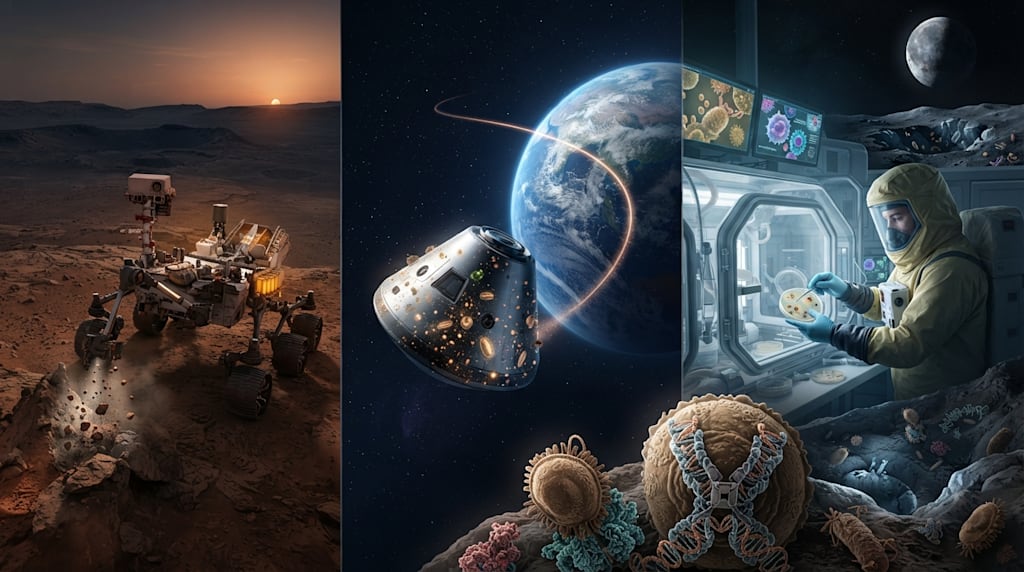
In February 2021, NASA’s Perseverance rover landed in Jezero Crater. It carried drills, cameras, and spectrometers. It drilled into reddish rock layers and sealed rock cores in titanium tubes. Those tubes lie on the Martian surface, waiting for a return mission that has not been determined. Scientists want to know whether the rocks contain traces of ancient life. They are also dealing with another question: if there is life in the tubes, could it make us sick on Earth?
There is no tense soundtrack. The work happens in laboratory protocols, spacecraft cleanliness standards, and planetary protection rules. The usual answer is “risk is extremely low.” Extremely low is not zero. To see where the risk comes from, break “alien life” into concrete scenarios.
I. Alien life is probably not aliens, but microbes
Astrobiologist Michaela Musilova has worked with NASA and ESA. She says alien life may not look like the green aliens in movies. It is more likely to be microorganisms. Bacteria and other simple organisms are the best candidates for surviving space. Some Earth bacteria survive in space for long periods by forming spores and entering dormancy.
Musilova describes the process. A thick protective shell forms in the cell. DNA is tightly packed. Special proteins act like seatbelts, holding the DNA in place. Radiation usually breaks DNA into small fragments. These proteins protect it. Some theories suggest bacterial spores may survive thousands of years in space. The theories remain hypotheses. Scientists have not run such experiments on the International Space Station for very long.
If alien life exists, it is unlikely to attack humans. It is more likely to move passively with rocks, dust, or spacecraft surfaces. The risk is not alien invasion. It is microbial hitchhiking.
II. Reverse contamination: samples brought back from Mars
Could microbial life from outer space be brought back to Earth? This is called reverse contamination. Past expert panels have said the risk of Martian surface samples harming Earth is “extremely low.” Musilova says NASA and other space agencies still take the threat “quite seriously.”
The Mars Sample Return program, a NASA and ESA collaboration, was intended to bring Martian samples to Earth for the first time. It is currently suspended. It had contingency plans. Musilova says they planned special isolation laboratories on Earth. Samples would be stored and tested there first.
Silvio Sinibaldi, a planetary protection officer at ESA, worked on the program. He says researchers considered threats beyond the samples themselves. They studied particles that could cross-contaminate the outside of spacecraft. They do not want those particles to approach Earth’s atmosphere. Planetary protection is concerned with what is inside the sample and what is stuck to the outside of the spacecraft. Any object returning from space could carry microorganisms.
III. Forward contamination: what humans bring into space
If microorganisms survive in space, what are humans bringing into space? Former NASA astronaut and University of Pittsburgh microbiologist Kate Rubins says humans inevitably bring microorganisms with them. The human body is a microbial ecosystem. Skin, mouth, intestines, and respiratory tract host trillions of bacteria, fungi, and viruses. Astronauts cannot leave them at home. They enter spacecraft and the International Space Station along with human bodies, equipment, food, and air.
Rubins says microorganisms sense their surroundings. They react to stress. Spaceflight and microgravity are full of stress. Rubins says research shows that some bacteria activate genes related to virulence after exposure to microgravity. Virulence means the ability to cause disease. Rubins says their pathogenicity increases slightly.
Spaceflight may also affect the human immune system. NASA has observed that some latent viruses, including those related to shingles, reactivate under certain conditions in space. Rubins says: “This may mean that the function of the immune system has been suppressed… and this virus wakes up and reactivates.” If microbial pathogenicity increases and human immunity declines, astronauts may become more susceptible to infection and slower to recover.
IV. Contaminating science: Martian life may be Earth visitors
Bringing microorganisms into space can also threaten scientific research. Musilova says probes sent to Mars study whether the Martian environment was once suitable for life. “It is almost certain that some microorganisms successfully ‘hitchhiked’ all the way to Mars,” she says. If we discover life on Mars, the first thing to confirm is that it is not a contaminant from Earth.
Sinibaldi adds that reducing this risk also prevents bringing organisms that might reproduce on other planets. This is forward contamination. It affects whether alien ecosystems are destroyed by Earth life and whether scientific conclusions are reliable. If a probe brings Earth microorganisms to Mars and scientists detect signals resembling life, is it native Martian life or Earth contamination? Verifying that could take years or decades. If Earth microorganisms survive, reproduce, or change the local environment on another planet, humans may never know what that place originally looked like.
V. Planetary protection: ExoMars cleanliness standards
Spacecraft design matters for planetary protection. ESA’s ExoMars Rosalind Franklin rover is expected to launch in 2028. It is designed to minimize contamination risk. ESA says the rover was assembled in an ultra-clean environment. Engineers used dry heat microbial reduction, ultraviolet light, and gamma rays to reduce bacterial counts. They cannot completely eliminate bacteria.
ExoMars engineer Paul Meacham says: “The number of bacterial spores on the entire rover surface must not exceed 10,000, an amount usually found on an area one-eighth the size of a needle tip. And what we actually achieved is only 10 percent of this upper limit.” A tiny omission can travel hundreds of millions of kilometers with a probe and reach another world.
VI. The discovery at the lunar south pole and longer journeys
In August 2026, NASA scientists found that some Earth microorganisms can survive in shadowed corners and crevices of the lunar south pole. They said the discovery shows we need to understand how microorganisms respond in space. The shadowed regions are extremely cold. Microorganisms may still find space to survive. If the Moon is not sterile, planetary protection for Mars and other planets still matters.
Microorganisms may survive in space or become more pathogenic. Spaceflight may suppress the human immune system. Together, these factors could harm astronauts’ health and affect mission success. As humans plan longer journeys, the issues grow. If someone gets sick on the International Space Station, they can return to Earth within 24 hours. From the Moon, return takes several days.
Rubins says: “It sounds like not very long, but if you get a serious infection, this could become a problem.” On deep-space missions, medical resources are limited. Return to Earth may take months or longer. An ordinary infection could become a crisis.
Future space exploration will need microbiology, immunology, and planetary protection alongside rocket thrust, life-support systems, and landing technology. Researchers need to study how microgravity affects bacteria and viruses, how astronauts’ immune systems change, and how to prevent and treat infections on long missions. International rules need to ensure sample return, crewed landings, and planetary exploration do not bring Earth life to places where it should not go, and do not bring unknown alien life back to Earth.
These questions have no simple endpoint. Perseverance’s titanium tubes are still lying on the Martian surface. Rosalind Franklin is still being assembled in the clean room. Astronauts on the International Space Station are still living in microgravity. Rubins’s sentence remains: if you get a serious infection, this could become a problem.
About the Creator
Jin
Writer of reamstories
https://reamstories.com/jin
Enjoyed the story? Support the Creator.
Subscribe for free to receive all their stories in your feed. You could also become a paid subscriber, letting them know you appreciate their work.
Comments
There are no comments for this story
Be the first to respond and start the conversation.