
Mexico System Integration Market Set to Reach US$ 19.99 Billion by 2033 as Digital Transformation Reshapes Enterprise IT
Smart city initiatives, cloud adoption, AI deployment, and rising cybersecurity needs are turning system integration into a core capability for Mexico’s modern economy.

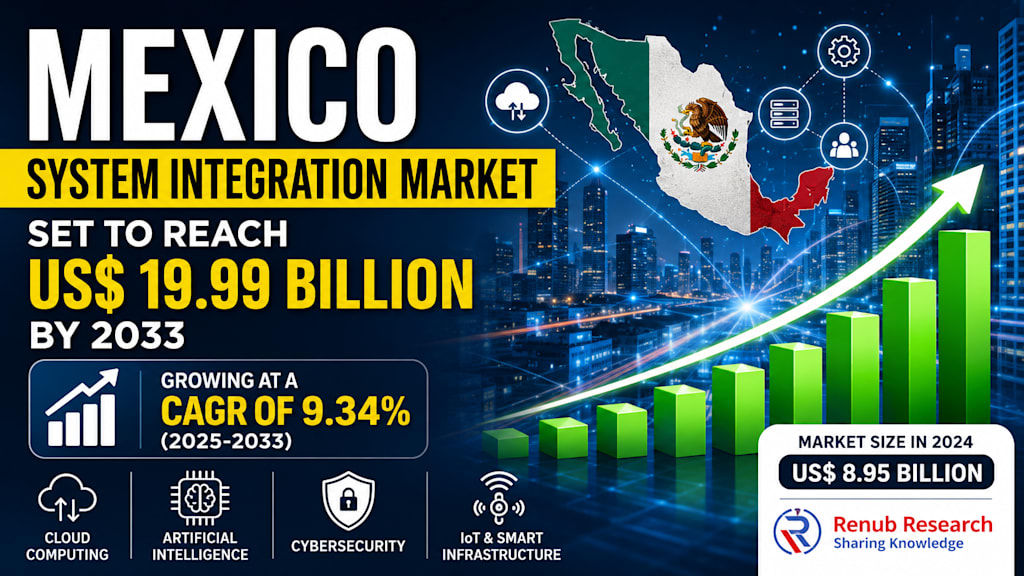
Mexico’s system integration market is moving from a back-end IT support function to a strategic enabler of digital business. According to Renub Research, the market is expected to grow from US$ 8.95 billion in 2024 to US$ 19.99 billion by 2033, reflecting a CAGR of 9.34% from 2025 to 2033. That growth outlook captures a larger story: as organizations in Mexico modernize their operations, they need their systems, data, cloud platforms, and security layers to work together smoothly.
At the center of this expansion is a simple but powerful reality. Businesses no longer operate with one software package, one network, or one data source. They rely on a connected mix of databases, applications, cloud services, APIs, devices, and analytics tools. System integration brings those components together so they can communicate, exchange data, and support faster decision-making. In practical terms, it helps organizations reduce complexity, improve productivity, and adapt faster to new technology changes.
Mexico is a particularly interesting market because multiple transformation trends are happening at once. Digitalization is accelerating across manufacturing, healthcare, financial services, retail, logistics, and public administration. At the same time, government-backed smart city programs, stronger IT spending, and rising interest in cloud, cybersecurity, IoT, and AI are creating demand for integration services that can connect everything into one usable ecosystem.
Why the market is expanding
One of the strongest growth engines is digital transformation. Mexican enterprises and public-sector organizations are modernizing infrastructure, expanding e-government services, and increasing ICT penetration. The report also highlights the role of major technology investments, including Microsoft’s commitment to expand cloud and AI adoption for small and medium enterprises. These developments matter because digital transformation is not only about buying new tools; it is about making those tools work together in a coordinated way.
Artificial intelligence is another major driver. As AI use cases spread across finance, manufacturing, healthcare, logistics, and customer service, organizations need integrated systems that can handle large workloads securely and reliably. AI platforms cannot create business value in isolation. They must connect to existing ERP systems, data platforms, security tools, cloud environments, and operational workflows. That is where integration vendors play a crucial role.
The rise of e-commerce and digital payments is adding even more momentum. Mexican businesses are managing more sales channels, more payment types, and more customer touchpoints than before. This creates a need for integrated transaction systems that can support speed, security, and a better user experience. The same pressure appears in mobile commerce and in the collaboration between banks, fintech firms, and payment processors, where disconnected systems can quickly become a bottleneck.
The biggest challenges
The market’s long-term outlook is strong, but two obstacles stand out.
First is data security. As more platforms are connected, the attack surface grows. Organizations must protect sensitive data across applications, endpoints, and networks while staying compliant with laws such as Mexico’s Federal Law on Protection of Personal Data. That requires strong encryption, authentication, monitoring, and governance practices, which are not always easy or affordable to implement consistently.
Second is market fragmentation. The report notes that Mexico has many small and mid-sized providers with different service standards and levels of expertise. This can complicate vendor selection, slow projects, and make end-to-end integration harder to deliver. It can also limit innovation when smaller firms struggle to scale or invest in advanced tools.
Market structure and application areas
Renub Research segments the market by services into infrastructure integration, application integration, and consulting, and by end use into IT & telecom, defense & security, BFSI, oil and gas, healthcare, transportation, retail, and others. That mix reflects how broad the opportunity is: integration is no longer confined to one industry or one project type. It is part of nearly every sector that is digitizing operations.
Among these segments, application integration and infrastructure integration are especially important because they sit at the heart of digital operations. Application integration helps companies connect business software, while infrastructure integration aligns networks, servers, storage, and devices. Consulting remains important too, because many organizations need strategic guidance before they can successfully implement a broader transformation roadmap.
Why this matters now
What makes Mexico stand out is the convergence of public and private demand. The public sector is pushing digital infrastructure and smarter cities. The private sector is pushing automation, cloud migration, AI adoption, omnichannel commerce, and stronger cyber defense. Each of these priorities creates an integration requirement. The result is a market where vendors are no longer selling a single solution; they are helping organizations design, connect, secure, and operate entire digital environments.
The opportunity is especially visible in industries that deal with complex operations and sensitive data. Healthcare needs better interoperability. BFSI needs secure and compliant transaction systems. Retail needs integrated inventory, customer, and payment flows. Defense and security need resilient architectures and controlled access. Transportation and logistics need real-time data exchange. In each case, system integration becomes the layer that makes digital tools useful at scale.
Recent developments and company moves
The report highlights Cisco and NEC as active players in the market’s development, with Cisco launching a new Security Service Edge solution in June 2023 and Cisco Systems, Inc. announcing a collaboration with NEC Corporation in February 2023 to explore system integration opportunities in private 5G and 5G xHaul. Those moves underline an important theme in Mexico’s integration market: security and connectivity are increasingly being designed together.
Below are ten recent company developments that show how the broader system integration ecosystem is evolving around AI, cloud, networking, and cybersecurity:
Cisco unveiled new security and network capabilities in June 2025 designed to help organizations accelerate AI adoption with next-generation networking, security, observability, and collaboration tools. The company positioned these updates around secure infrastructure for the AI era.
IBM announced in May 2025 that it was combining hybrid technologies, agent capabilities, and consulting expertise to help businesses operationalize AI more effectively across connected enterprise environments.
Capgemini signed a multi-year agreement in June 2025 with Dai-ichi Life Holdings to establish a Global Capability Center in India, reinforcing its role in large-scale digital transformation delivery and global integration services.
Infosys inaugurated a Center for Advanced AI, Cybersecurity, and Space Technology at its Hubballi Development Center in August 2025, signaling continued investment in advanced digital capabilities and integration-led innovation.
HPE introduced new AI-driven security and advanced data protection innovations in August 2025, aimed at helping enterprises secure data and modernize infrastructure more effectively.
HPE Aruba Networking launched security-first, AI-powered networking innovations in January 2025, focused on retail IoT data collection and edge processing. That reflects the growing link between network design and system integration.
Fujitsu launched the Fujitsu Cloud Service Generative AI Platform in February 2025, combining cloud convenience with data confidentiality to support enterprise AI deployment.
HCLTech launched Agentic AI solutions with Google Cloud in April 2025, helping enterprises unlock more value from their digital and technology landscapes through AI-enabled transformation.
HCLTech also announced a strategic partnership with Western Union in March 2025 to transition to an AI-led platform operating model, showing how large enterprises are rethinking legacy technology structures.
Accenture announced in August 2025 that it would acquire CyberCX, expanding its cybersecurity capabilities in Asia Pacific. In the same year, it also highlighted the urgency of preparing organizations for AI-augmented cyber threats, which is closely tied to integration and security modernization.
A broader reading of these developments makes one thing clear: the system integration market is being pulled forward by the same forces shaping enterprise IT globally. AI, security, cloud modernization, and data governance are no longer separate conversations. They are becoming one operating agenda, and integration is the bridge between them.
Competitive landscape
The report lists major players such as Accenture Plc., BAE Systems Plc., Capgemini SA., Cisco Systems Inc., Dell Inc., Fujitsu Limited, HCL Technologies Limited, Hewlett Packard Enterprise Company, IBM Corporation, and Infosys Limited. This lineup shows how competitive the market is likely to be, with global technology and consulting firms competing across infrastructure, applications, consulting, and security-led integration services.
That competitive structure matters because Mexico’s buyers are increasingly looking for more than implementation support. They want vendors who can help with architecture planning, cloud migration, cybersecurity, AI enablement, and ongoing system optimization. In other words, the winning providers are likely to be the ones that can combine technical depth with business understanding.
Outlook
Mexico’s system integration market is on a strong growth path because the country is not just digitizing; it is re-architecting how organizations work. The pace of investment in cloud, AI, cybersecurity, and connected infrastructure is likely to keep integration demand high through 2033. The market forecast from Renub Research points to this shift clearly: the opportunity is large, expanding, and increasingly strategic.
For enterprises, the message is straightforward. Technology stacks are becoming more complex, not less. Successful companies will be the ones that can unify platforms, protect data, and create seamless digital operations across departments and channels. In that environment, system integration is not a support service. It is a competitive advantage.
Final Thoughts
The Mexico system integration market is entering a phase where every major digital initiative depends on connectivity, interoperability, and security. As cloud adoption rises, AI use cases expand, and businesses demand faster digital execution, the need for integration will only deepen. The companies that can simplify complexity will define the next wave of growth.
About the Creator
Enjoyed the story? Support the Creator.
Subscribe for free to receive all their stories in your feed.
Comments
There are no comments for this story
Be the first to respond and start the conversation.