
MARS and it's MOON
MARS is planning to destory it's own MOON
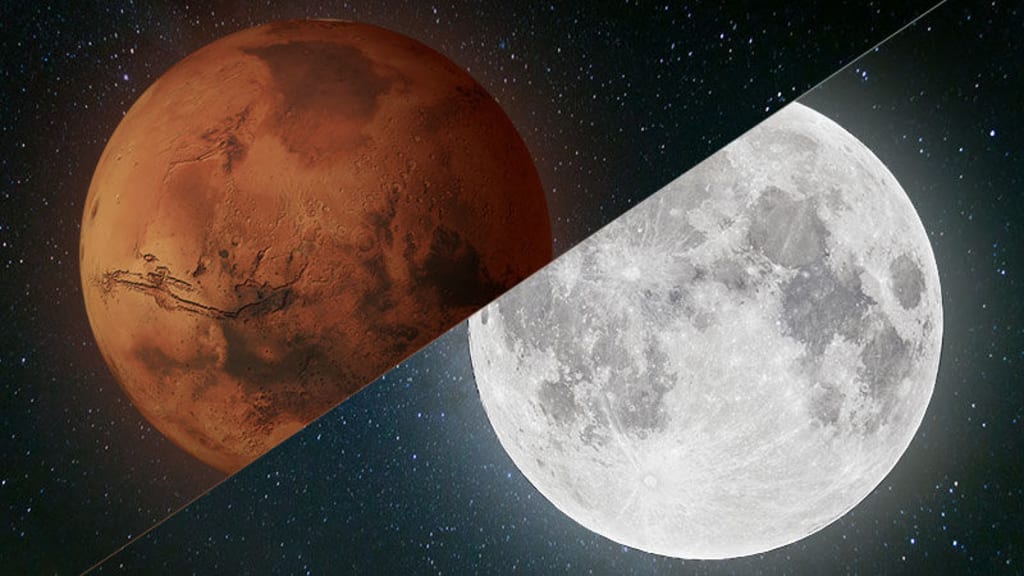
What a delightful occasion it is to witness the gathering of the Cosmic Family, including the esteemed presence of Mars. It is highly probable that you have encountered Mars on previous occasions. Allow me to introduce the two smaller celestial bodies accompanying Mars, namely Phobos and Dios, which are recognized as its moons. Unfortunately, it appears that Mars is not treating these diminutive entities with the appropriate regard. Phobos and Dios are believed to have been captured asteroids. However, due to the influence of gravity, Phobos is gradually drawing closer to Mars, and it is predicted that within the next 35 million years, it will succumb to the planet's gravitational forces and be destroyed. Consequently, it is anticipated that this event will result in the formation of a ring of debris encircling Mars, akin to the magnificent rings of Saturn. It is important to note that this process is a natural phenomenon and not an intentional act of destruction by Mars.
Evidently, Phobos is undergoing a distressing experience, as it is being torn apart by the formidable gravitational forces exerted by the red planet. Furthermore, Phobos exhibits peculiar parallel grooves across its surface. Initially, it was hypothesized that these grooves were a consequence of an asteroid collision. However, scientists now propose that they are a result of Mars's intense gravitational pull, which is causing the moon to disintegrate. This phenomenon is commonly referred to as the tidal force. It is projected that Phobos will be stretched to such an extent that it will eventually disintegrate, leading to the formation of a minuscule ring around Mars, reminiscent of Saturn's majestic rings.
Previously, some individuals speculated that Phobos's distinctive grooves were caused by tidal forces. However, this theory was debunked due to the moon's remarkably porous composition. Nevertheless, ingenious researchers have conducted computer simulations, which suggest the presence of a rigid shell beneath Phobos's fluffy exterior, capable of creating the observed grooves on its surface. It is worth mentioning that Phobos's current trajectory indicates a collision with Mars in approximately 40 million years. However, considering the ongoing effects of tidal forces, it is uncertain whether Phobos will endure until that time. Nonetheless, this presents a valuable opportunity for further exploration and understanding of Phobos. Notably, NASA has assembled a team of ten esteemed researchers from various locations across the United States to contribute to the scientific endeavors of Jax's Martian Moon's exploration, also known as MMX mission, supported by NASA, involves the participation of scientists who will assist JAXA in exploring the Martian moons Phobos and Deimos. Remarkably, they are even planning to land on Phobos and collect a sample from its surface. The mission is scheduled to launch in 2024, and we anticipate obtaining the sample in 2029. Seven fortunate researchers will utilize the MMX flight instruments to conduct their research.
Phobos is an intriguing celestial body, measuring a mere 17 miles in width, and it orbits Mars at a distance of precisely 3,728 miles. This proximity is significantly closer than Earth's Moon, which takes a full 27 days to complete an orbit. However, Phobos is currently in a perilous spiral towards Mars, gradually descending towards the planet's surface at a rate of 6 feet every 100 years. There must be a reason for Mars's hostile behavior. Could it be driven by vengeance?
Consider this scenario: Mars is peacefully existing, resembling a young Earth with its hot and watery nature. It possesses a protective magnetic field that shields it from cosmic radiation and maintains a dense atmosphere. Life is thriving. However, suddenly, at least 20 asteroids, each the size of a small country, collide with Mars, resembling a colossal game of cosmic whack-a-mole. One of these asteroids even leaves a crater nearly 2,000 miles wide. Imagine the impact on Mars, with two asteroids now serving as its moons, following the havoc caused by other asteroids. These impacts are akin to a massive blow to Mars's core, rendering its already feeble magnetic field incapacitated. The core becomes overheated, hindering proper circulation, resulting in the loss of the planet's magnetic field, leaving it vulnerable, akin to being unprotected at the depths of the Mariana Trench. If it were possible, one would be defenseless and exposed to the cold, similar to the unfortunate situation that Mars currently faces. Mars is now left vulnerable to harmful cosmic rays, much like going outside without sunscreen, which is not advisable. However, we can learn from Mars's mistakes and ensure that Earth does not suffer the same fate. Perhaps it would be wise to consider investing in asteroid insurance. Nevertheless, it is important to note that Mars is not a hostile planet; in fact, it is quite hospitable. While Mars may appear harsh, there is a possibility that Phobos, one of its moons, could be thriving with the assistance of Mars. Astonishingly, a team of scientists has discovered a method to cultivate rice on Mars. They utilized a special soil called Mojave Mars simulant, designed to mimic Martian soil. However, Martian soil contains harmful salts that can be toxic to plants. To overcome this challenge, the team grew three types of rice: one normal and two genetically modified with mutations that enhance their ability to withstand stress such as drought or salinity. Surprisingly, the mutant strains were able to thrive in soil containing 1 gram of percolate per kilometer. This is a significant achievement, considering the toxic nature of Martian soil. However, it is worth noting that the rice grown in the Mojave Mars simulant did not yield as well as those grown in regular potting soil. Consequently, the team decided to mix a quarter of potting soil with the Martian simulant, resulting in improved plant development. These scientists are not solely focused on feeding potential Martian inhabitants; they also aim to apply their findings to cultivate crops in areas on Earth with high salinity. Remarkably, this project originated from a casual meeting between two researchers who decided to explore the possibility of growing plants together. It is important to address the concern that arises: the immense amount of water required to sustain rice cultivation on Mars would need to be transported from Earth, which poses significant challenges in meeting the plant's hydration needs. You are correct in stating that approximately 449 gallons of water are required to cultivate a single pound of R. However, it is worth noting that scientists have recently made a groundbreaking announcement at the Lunar Imp Planet Science Conference in Texas. They have discovered a relic Glacier near Mars's equator, indicating the presence of water ice on Mars, even in close proximity to the equator. This discovery holds significant implications and suggests the possibility of additional ice reserves beneath the surface. The Glacier in question is not an ordinary one; it is estimated to be 3.5 million meters long and up to 2.5 million meters wide, comparable in size to a small town. It possesses all the characteristics of a typical glacier, including crass fields and morine bands. However, it is important to note that this "ice" is actually a salt deposit that has formed on top of the glacier, preserving its shape. The formation of this salt deposit can be attributed to the volcanic materials that cover the region. When these materials come into contact with water ice, sulfate salts may form and accumulate, eventually creating a hardened crusty layer. Over time, erosion removes the volcanic materials, exposing the sulfates and revealing the unique features of the glacier. This glacier is relatively young, likely from the Amazonian geologic period, indicating that Mars has had surface ice in recent history. The existence of this relic Glacier raises the question of what other icy secrets Mars may be concealing. However, further research is necessary to determine if water ice is still preserved beneath the salt deposit or if it has completely disappeared. If water ice is still present at shallow depths near the equator, it could have significant implications for human exploration. The ability to extract water from the ground in a warmer location would be a game-changer. Therefore, it is crucial to await further discoveries from these scientists regarding our beloved red neighbor. Perhaps one day, we may even have the opportunity to personally visit the salt Glacier statue. Thank you for joining us today, and if you found this information intriguing, please consider liking and sharing the video with your friends. For more fascinating content, please click on the provided videos and stay tuned to the Bright Side.
About the Creator
Tooba Anees
Hey there , this is Tooba Anees. This is a platform for you to enjoy content relating different things.You can comment your preferences as well.
Enjoyed the story? Support the Creator.
Subscribe for free to receive all their stories in your feed.
Comments
There are no comments for this story
Be the first to respond and start the conversation.