
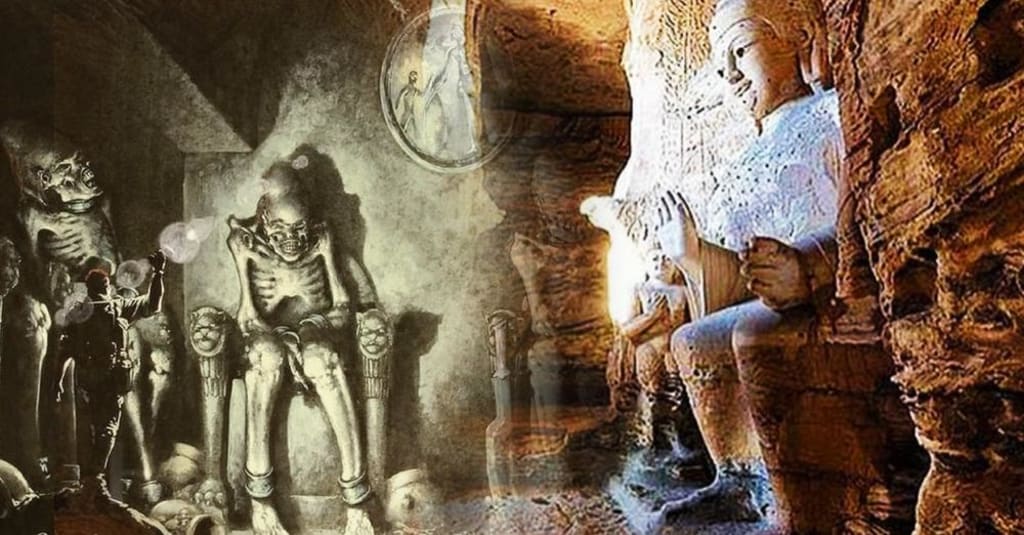
In the remote and uncharted depths of the Amazon jungle in Ecuador, local legends echo with tales of a once-majestic city, said to have been constructed by giants. Gigantic stone structures, fashioned from massive blocks, now succumb to the relentless embrace of Mother Nature, as she reclaims all that was taken from her. These legends have endured for centuries, whispered through generations, yet official institutions dismiss this as mere fantasy and folklore. However, a group of intrepid adventurers and explorers stumbles upon something too peculiar and captivating to dismiss as myth. This video takes you on a journey following these fearless explorers as they delve into the heart of the jungle, unveiling the city of giants—a place shrouded in centuries of silence and brimming with enigmatic puzzles. We embark on a quest to unearth suppressed truths that have lingered in obscurity for far too long—a tale laden with adventure, mystery, and forbidden knowledge that promises to challenge our understanding of human history.
Deep within the Amazon rainforest of Ecuador, the myths and legends cherished by local tribes recount the epic saga of ancient cities constructed by giants. These colossal structures, they claim, once harbored a formidable race that inhabited this realm long before the arrival of regular-sized humans. These legends have been passed down through centuries, carried from one generation to the next through the oral traditions of the numerous tribes that call the Amazon jungle home. These tales speak of giant pyramids and colossal structures fashioned from gargantuan stones, awe-inspiring in their magnitude and scale. According to these narratives, these cities of giants nurtured thriving civilizations that predated both modern tribes and their ancestors. Over the ages, local tribes have utilized these sites for their ritual gatherings, believing them to be inhabited by potent spirits and mystical forces, deterring others from approaching.
These legends paint giants as majestic beings, exceeding ordinary human proportions. The tools they left behind were of such monumental size that an ordinary individual would struggle to wield them. These gigantic tools, along with other archaeological discoveries, hint at the existence of an exceptionally advanced civilization, boasting profound technological prowess and knowledge far surpassing their contemporaries in the region. It is these enduring myths, echoing across the centuries, that serve as the catalyst for a group of explorers embarking on an arduous journey through the uncharted jungles of the Amazon in pursuit of the fabled city of giants.
In 2012, an expedition led by a team of scientific researchers set out to investigate the claims entwined with the legends of the indigenous tribes. In a remote region of the Ecuadorian Amazon jungle, they unearthed a trove of megalithic structures, including an immense pyramid standing at a towering 80 meters in height and breadth. This colossal edifice was constructed from hundreds of massive, irregularly shaped stones, each weighing approximately 2 tons. Crowning this pyramid is a flat platform, suggesting its possible use for ceremonial or sacrificial rituals. Additionally, the expedition encountered an assortment of colossal ancient tools scattered throughout the forest, their sheer size rendering them virtually impractical for use by an average person. While these tools are believed to have been employed in metalworking, their exact function remains a mystery. Furthermore, the discovery of a cement-like substance used to bind the massive stones together suggests an early utilization of concrete in the Americas, according to researchers. These findings collectively point to an ancient civilization endowed with engineering expertise far beyond its time. Bruce Fenton, one of the researchers, asserts, "What we saw really strongly suggests that this population was of the same race as the giants. We came across extremely large hammers, or at least stone hammerheads. Assuming they were attached to handles made of hardwood, they would have been extremely large and heavy, making their use as tools impractical for a typical Inca or Native American, who are usually quite small people."
The expedition also revealed numerous sizable mounds yet to be excavated, their concealed contents obscured by mud and vegetation. The configuration of these mounds strongly hints at the possibility of further pyramids concealed beneath. Notably, the team encountered large stones bearing circular holes at their centers, providing additional evidence against claims that the pyramid-like structure might be a natural formation. All indications suggest that the discovery surpasses initial expectations. According to the researchers, this find holds the potential to unravel many of South America's mysteries and could potentially lead to the discovery of one of the world's most sought-after treasures. Some speculate that this structure might be the final resting place of Atahualpa, the last Inca emperor, who was captured by the Spanish and said to have been buried alongside an immense trove of gold collected by his followers for his ransom. The search for his tomb and its rumored riches stands as one of the most significant historical treasure hunts in the world, having inspired numerous expeditions, all of which, thus far, have ended in disappointment. Bruce Fenton, however, an extensive researcher of indigenous cultures in the region, proposes that the site likely predates Atahualpa and is attributed to an unknown pre-Inca culture. His conviction stems from the thirty tools discovered in the vicinity and the degree of erosion observed on the massive stone blocks.
Exploring this site is a formidable challenge due to the treacherous conditions. The nearest town is approximately an eight-hour journey through dense, mountainous jungle, and the route to the site traverses terrain infested with "killer" bees, the result of a failed experiment in the 1950s that led to the escape of thousands of these aggressive bees, resulting in numerous deaths from their stings across North and South America.
In response to these discoveries, the Ecuadorian Ministry of Culture dispatched a team in 2013 to verify the findings. Despite the presence of evidently man-made structures and tools, the official ministry report categorically deemed the site as a natural formation and not an ancient archaeological site. Bruce Fenton, Benoit Duvernoy, and their colleagues, however, vigorously contest this conclusion. The size and precision of the stones, as well as the technique used in their cutting, polishing, and assembly, strongly suggest an artificial origin. Researchers expressed their disappointment at the lack of a thorough and systematic exploration of the site. Despite their protests, no further investigations were conducted. Many artifacts had already been pilfered by this point, further complicating attempts to reconstruct the site's history. Some sources suggest that while the Ecuadorian government resisted further archaeological investigations, they were open to excavations for oil deposits, raising controversial questions surrounding the "lost city of giants."
Presently, over a decade after the initial expedition, information regarding additional research or fresh discoveries at the site remains scarce. The stance of the scientific community towards the so-called "Lost City of Giants" in Ecuador is characterized by skepticism. The reported findings by the research team have sparked considerable debate, controversy, and deliberation within the scientific community. These scholars underscore the critical importance of verifiable and dependable evidence in archaeology, especially when dealing with extraordinary claims, such as the existence of an ancient civilization of giants. Thorough scientific evaluation is paramount, factoring in the context of the discovery, plausible alternative explanations, and the imperative need for supplementary evidence.
Regrettably, the site languishes unexplored, left to the inexorable forces of nature and looters trafficking in ancient artifacts. Whether it is a captivating work of fiction, an age-old legend, or a faded truth drifting through the annals of time, the tale of the ancient city of giants endures as yet another enigma in human history.
About the Creator
Enjoyed the story? Support the Creator.
Subscribe for free to receive all their stories in your feed.
Comments
There are no comments for this story
Be the first to respond and start the conversation.