
Lion vs. Tiger: Who Is Stronger, and Who Really Is the King of Beasts?
Why the tiger may be stronger in a direct fight, while the lion still keeps the older title of king of beasts.
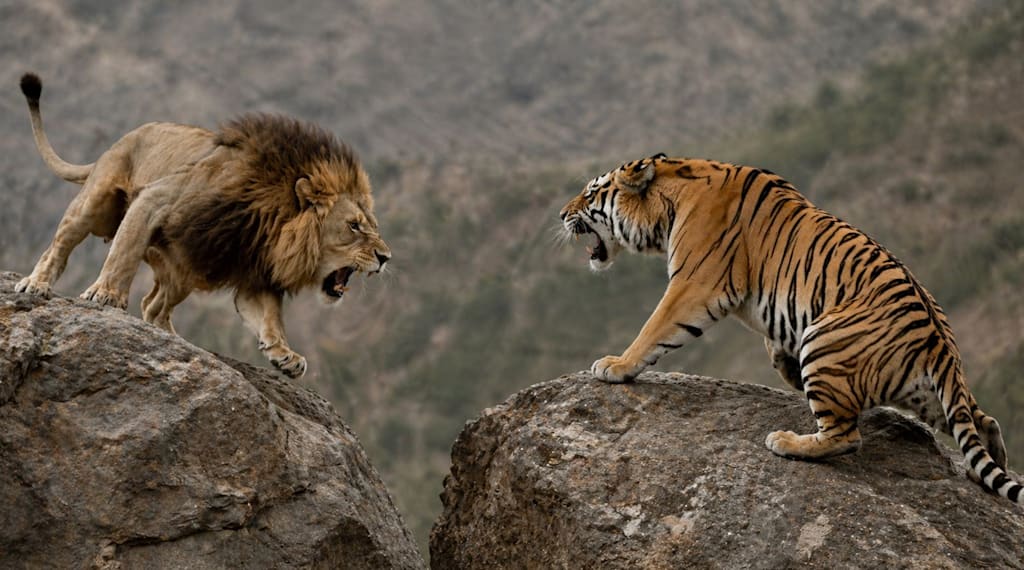
The lion and the tiger are the two main symbols of strength in the world of big cats. One wears a magnificent mane and for centuries has been called the king of beasts. The other lives alone, slips silently out of the forest, and with a single rush brings down prey that can weigh several times more than it does. And the question here is simple: if we strip away the legends, coats of arms, and beautiful stories, who is stronger — the lion or the tiger?
The tiger is larger and heavier

If we compare physical strength, the advantage will more often be on the tiger’s side. That is especially true if we are talking about large subspecies such as the Bengal tiger or the Amur tiger. A tiger is usually more massive than a lion, with a longer body, more powerful paws, and tremendous explosive strength. It is a solitary hunter. It cannot rely on anyone else: not on a pride, not on the support of other males. If a tiger attacks, it has to do everything by itself — stalk, leap, hold, and kill the prey. That is why the tiger looks like a machine built for solitary hunting. It is not just big. It is also highly flexible, fast over short distances, and incredibly strong in the forelimbs.
But the lion is no weaker in character

The lion cannot be dismissed. Yes, it often hunts as part of a pride, but male lions live in constant struggle. They have to defend territory, repel attacks from other males, and hold onto power. A lion is not only a hunter, but also a fighter for status. Its life is arranged in such a way that fights with its own kind are not rare. A male lion must be able to take blows, go into a frontal clash, and refuse to back down. The lion also has one important advantage — its mane. It is not just decoration. In a fight, it partly protects the neck and head, which are the most vulnerable areas. So in a direct confrontation, a lion would not be easy prey even for a larger tiger.
Who would win one on one?

If we imagine a fair one-on-one fight, without interference from other animals, the advantage would usually go to the tiger. It is larger, more solitary by nature, uses its paws better, and is usually stronger physically. But that does not mean the lion is doomed. In nature, there are no mathematical guarantees. Age, weight, experience, health, and circumstances can decide everything. A young, strong lion is fully capable of defeating a tiger, especially if the clash is frontal and short. But if we take the average case — an adult male lion against a large adult tiger — the tiger looks like the more dangerous opponent.
Then why is the lion the king of beasts?
This is where the most interesting part begins. The lion became the king of beasts not because it is necessarily stronger than every other animal. Its image was shaped by its appearance and behavior. The mane makes the lion look like a true ruler. It does not hide in thick forest like the tiger, but lies openly on the plain, roars, guards territory, and leads a pride. The lion is visible. It looks majestic. It seems almost specially made for coats of arms, flags, legends, and ancient myths. The tiger is stronger as a solitary fighter, but the tiger is a secretive predator. It is the king of shadow, forest, and ambush. The lion, by contrast, is the king of the stage. You can see it, hear it, and easily turn its image into a symbol of power.
The tiger is a warrior, the lion is a monarch
If we compare them not only by muscle, but by image, an interesting division appears. The tiger is a solitary warrior. Silent, hidden, lethally dangerous, and almost always relying only on itself. The lion is a monarch. It lives among its pride, defends territory, displays strength, and looks like an animal to which nature itself handed a crown in the form of a mane. That is why the debate over “who is stronger” and the debate over “who is the king of beasts” are not quite the same thing.
The main conclusion
If we are talking about physical strength and the likely winner in a one-on-one fight, the advantage goes to the tiger. It is larger, more powerful, and better adapted to solitary hunting. But if we are talking about the title of king of beasts, the lion keeps the throne. Not because it is unbeatable, but because its appearance, roar, mane, pride, and behavior have for centuries created the image of a true ruler of the animal world.
About the Creator
Enjoyed the story? Support the Creator.
Subscribe for free to receive all their stories in your feed.
Comments
There are no comments for this story
Be the first to respond and start the conversation.