
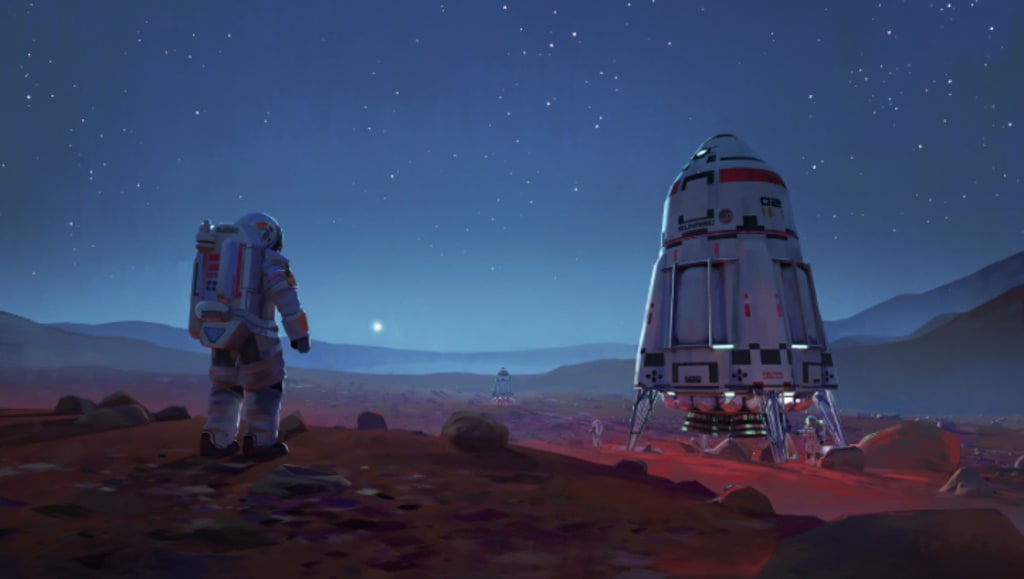
Once upon a time, there was a planet named Mars. For centuries, humans had been fascinated by this planet, which appeared as a small red dot in the sky. But it wasn't until the early 21st century that we finally managed to send a mission to Mars to explore the planet's surface and see if there was any evidence of life.
The mission was called the Mars Exploration Rover mission, and it was launched in 2003. The two rovers, Spirit and Opportunity, landed on opposite sides of the planet and began exploring the terrain. For years, they sent back stunning images and data that gave us a glimpse into the Martian landscape.
But it wasn't until 2020 that we finally found evidence of life on Mars. The discovery was made by a team of scientists from the United States and Europe, who had been analyzing data collected by the rovers and orbiting satellites for years.
The discovery was shocking, to say the least. The scientists found complex organic molecules, the building blocks of life, in the Martian soil. They also found evidence of microbial life, tiny organisms that were thriving in the harsh Martian environment.
The news was met with both excitement and skepticism. Many people couldn't believe that life could exist on such a barren, inhospitable planet. But the evidence was clear, and the scientific community quickly rallied around the discovery.
Over the next few years, more missions were launched to Mars to study the microbial life and try to understand how it was able to survive in such extreme conditions. The missions were conducted by a collaboration of international space agencies, including NASA, ESA, and Roscosmos.
The scientists discovered that the microbial life on Mars had adapted to the planet's harsh environment in some incredible ways. They were able to survive on a diet of minerals and rocks, extracting the nutrients they needed from the soil. They had also developed unique ways of protecting themselves from the planet's radiation, which is much higher than on Earth.
The discovery of life on Mars had a profound impact on humanity. It showed us that life could exist in places we never thought possible, and it raised new questions about the origins of life in the universe.
Over the next few decades, humans continued to study and explore Mars, building new habitats and conducting experiments to try to learn more about the planet and its inhabitants. In the year 2060, the first human mission to Mars was launched, marking a new era of exploration and discovery.
The humans who arrived on Mars were awed by the planet's beauty and strangeness. They explored the red deserts, climbed the towering mountains, and swam in the underground oceans. They met the microbial life that had been thriving on the planet for millions of years, and they marveled at the ingenuity and resilience of these tiny organisms.
Over the next century, humans continued to colonize Mars, building new cities and infrastructure to support a growing population. They worked alongside the microbial life, studying it and learning from it, and they began to develop new technologies and scientific theories that would change the course of human history.
As the years went by, Mars became a second home for humanity, a place where people could live and thrive in harmony with the planet's unique environment. And as they looked up at the night sky, they knew that they were not alone in the universe, that there were other worlds waiting to be explored and other mysteries waiting to be solved.
And so, the story of life on Mars continued, a never-ending adventure of discovery and exploration that would inspire generations to come.
About the Creator
Enjoyed the story? Support the Creator.
Subscribe for free to receive all their stories in your feed.
Comments
There are no comments for this story
Be the first to respond and start the conversation.