Latest Stories
Most recently published stories in Earth.
Top 50 Must-Visit Destinations in Europe: A Journey Through History, Culture, and Natural Beauty
Seven of the top ten most visited countries are European, thanks to the continent's rich cultural heritage, historical landmarks, safety, and efficient infrastructure. Embark on a journey through the top 50 destinations that showcase Europe's diverse allure.
By Sharmin Smrityabout a year ago in Earth
The Sanda Lizard: Ecology, Culture, and Conservation in South Asia
The Sanda Lizard: Ecology, Culture, and Conservation in South Asia The sanda lizard, scientifically known as Saara hardwickii or Hardwicke’s spiny-tailed lizard, is a remarkable herbivorous reptile native to the arid landscapes of South Asia, particularly the Thar Desert, Kutch, and parts of Pakistan’s Sindh region. Locally called "sanda" or "sandho" in Bangladesh, India, and Pakistan, this burrow-dwelling creature has captured attention not only for its unique biology but also for its cultural, culinary, and medicinal significance. In recent years, the sanda has surged into the spotlight in Bangladesh due to viral social media trends, with memes and videos highlighting its consumption, particularly among expatriate workers in the Middle East. However, the species faces significant threats from poaching, illegal trade, and habitat loss, exacerbated by modernization and agricultural expansion. This article delves into the sanda lizard’s ecology, its role in South Asian culture, its consumption and trade dynamics, conservation challenges, and the broader regional context, including the impact of the India-Pakistan ceasefire of May 10, 2025, on trade routes that affect sanda-related markets.
By MD EMRUL KAYESabout a year ago in Earth
How Tornadoes Reflect Nature’s Power and Our Preparedness. AI-Generated.
Tornadoes are among the most dramatic and dangerous natural events on Earth. These powerful rotating columns of air can destroy buildings, flip cars, and uproot trees in a matter of seconds. But beyond the physical destruction, tornadoes also reflect something deeper: the immense power of nature and how human beings prepare, respond, and adapt in the face of that power.
By Mr Rifat Ahmedabout a year ago in Earth
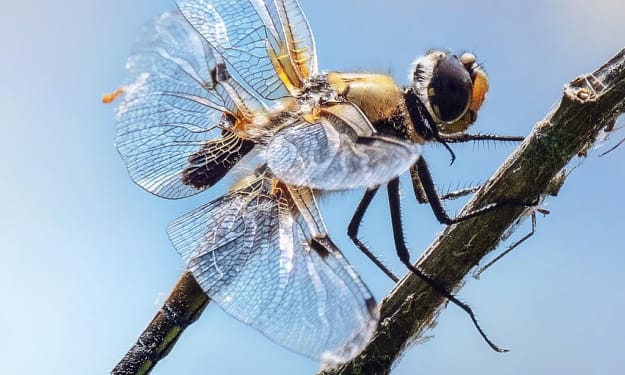
Dragonfly: The Ancient Aviator of the Skies
Introduction The dragonfly, a shimmering symbol of transformation and agility, is not just an insect — it is a marvel of evolution, a predator of precision, and a creature of deep cultural significance. Found across almost every continent, dragonflies have fascinated humanity for millennia. From their prehistoric lineage to their mesmerizing flight mechanics, the story of the dragonfly is as complex and fascinating as the creature itself. --- 1. Evolutionary History: Living Fossils of the Insect World Dragonflies are some of the oldest flying insects on Earth. Their ancestors date back over 300 million years, long before the age of dinosaurs. Fossil records show that ancient dragonflies like Meganeura had wingspans of up to 28 inches, dwarfing their modern descendants. Belonging to the order Odonata, which also includes damselflies, dragonflies are further classified under the suborder Anisoptera. Their primitive features — such as fixed-wing structures and aquatic larvae — highlight their ancient evolutionary roots. --- 2. Anatomy and Physiology: Designed for Speed and Agility Dragonflies are built for flight dominance. With two pairs of independently moving wings, they can hover, glide, fly backward, and even make sharp turns at high speeds. Their flight capabilities have inspired engineers and roboticists studying micro aerial vehicles. Key anatomical features include: Compound eyes: Each eye contains up to 30,000 ommatidia, giving them nearly 360-degree vision. They can detect polarized light and even colors in the ultraviolet range. Thorax: Strong muscles in the thorax control wing movement independently. Abdomen: Long and slender, it balances the dragonfly during flight and aids in mating. Legs: While not used for walking, the six spiny legs are perfect for catching prey mid-air. Dragonflies are ectothermic, relying on environmental heat. Some species, like Pantala flavescens, use a technique called wing-whirring to warm up their flight muscles before takeoff. --- 3. Lifecycle: From Aquatic Predator to Aerial Hunter Dragonflies undergo incomplete metamorphosis, passing through three stages: egg, nymph (larva), and adult. Eggs: Laid in or near water, dragonfly eggs hatch in a few days to several weeks, depending on species and climate. Nymph: This aquatic stage can last from months to several years. Dragonfly nymphs are voracious predators, feeding on mosquito larvae, tadpoles, and even small fish. They use a hinged, extendable lower jaw to snatch prey. Emergence: After molting multiple times, the nymph climbs out of the water and undergoes its final transformation. The adult dragonfly emerges, pumping fluid into its wings to expand them. Most adult dragonflies live only a few weeks to a few months, during which their primary focus is reproduction. --- 4. Behavior and Ecology: Masters of the Air and Water Dragonflies are apex insect predators in both their larval and adult stages. They exhibit complex behaviors such as: Territoriality: Males are highly territorial and often engage in aerial battles to defend prime mating spots near water. Mating: Their unique "wheel position" during mating is iconic. Males use claspers at the end of their abdomen to grip the female behind the head, while the female bends her abdomen forward to collect sperm. Oviposition: Females lay eggs in water or on aquatic plants. Some species dip their abdomens repeatedly into the water to release eggs. Dragonflies help maintain ecological balance by feeding on pests like mosquitoes, flies, and midges. They are sensitive to pollution and serve as bioindicators of water quality. --- 5. Diversity: Over 5,000 Species Worldwide There are more than 5,000 known species of dragonflies, with incredible diversity in size, color, and behavior. Some notable families include: Libellulidae (Skimmers): The largest family, found in a wide range of habitats. Aeshnidae (Darners): Large, strong fliers with distinctive stripes. Gomphidae (Clubtails): Named for their swollen tail segments. Corduliidae (Emeralds): Often metallic green or blue. Tropical regions like Southeast Asia, South America, and Africa are hotspots for dragonfly biodiversity. --- 6. Dragonflies in Culture and Symbolism Dragonflies carry deep symbolic meaning across cultures: Japan: Considered symbols of strength, courage, and happiness. Samurai used them in armor and art. Native American traditions: Associated with swiftness and change. Europe: Once linked with superstition and danger (e.g., "Devil’s darning needle"), modern views are more positive. China: Symbols of harmony, prosperity, and the arrival of summer. In modern symbolism, the dragonfly is often seen as a sign of transformation, adaptability, and self-realization. --- 7. Conservation Status: Threats and Protection Despite their ancient success, dragonflies are under threat due to: Habitat destruction: Wetland drainage, deforestation, and urbanization. Pollution: Pesticides and water contamination harm larval stages. Climate change: Alters migration patterns and breeding cycles. Organizations like the IUCN monitor dragonfly populations. Wetland preservation and clean water initiatives are crucial to protecting them. Some species, such as the Hine's emerald dragonfly (Somatochlora hineana), are listed as endangered. --- 8. Dragonflies and Science: Bioinspiration and Research Dragonflies have become a focal point in scientific research due to their unique features: Aviation and robotics: Their flight mechanics inspire biomimetic drones and micro air vehicles. Neuroscience: Studies of their vision and motion detection contribute to understanding sensory processing. Pest control: Research continues into using dragonflies for natural mosquito population management. Additionally, dragonflies are used in citizen science projects where communities help monitor local species. --- 9. Fun Facts About Dragonflies A dragonfly can fly up to 35 miles per hour, making it one of the fastest insects. Pantala flavescens is the most widespread dragonfly, known for transoceanic migrations over thousands of kilometers. Dragonflies can eat their own body weight in insects every 30 minutes. Their wings beat independently, allowing them to perform aerial feats no helicopter can mimic. --- Conclusion: The Living Jewel of the Natural World Dragonflies are more than just beautiful insects gliding over ponds — they are ancient survivors, ecological warriors, and icons of transformation. In a rapidly changing world, protecting dragonflies means protecting the delicate ecosystems they inhabit. Observing a dragonfly is like glimpsing nature’s artistry and engineering at its finest — a reminder that even the smallest creatures have the power to inspire awe and curiosity.
By Ikram Ullahabout a year ago in Earth
North America's 'Broken Heart': The Billion-Year-Old Scar from When the Continent Nearly Ripped Apart. AI-Generated.
North America's 'Broken Heart': The Billion-Year-Old Scar from When the Continent Nearly Ripped Apart Deep beneath the surface of North America lies a hidden geological wound—an ancient scar etched into the very foundation of the continent. Known as the Midcontinent Rift, this billion-year-old feature is a reminder of a dramatic episode in Earth’s history when North America almost split into two separate landmasses. Often called the "broken heart" of the continent, this rift tells a story of powerful tectonic forces, volcanic upheaval, and a near miss that could have rewritten the map of the world as we know it.
By Adnan Rasheedabout a year ago in Earth
The resurrection of the Dire Wolf
The Dire Wolf, an ancient animal popularized from the world famous novel and film series, Game of Thrones. In the world of fantasy they are known for being loyal to their owners, willing to do anything, even die for them within seconds, both in fantasy and in reality, the Dire Wolf is a regal animal.
By Breanna Fergusonabout a year ago in Earth
Buying and Selling Salvage and Used Vehicles in Sharjah: A Complete Guide
Dubai, one of the most vibrant and rapidly growing cities in the UAE, offers a wide array of opportunities for both locals and expatriates to buy and sell vehicles. Whether you're a car enthusiast or simply looking for a good deal, buying and selling Salvage and Used Vehicles in Sharjah has become a popular option for many. This growing market caters to various needs, from those seeking a second-hand vehicle to those searching for salvage cars to rebuild and repurpose. In this guide, we will explore how you can take advantage of the market in Sharjah and Dubai, as well as the benefits of participating in Online Dubai Car Auction and discovering the Best Auction Cars in Dubai.
By Al Qaryah Auctionsabout a year ago in Earth