Latest Stories
Most recently published stories in Earth.
Guardians of Compassion: Strengthening Animal Welfare Laws for a Kinder World. AI-Generated.
Animal welfare laws stand as a testament to humanity’s evolving commitment to compassion, ensuring animals are treated with dignity and respect. Across the globe, legislation like India’s Prevention of Cruelty to Animals Act (PCA) and the U.S. Animal Welfare Act (AWA) sets standards to prevent cruelty and promote ethical treatment. Yet, enforcement gaps and societal attitudes challenge their impact. By understanding responsibilities under these laws and embracing recent advancements, we can forge a future where animals thrive. Let’s delve into the challenges, impacts, and transformative solutions shaping animal protection worldwide.
By Arjun. S. Gaikwadabout a year ago in Earth
Asia’s Agricultural Awakening: Powering Food Security for 4.7 Billion. AI-Generated.
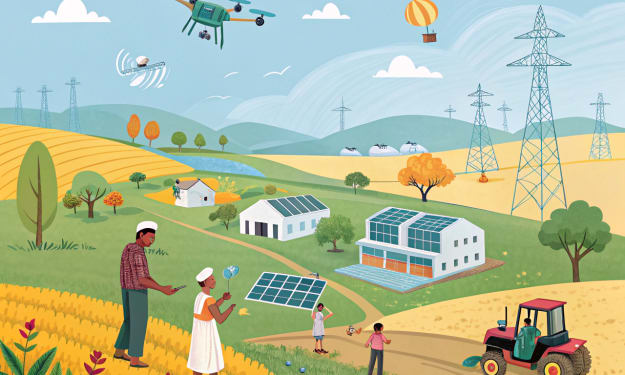
Asia, home to 60% of the world’s population, is the epicenter of global agriculture, producing 50% of the world’s food on 40% of its arable land. From India’s rice paddies to China’s high-tech farms, agriculture drives economies, employing 700 million people and contributing 10% to regional GDP. Yet, climate change, resource scarcity, and urbanization threaten this vital sector. Through innovation, policy reforms, and sustainable practices, Asia is redefining its agricultural future. Let’s explore the challenges, impacts, and transformative solutions shaping this dynamic region.
By Arjun. S. Gaikwadabout a year ago in Earth
South Korea’s Agricultural Leap: Innovating for Food Security and Sustainability. AI-Generated.
South Korea’s agriculture, a vital pillar supporting 51 million people, blends tradition with cutting-edge innovation on just 1.6 million hectares of arable land. Contributing 2% to GDP and employing 1.2 million workers, the sector faces pressures from climate change, an aging workforce, and import reliance. Yet, through smart farming, policy reforms, and sustainable practices, South Korea is redefining its agricultural future. Let’s explore the challenges, impacts, and transformative solutions driving this dynamic evolution.
By Arjun. S. Gaikwadabout a year ago in Earth
Japan’s Agricultural Evolution: Blending Tradition with Innovation for a Sustainable Future. AI-Generated.
Japan’s agriculture, a harmonious blend of ancient traditions and cutting-edge innovation, sustains a nation of 125 million on just 4.4 million hectares of arable land. Contributing 1.2% to GDP and employing 3.4 million people, it faces unique challenges like an aging workforce and climate pressures. Yet, Japan is pioneering a high-tech, sustainable agricultural model that balances heritage with progress. Let’s explore the challenges, impacts, and transformative solutions shaping Japan’s agricultural renaissance.
By Arjun. S. Gaikwadabout a year ago in Earth
China’s Agricultural Revolution: Feeding a Nation, Sustaining the Future. AI-Generated.
China, the world’s largest agricultural producer, feeds 20% of the global population on just 7% of its arable land. Contributing 7% to GDP and employing 170 million people, agriculture is a cornerstone of the nation’s economy. Yet, climate change, resource constraints, and rural-urban disparities pose significant challenges. Through cutting-edge technology, robust policies, and sustainable practices, China is transforming its agricultural landscape. Let’s explore the challenges, impacts, and visionary solutions driving this powerhouse forward.
By Arjun. S. Gaikwadabout a year ago in Earth
India’s Agricultural Renaissance: Cultivating a Sustainable Future for 1.4 Billion. AI-Generated.
India, the world’s second-largest agricultural producer, feeds 1.4 billion people while shaping global food systems. Contributing 18% to GDP and employing 44% of the workforce, agriculture is the nation’s backbone. Yet, climate change, resource constraints, and systemic inefficiencies threaten its potential. Through cutting-edge technology, policy reforms, and sustainable practices, India is poised for an agricultural revolution. Let’s explore the challenges, impacts, and transformative solutions driving this vital sector forward.
By Arjun. S. Gaikwadabout a year ago in Earth
The Future of Agriculture: Feeding the World Through Innovation and Sustainability. AI-Generated.
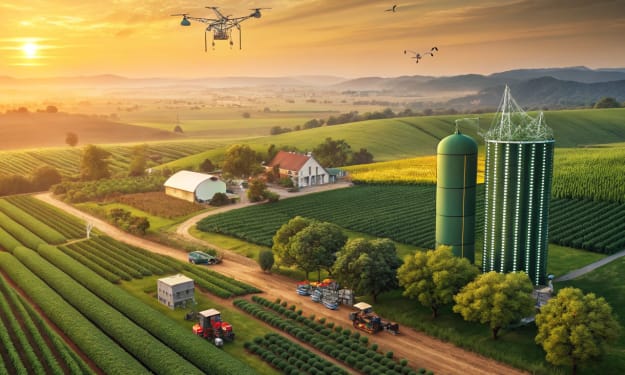
Agriculture, the backbone of human civilization, faces unprecedented challenges in feeding a global population projected to reach 9.7 billion by 2050. As climate change, resource scarcity, and urbanization reshape the landscape, innovative solutions and sustainable practices are transforming the sector. From precision farming to regenerative techniques, agriculture is poised for a revolution. Let’s explore the challenges, impacts, and visionary strategies driving the future of global food production.
By Arjun. S. Gaikwadabout a year ago in Earth
The Healing Power of Nature: Why the Earth Still Holds the Medicine We Need
When Did You Last Touch the Earth? Not walk on it—but really connect with it. When was the last time you sat under a tree and let the wind whisper into your thoughts? When did you last feel sun on your skin—not as a backdrop for a selfie, but as a source of warmth, life, and presence? Most of us live detached from the natural world that once nurtured every part of our being. And yet, the Earth waits. It doesn’t judge our rush. It doesn’t criticize our chaos. It simply offers—beauty, balance, and healing. --- We Were Not Meant to Live This Fast Modern life is noisy, digital, and demanding. We live by deadlines, phone notifications, and traffic lights. We’ve replaced soil with concrete, starlight with screens. And somewhere in all this progress, we’ve forgotten something ancient: We are nature. We come from it. We belong to it. And we need it. More than ever. --- Nature Doesn’t Just Relax You—It Heals You Science is finally catching up with what Indigenous cultures and ancient wisdom have always known: the Earth is medicine. Here’s how spending time in nature can transform your mental, emotional, and physical well-being: --- 1. Nature Lowers Stress and Anxiety Studies show that just 20 minutes in nature can reduce cortisol levels (your body’s stress hormone). Forest walks have been linked to lowered heart rates, reduced anxiety, and calmer moods. It's called “forest bathing” in Japan—Shinrin-yoku—and it’s a legitimate therapy. No screens. No noise. Just trees. It works. --- 2. It Boosts Your Mood (Naturally) Natural light triggers serotonin production, a chemical that stabilizes mood and brings feelings of well-being. Ever notice how even a short walk on a sunny day can shift your whole vibe? That’s not random. That’s biology. --- 3. It Strengthens Your Immune System Exposure to trees and plants increases natural killer (NK) cells—key players in fighting viruses and even some forms of cancer. Nature literally makes you stronger. --- 4. It Grounds You (Literally and Spiritually) “Grounding” or “earthing”—walking barefoot on natural ground—helps regulate your nervous system. It reduces inflammation, improves sleep, and brings you back to the present moment. Feeling anxious? Take your shoes off. Stand on the earth. It’s ancient therapy—and it’s free. --- The Earth Teaches Us Everything We Forgot Nature isn’t just relaxing—it’s wise. It holds sacred lessons that modern life rushes past: Trees teach patience. They grow slow, tall, strong, and rooted. Seasons teach change. Nothing blooms forever—and that’s okay. Rivers teach surrender. They flow, they adapt, they don’t resist. Everything in nature moves with purpose but without panic. Imagine living like that. --- Reconnecting with the Earth Doesn’t Require a Plane Ticket You don’t need a remote cabin or a week-long retreat to reconnect with nature. Start simple: Step outside and watch the sunrise in silence Touch leaves. Smell flowers. Notice clouds Journal under a tree Plant herbs in your kitchen Watch birds instead of scrolling Walk at sunset and feel the wind Nature is always around you—even in cities. Even in small moments. You just have to notice. --- Nature as a Mirror Sometimes, we look to the world for answers—and find them in a single moment outside. The way a tree survives winter reminds you: You’ll get through this too. The ocean’s rhythm reminds you: You’re allowed to be soft and powerful. The sunset reminds you: Endings can be beautiful. Nature doesn’t speak our language, but it communicates. Deeply. Soulfully. --- We Protect What We Love Reconnecting with nature also reignites a sense of responsibility. When you touch the Earth, you remember it’s alive. When you feel its peace, you want to protect it. Sustainability isn’t a trend—it’s a relationship. One where you give back to the source that gives you everything. Recycle. Plant trees. Reduce waste. Walk instead of drive. Not because you “should”—but because you care. --- Final Thought: The Earth Still Wants You Back No matter how long you’ve been gone, nature doesn’t hold it against you. You can always return. To the trail. The field. The forest. The sky. To the deeper part of yourself that still remembers what stillness feels like. Nature is waiting—not to be admired, but to be felt. Let the wind tangle your thoughts. Let the rain cleanse what you’re holding. Let the ground remind you: you are not separate from life—you are life. So go outside. Not to escape your life, but to remember it. --- Word Count: ~950 Best Vocal Communities: Earth, Lonely, Motivation, Mindfulness, Humans Suggested Tags (for SEO): nature healing, forest bathing, grounding, reconnecting with nature, mental health, mindfulness, eco therapy, nature and wellness, self-care, earth medicine, sustainable living
By GoldenToneabout a year ago in Earth
What's not to Love about Nasturtiums.
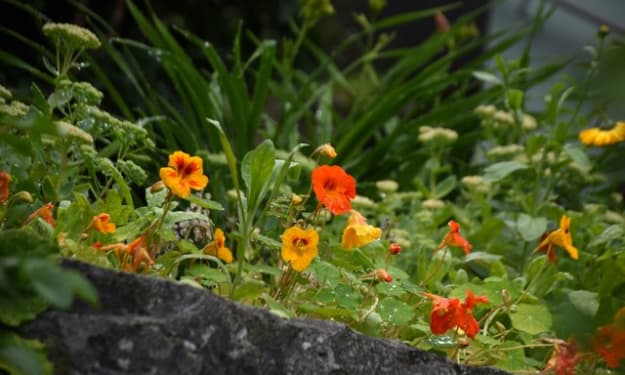
I know some people have a bit of a "love / hate" relationship with this plant, but ever since I discovered that the combination of a nasturtium leaf and a little bit of water could create diamonds... I was in love! Yes, they can indeed be a messy plant, straggly even - when left unattended for too long... especially considering their somewhat "invasive" nature.
By Feral La Femmeabout a year ago in Earth