Latest Stories
Most recently published stories in Earth.
Western Ghats in tamilnadu Nilgiri side
The section of the Western Ghats in Tamil Nadu known as Nilgiri Malai The Nilgiri Malai is a section of the Western Ghats that runs through Tamil Nadu. This region is home to a large number of plant and animal species, as well as some of the oldest rocks in India. The Nilgiri Malai is also a popular tourist destination for its scenic views and hiking trails.
By Devendiran Balraj4 years ago in Earth
NASA's Moon Construction Project Olympus
BIG has partnered with SEArch+ (Space Exploration Architecture) and ICON, a developer of cutting-edge construction technologies, to imagine the place where humans will call home on an alien planet. The collaboration with NASA aims to develop a "space-based construction system that could support future exploration of the Moon." According to the project's website, "Project Olympus is a sustainable lunar habitat that will be the first human foray into extraterrestrial building with robust structures that provide better thermal, radiation, and micrometeorite protection than metal or inflatable habitats can offer."
By Waqas Hussain4 years ago in Earth
Scientific implications of ethical decisions
The Quran is considered to be the most authoritative source of Islamic ethics and morality. Its teachings are not only confined to moral and spiritual issues but also encompass a wide range of scientific and ethical issues. Scientific implications of ethical decisions in the Quran play a crucial role in shaping the worldview of Muslims and influencing their daily life practices. One of the key scientific implications of ethical decisions in the Quran is related to the concept of environmental responsibility. The Quran emphasizes the importance of preserving the balance of nature and taking care of the environment. It instructs Muslims to not waste resources, to be mindful of their actions and to take steps to preserve the environment. This can be seen in verses such as “And the earth, We have spread it out and set therein firmly set mountains and caused to grow therein [something] of every beautiful kind” (Quran, Surah Al-Kahf, 18:47). The verse highlights the idea that the earth is a gift from God and it is our responsibility to take care of it. Another scientific implication of ethical decisions in the Quran is related to the concept of animal welfare. The Quran instructs Muslims to be kind to animals and to treat them humanely. This can be seen in verses such as “And there is not a creature on [or within] the earth or bird that flies with its wings except [that they are] communities like you.” (Quran, Surah Al-An'am, 6:38). The verse highlights the idea that animals are also part of the community and should be treated with respect and kindness. In the area of medicine, the Quran instructs Muslims to take care of their health and seek medical treatment when necessary. It also instructs them to be mindful of their actions and avoid actions that could lead to disease or harm. This can be seen in verses such as “And do not kill yourselves [or one another]. Indeed, Allah is to you ever Merciful” (Quran, Surah An-Nisa, 4:29). The verse highlights the idea that taking care of one's health and avoiding actions that could lead to harm is an important part of being a responsible Muslim. The Quran also has ethical implications related to the field of genetics and biotechnology. The Quran instructs Muslims to be mindful of their actions and to avoid actions that could lead to harm or ethical violations. This can be seen in verses such as “And Allah has made for you from yourselves mates and has made for you from your mates children and grandchildren and provided for you from the good things. And [yet], they [sometimes] attribute to Allah partners while they themselves have created something similar to Him.” (Quran, Surah Al-Nahl, 16:72). The verse highlights the idea that humans should be mindful of their actions and avoid actions that could lead to harm or ethical violations. In the field of psychology, the Quran provides guidance on mental health and the importance of maintaining a positive outlook on life. It instructs Muslims to avoid negative thoughts and actions that could lead to depression and anxiety. This can be seen in verses such as “So do not weaken and do not grieve, and you will be superior if you are [true] believers.” (Quran, Surah Ali 'Imran, 3:139). The verse highlights the idea that maintaining a positive outlook on life and avoiding negative thoughts and actions is an important part of being a responsible Muslim. The Quran also has implications for the field of economics. It instructs Muslims to be responsible in their financial dealings and to avoid actions that could lead to harm or ethical violations.
By Islamic Insight 4 years ago in Earth
The Explosive Power of Five of the Most Dangerous Volcanoes on Earth
Volcanoes are some of the most powerful and destructive natural phenomena on Earth. They can cause widespread destruction and devastation, and at times, can even be deadly. Despite their destructive power, volcanoes can also be beneficial, providing resources such as geothermal energy, valuable minerals, and fertile soil.
By Shivam Rajput4 years ago in Earth
Secrets Of Snakes
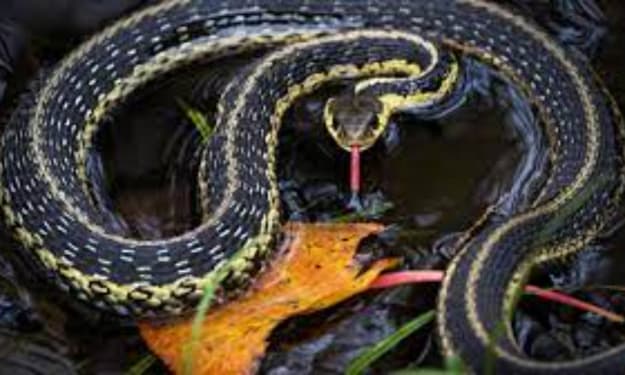
Snakes are one of the most intriguing and mysterious creatures in the animal kingdom. Despite their reputation for being dangerous and frightening, there is much to be learned about these fascinating creatures. From their unique adaptations to their remarkable hunting skills, snakes have many secrets that have yet to be discovered. In this article, we will explore some of the secrets of snakes and try to shed light on some of the misconceptions surrounding these incredible creatures.
By Dhinesh kumar.P4 years ago in Earth
What is the Future of Earth?
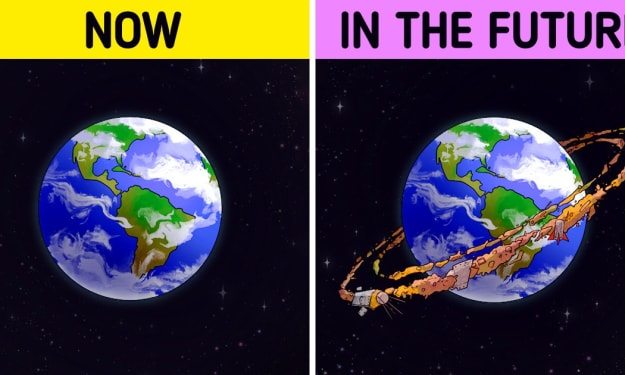
Earth is the third planet from the Sun and the only astronomical object known to harbor life. According to radiometric dating and other sources of evidence, Earth formed over 4.5 billion years ago. Earth's gravity interacts with other objects in space, especially the Sun and the Moon, Earth's only natural satellite. Earth revolves around the Sun in 365.26 days, a period known as an Earth year. During this time, Earth rotates about its axis about 366.26 times.
By vanshika 1114 years ago in Earth
India
India is a country located in South Asia, bordered by Pakistan to the west, China and Nepal to the north, Bhutan to the northeast, and Bangladesh and Myanmar to the east. It is the seventh largest country in the world by area, with a population of over 1.3 billion people, making it the second most populous country in the world.
By Kumara Swamy4 years ago in Earth