Latest Stories
Most recently published stories in Earth.
Time to Spring Forward: What to Know About Daylight Saving Time in NC
As we approach the resulting Sunday in March, this moment is the best opportunity to start thinking about Daylight Saving Time (DST) in North Carolina. On March 14th, we will "spring forward" and move our clocks forward by one hour, losing an hour of sleep but gaining an extra hour of daylight in the evenings. This is the thing you really want to be familiar with DST in North Carolina: DST is seen in many states in the US, including North Carolina. The act of DST was first presented quite a while during The Second Great War to moderate energy and has been set up in some structure from that point forward.
By Paulraj Manickam Ashari4 years ago in Earth
Ice Ages: The Frozen Earth's Ancient Past and Future
Introduction Ice ages, also known as glacial periods, are long periods of time in Earth's history when global temperatures decrease significantly, leading to the expansion of continental ice sheets and glaciers. These periods are characterized by colder temperatures, lower sea levels, and the emergence of vast ice sheets over large areas of the planet. The most recent ice age occurred approximately 2.6 million years ago, and lasted until about 11,700 years ago. During this time, the Earth experienced a series of glacial and interglacial periods, in which glaciers advanced and retreated across the globe. In this article, we will explore the causes and effects of ice ages, as well as their impact on the Earth's climate, geography, and ecosystems.
By Keerthana Thirumalairaj4 years ago in Earth
Exploring the Earth's Shifting Landscapes
Introduction Continental drift is a theory that describes the movement of continents across the Earth's surface. The theory suggests that the continents were once joined together in a supercontinent called Pangaea, and over millions of years, they slowly drifted apart to their current positions. This theory was proposed by the German scientist Alfred Wegener in 1912 and was later supported by scientific evidence.
By Keerthana Thirumalairaj4 years ago in Earth
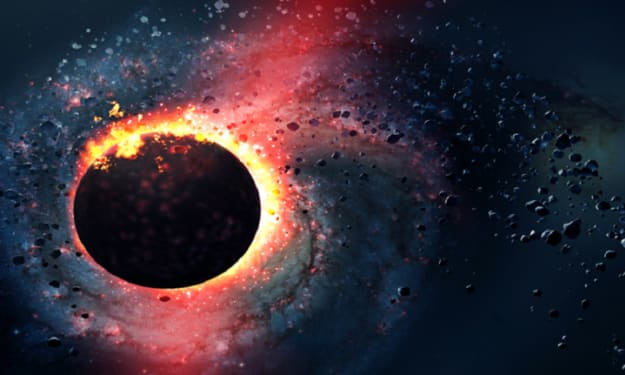
What if the universe started with a dark big bang?
In the standard cosmological picture, the early universe was a very strange place. Perhaps the most important thing that happened in our universe was the inflation event, which sent the universe very early after the Big Bang into a period of extremely rapid expansion.
By News Correct4 years ago in Earth
The Fascinating Evolution of Life on Earth
Introduction The evolution of life on Earth is a complex and fascinating topic that has captivated the imagination of scientists and non-scientists alike for centuries. The story of how life arose and diversified on our planet over billions of years is one of the greatest mysteries of all time, and it has been the subject of much scientific research and debate.
By Keerthana Thirumalairaj4 years ago in Earth
God Comes to Earth And Kills 8 Billion People in an Instant Except For a Small Part of Europe
In the near future in the city of Moscow, Oleg and Alyona are having a date, during which Oleg explains he's a soldier on a two-week break. The date goes great, and the two of them end up spending the night together. Meanwhile in Paris, a plane is about to land when suddenly all its lights go out and everyone aboard loses consciousness. Soon this loss of power spreads around the world, only leaving a small section of Eastern Europe with light.
By Mubeshir Mehmood4 years ago in Earth
The Formation and Evolution of Earth: From the Big Bang to Life Emergence
Introduction The formation of the Earth is a complex process that occurred over billions of years. Understanding how our planet came into existence requires a deep understanding of the early universe and the processes that led to the formation of our solar system.
By Keerthana Thirumalairaj4 years ago in Earth
Understanding Plate Tectonics
Introduction: Plate tectonics is the scientific theory that explains the structure and movement of the Earth's lithosphere, which is composed of large, rigid plates that float on the underlying, more ductile mantle. It is a unifying concept that explains a variety of geological phenomena, including the distribution of volcanoes and earthquakes, the formation of mountain ranges and ocean basins, and the evolution of the Earth's climate and biota.
By Keerthana Thirumalairaj4 years ago in Earth