Latest Stories
Most recently published stories in Earth.
How Thomas Midgley Jr.'s inventions almost ended life on Earth
I revisited a dark chapter in the history of humanity and remembered how the greed of one man almost destroyed the planet. A recent discussion with John Pearce, editor of ECO (news and views on environmental issues, politics, society, technology, and the wider world) reminded me of this individual; one who managed to destroy the ozone layer single handed, amongst other things. Do you think I’m being too harsh? Not really. Facts are facts.
By Susan Fourtané about a year ago in Earth
Did you know ... jellyfish are not fish?
One of my favourite marine creatures, jellyfish are hypnotic, mysterious, fascinating. Long time ago, I went to Sea Life specifically because they were having a new jellyfish exhibition which promised an out-of-this-world experience. It didn’t disappoint.
By Susan Fourtané about a year ago in Earth
🌊 Is a Mega Disaster Looming Over Pacific Nations?
🔴 A Powerful Earthquake Hits Russia – Magnitude 8.8 On July 30, 2025, the world witnessed a massive natural disaster when a magnitude 8.8 earthquake struck near the Kamchatka Peninsula in far-eastern Russia. The quake, which occurred in one of the most seismically active zones on earth—the Ring of Fire—sent tsunami alerts across the Pacific Ocean. Although the main impact was felt in Russia, the tremors and potential tsunami waves created panic in Japan, South Korea, the U.S. West Coast, Hawaii, Canada, China, and even parts of Latin America. Authorities in Japan quickly evacuated over 2 million people from coastal regions, fearing a disaster similar to the 2011 Fukushima earthquake and tsunami, which had caused a nuclear crisis. While tsunami waves were recorded in several regions, ranging from 4 to 8 feet, the worst-case scenario was avoided thanks to advanced early warning systems and timely evacuations. However, the quake’s intensity and reach serve as a reminder that the Pacific Basin remains a fragile zone where the earth's crust constantly shifts. 🐟 The Mysterious Oarfish Sightings — Harbingers of Doom? Soon after the Russian quake, social media lit up with videos and news reports of giant oarfish being seen near the shores of Japan, the Philippines, and even Mexico. These rare deep-sea creatures, which can grow up to 10 meters in length, have long been associated with ancient Japanese legends as “messengers of the sea god.” In February 2025, an oarfish was spotted near Baja California, Mexico—just months before the Russian earthquake. Similarly, oarfish were seen in early 2011, just before the devastating Japan earthquake and tsunami in March of that year. This has fueled public speculation that these fish can sense deep-sea seismic activity and rise to the surface in response. But what does science say? According to marine biologists and geological experts, there is no proven connection between oarfish behavior and earthquake prediction. Most scientists agree that these fish may rise to the surface due to sickness, changing ocean temperatures, or pollution—not to warn humanity of a coming disaster. Yet, the timing of these appearances is hard to ignore for many people around the world, especially in earthquake-prone areas. 📖 A Prophecy from 1999 – Was it Fulfilled? The story gets even more chilling when we recall a prophetic vision by a Japanese manga artist, Ryo Tatsuki, who published her predictions in 1999. One of her most alarming prophecies said that “on July 5, 2025, a mega disaster will hit Japan, boiling the sea.” When July 5 passed without any major event, many dismissed the prophecy. But just a few weeks later, on July 30, the massive earthquake struck Russia, shaking the Pacific basin and triggering tsunami alerts across Japan. Many are now linking her vision to this recent disaster, suggesting she may have foreseen the event two decades in advance. It’s not the first time that Tatsuki’s predictions have caught attention. Some of her past forecasts—like economic crises and natural disasters—have reportedly aligned with real-world events. However, scientific communities remain cautious and do not support the use of prophecies in disaster preparedness. Still, to ordinary people, such coincidences raise eyebrows and add to the fear surrounding natural events. 🐋 Whales Surfacing in Japan – Another Sign? Adding to the mystery, residents of coastal Japan have reported whales and other marine life appearing unusually close to shore. In Japanese culture, such unusual behavior is often interpreted as a natural signal of unrest under the sea. Some researchers have proposed that low-frequency vibrations caused by tectonic stress may disturb whales and other marine animals, forcing them to move or beach themselves. While the scientific link remains under investigation, historical data does show whale beachings have occurred days or weeks before major seismic events in some cases.
By Ikram Ullahabout a year ago in Earth
"I Am Green"
Not just in color, but in soul, in spirit, in the quiet rhythm that moves with the wind. I am the fresh breath of morning dew clinging to the grass. I am the shade that rests upon weary travelers when the sun burns too bright. I am the promise of renewal, the gentle reminder that life can begin again—always.
By Hanif Ullah about a year ago in Earth
“The Glacier That Screamed: What I Heard Before the Collapse Changed Everything”
Echoes Beneath the Glacier Maria had heard the glacier before she saw it. Long before her boots creaked on the icy moraine, she sensed the glacier’s groan—a deep, resonant sound like an animal’s slow breath, echoing up through her hiking pole into her bones. It had drawn her here from thousands of miles away, chasing the sound of ice shifting, of time slipping away beneath her feet.
By @HiddenHistoryabout a year ago in Earth
Upper Mustang Trek
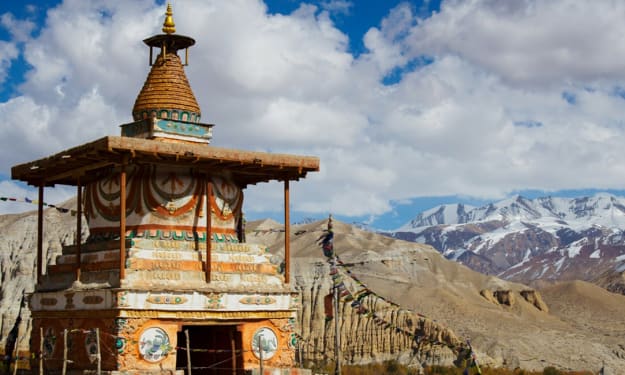
Upper Mustang Trek Upper Mustang is a unique part of Nepal that feels like stepping into another world. It is hidden behind the tall mountains of Annapurna and Dhaulagiri. It was once a restricted area but it still holds strong Tibetan traditions, old monasteries, and a dry desert like landscape that is very different from the rest of the country.
By Nepal Hiking Trekabout a year ago in Earth
The Beautiful Girl and the Owl
In a quiet village surrounded by ancient woods and silver rivers, lived a girl named Elara. She was known for her kindness, her laughter that rang like wind chimes, and her beauty that seemed to glow softly from within. But what made Elara truly special wasn’t how she looked—it was how she saw. While others hurried past wildflowers and night skies, Elara paused to listen to the wind, to admire the dance of shadows, to notice the small magic in everyday life.
By Muhammmad Zain Ul Hassanabout a year ago in Earth
Environmentally Friendly Power: The Eventual Anergy of Manageability
Presentation The World Is Going Through an Energy Change. With Environmental Change Compromising Biological Systems and Economies, the Shift Toward Sustainable Power Is More Dire Than Any Time in Recent Memory. The Consuming of Petroleum Derivatives Like Coal, Oil, and Gas Has for Some Time Been the Prevailing Wellspring of Energy, Yet This Comes at a Huge Expense — Ozone Harming Substance Outflows, Natural Corruption, and Asset Exhaustion. Sustainable Power Presents an Economical Arrangement, Offering the Possibility to Produce Spotless, Limitless, and Low-Carbon Power.
By sidharth dhawanabout a year ago in Earth
"Massive Earthquake Strikes Russia: Tsunami Fears Trigger Pacific-Wide Alerts"
🔴 On July 30, 2025, a powerful earthquake measuring 8.8 on the Richter scale struck off the eastern coast of Russia. The tremor, one of the most powerful recorded in recent decades, sent shockwaves through the region, triggering widespread alerts across the Pacific Rim, including Japan and the United States. This massive quake, classified as a megathrust earthquake, has set off alarms for a potentially deadly tsunami affecting millions. 🔵 A Tremor Felt Across Continents According to global seismic monitoring agencies, the epicenter of the earthquake was located beneath the seabed off the Kamchatka Peninsula, a region historically known for tectonic volatility. Such earthquakes occur along subduction zones, where one tectonic plate dives beneath another, releasing massive energy. Witnesses in nearby Russian towns reported violent ground shaking, toppled buildings, and power outages. Though detailed casualty reports are still pending, emergency services have already begun rescue and relief operations in the affected areas. Japan, a nation highly experienced in dealing with seismic disasters, immediately issued a tsunami warning. Coastal sirens rang out in multiple prefectures, and authorities urged residents to evacuate to higher ground. Similarly, the United States issued tsunami advisories for Hawaii, California, Oregon, Washington, and as far north as Alaska. Early wave activity was reported along the coastlines within hours. 🔵 Mass Evacuations Underway The tsunami threat has sparked urgent evacuations across several countries. More than 20 million people across Russia and Japan were moved to safer zones within the first 12 hours after the quake. In the United States, emergency management agencies coordinated with local governments to initiate preemptive evacuations in low-lying areas vulnerable to ocean surges. Coastal infrastructure, including ports and seaside industries, was temporarily shut down. Officials have warned that tsunami waves could reach heights of up to 10 meters (33 feet) in some areas, depending on the underwater topography and distance from the epicenter. While no major damage has yet been reported in the U.S., authorities emphasized the need for vigilance. “We are not out of danger yet,” said a spokesperson from NOAA’s Tsunami Warning Center. “Tsunami waves can come in multiple surges hours apart.” 🔵 Economic and Environmental Impact The economic cost of this disaster is already estimated in the billions. Early reports from Russia indicate significant damage to infrastructure, particularly in coastal towns where buildings were not designed to withstand such strong tremors. Roads, power lines, and communication systems have also been affected, hampering rescue efforts. Japan’s early-warning system and strict building codes have minimized direct damage so far, but the long-term effects on shipping, fishing industries, and power plants—especially those near the coast—could be profound. Tsunamis are notorious not only for the human cost but also for their environmental devastation. Saltwater intrusion, debris spread, and pollution can impact marine life and agricultural lands for years to come. 🔵 A Reminder of Nature’s Power This disaster serves as a powerful reminder of how vulnerable even the most developed nations are to the forces of nature. Earthquakes of such magnitude are rare, but when they do occur, they expose the fragility of modern civilization. Despite all technological advancements, no nation can fully protect itself from the shifting of the Earth’s crust. Global response agencies, including the United Nations and the International Red Cross, have pledged to provide immediate emergency assistance. Rescue teams remain on high alert as the threat of further seismic activity persists. Satellite monitoring systems are actively tracking the region for potential aftershocks and future tsunami risks. 🔵 What’s Next? As emergency services continue their operations and tsunami threats remain, authorities are urging residents to stay calm yet vigilant. Coastal communities are being warned to avoid the shoreline and strictly follow government safety protocols. More comprehensive assessments in the coming months are expected to reveal the full extent of the devastation. This tragedy once again highlights the importance of disaster preparedness at both governmental and individual levels. Whether through infrastructure upgrades, public education, or evacuation drills, proactive measures can make the difference between survival and catastrophe. As recovery efforts begin, the international community hopes for a swift and safe return to normalcy for the affected populations.
By Javed Khan about a year ago in Earth