
Journey to the Sun: Unveiling Solar Mysteries
“Probing the Cosmic Enigma: India's Aditya-L-One and NASA's Parker Solar Probe Unravel the Mysteries of the Sun"
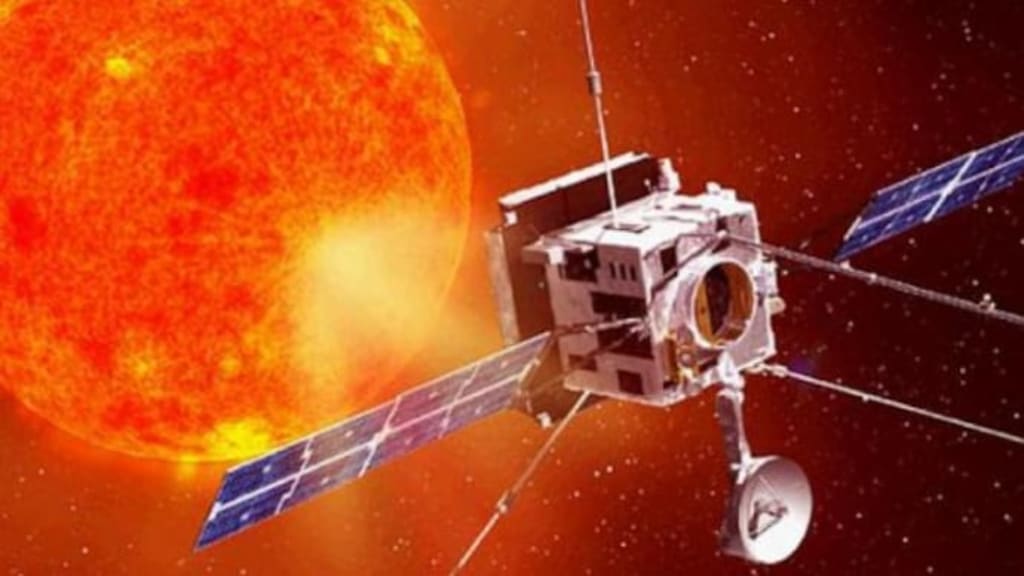
In a significant stride towards unraveling the mysteries of the universe, India embarked on a groundbreaking mission on September 2, 2023. The nation's inaugural space probe, Aditya-L-One, set forth on a remarkable odyssey destined to journey nearly one million miles to join a select group of spacecrafts stationed at LaGrange Point One. What sets this Indian mission apart is its unique approach. Aditya-L-One isn't merely a spacecraft; it's a pioneering observatory equipped to probe not one, but three fundamental questions that have long perplexed scientists.
The first enigma that Aditya-L-One aims to demystify is the nature of stars like our sun, specifically how they maintain their scorching outer layers. Secondly, scientists hope to understand the origins of the sun's potent magnetic storms, phenomena that have fascinated and bewildered researchers for decades. Lastly, this mission endeavors to shed light on how fluctuations in our star's magnetic field impact Earth's atmosphere, a puzzle integral to understanding our planet's climate and space weather.
Aditya-L-One boasts a suite of seven sophisticated instruments meticulously designed to scrutinize the sun's layers. Using electromagnetic and particle detectors, the probe will meticulously examine the sun's Corona, its outermost layer, from a secure distance of around ninety-two million miles. Researchers anticipate that the mission will yield invaluable data on the Corona's properties, unraveling the intricacies behind coronal mass ejections—massive bursts of electrons, ions, and magnetic fields that influence space weather.
Moreover, the probe will explore the sun's lower atmosphere and investigate the boundary where the atmosphere meets the star's interior. Of particular anticipation is the solar ultraviolet imaging telescope aboard Aditya-L-One, poised to capture unprecedented images of the sun's disk in near-ultraviolet light. This technology promises crucial insights into solar winds, coronal heating, and the dynamics within the sun's atmosphere, providing a clearer understanding of space weather phenomena.
Aditya-L-One's strategic orbit at LaGrange Point One is no coincidence. Positioned at this unique gravitational equilibrium point, the spacecraft can maintain its position with minimal fuel consumption, granting scientists an uninterrupted view of the sun. Scheduled to reach its orbit in mid-January, Aditya-L-One will soon start beaming back invaluable data. With around 1,440 images expected daily, scientists are eagerly awaiting the insights these images will unveil.
While India's Aditya-L-One explores the sun from a distance, NASA's Parker Solar Probe embarks on a daring mission, aiming to approach the sun closer than any spacecraft before it. Designed to endure extreme conditions, the probe's instruments are shielded by a robust 4.5-inch thick carbon composite shield, allowing it to withstand temperatures reaching 2,500 degrees Fahrenheit. Recently, in a historic achievement, Parker Solar Probe ventured into the sun's upper atmosphere, capturing samples of magnetic fields and particles. Its mission is to trace the flow of energy, study the heating of the Corona, and explore the acceleration of solar winds.
These ventures into the heart of our solar system remind us of the vastness and complexity of our universe. The sun, our seemingly distant celestial companion, governs our existence in ways both awe-inspiring and occasionally perilous. As scientists push the boundaries of knowledge, humanity edges closer to understanding the profound forces that shape our world. While the mysteries of the sun remain, these missions symbolize our relentless pursuit of knowledge, painting a brighter, enlightened future for all of humankind.
About the Creator
Enjoyed the story? Support the Creator.
Subscribe for free to receive all their stories in your feed.
Comments
There are no comments for this story
Be the first to respond and start the conversation.