
Japan's Earthquake Victims Are Begging You to Stop Sending Paper Cranes
A culture of good intentions is clogging disaster relief—and the people on the ground have had enough.
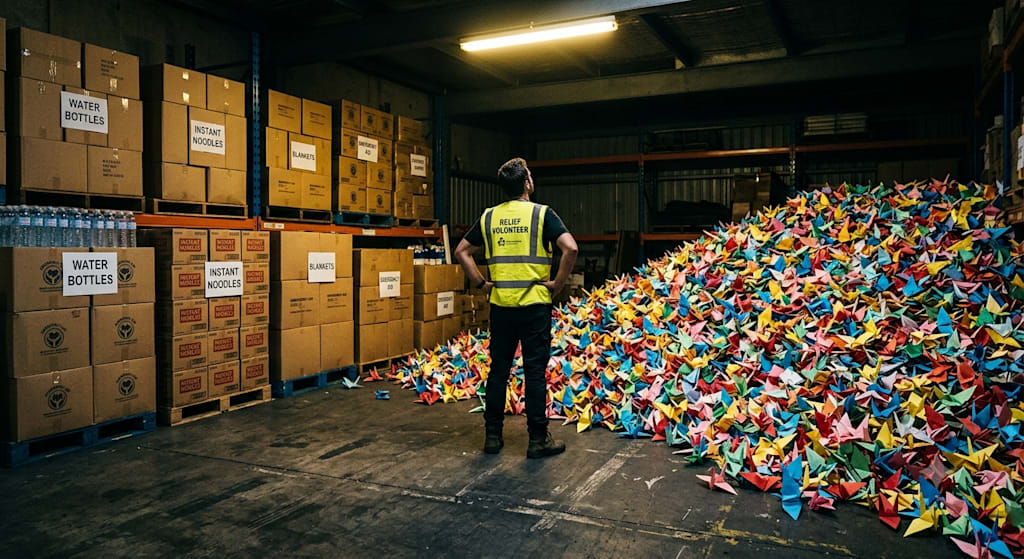
After the 7.1-magnitude earthquake in Kumamoto Prefecture claimed 38 lives, the disaster zone did not ask for more supplies. It asked, wearily, for people to stop sending paper cranes. Photographs on social media showed rows of colorful folded cranes sitting beside towering piles of relief goods. They looked wildly out of place.
This was not an isolated case. From the Noto Peninsula earthquake to the Ukraine crisis, from the rubble of Turkey to the COVID-19 pandemic, the Japanese custom of sending paper cranes to disaster areas has repeatedly sparked controversy. Affected regions and countries have politely declined them. A cultural symbol meant to carry blessings had become, in the reality of disaster relief, a "pink burden" that everyone avoided.
Fold a Thousand Times
To understand this persistence, trace the paper crane's roots in Japanese culture.
In ancient Japanese belief, the crane was a mystical bird with a thousand-year lifespan, so it came to represent longevity, good fortune, and health. The word "thousand" in Japanese does not mean exactly one thousand. It means immeasurable, countless. Stringing a thousand folded cranes together created a ritual of ultimate sincerity offered to the gods in exchange for a miracle.
Folding paper cranes in Japan is not merely a handicraft. It is a physical act of transmission. Fingers crease the paper, shape the wings, form the neck. Each fold echoes a wish. In traditional Japanese gift-giving culture, a gift's "sentiment" often outweighs its "utility." The paper crane is the extreme version of this idea. It has almost no practical use, but its very existence proves one thing: I spent time on this.
Age Twelve
The story that bound the paper crane to disaster and peace is Sadako Sasaki's.
In 1945, when the atomic bomb fell on Hiroshima, Sadako was two years old. Ten years later, she was diagnosed with leukemia. In the hospital, she heard a folk legend: fold a thousand paper cranes and you will recover. She began folding. She folded every day. The paper's sharp edges nicked her fingers, but she kept going. When she finished the first thousand and did not get better, she started another thousand. The miracle never came. At twelve, Sadako died.
Her story went into Japanese school textbooks and became a cornerstone of anti-war and peace education. At Hiroshima Peace Memorial Park, the bronze statue of Sadako holding a crane is always surrounded by folded cranes left by visitors. For the Japanese people, the paper crane had transformed. It was no longer just a private prayer. It had become a public symbol of empathy, anti-war sentiment, and reverence for life.
Japan's education system embedded this symbolism into habit. Origami is taught in manual arts and moral education classes. Schools frequently organize group folding activities. When major disasters strike, the response is almost reflexive: I must do something to show I care, and folding paper cranes is what I learned as a child. It is the most standard way.
Paper That Overflows the Warehouse
When a sacred symbol meets harsh reality, things bend.
Logistics. In a disaster's critical window, every road, every truck, every liter of fuel is a lifeline. Compared to water, food, thermal supplies, and hygiene products, paper cranes have virtually zero practical value. A Japanese journalist wrote on social media: "For the same money, for the same weight, we could be donating tea bags and food." Transporting paper cranes means clogging the disaster zone's supply chain with good intentions and bad timing.
Handling. Disaster victims are homeless. Government agencies and volunteers are stretched to the breaking point. The deluge of cranes has nowhere to go. They need storage space. They need protection from moisture. Eventually they need incineration. In evacuation centers with fragile sanitary conditions, piles of paper can breed bacteria. Relief workers must pull time away from life-saving tasks to sort and process these beautiful pieces of garbage.
Motive. The sender completes the gesture. I have shown concern. The disaster zone receives another box of paper that must be sorted, stored, and burned. The sender rarely stops to ask: what do the victims actually need right now? This kind of action treats the stricken region as a screen for projecting one's own sentiment, not as a place where real suffering demands practical solutions.
Offer Them at the Local Shrine
Japanese society has reflected on this persistent, unheeded phenomenon. Some netizens have even proposed a legislative ban on sending paper cranes to disaster areas.
Legislation is too blunt. The real solution is to redirect cultural inertia.
One proposal: if Shinto authorities announced that paper cranes need not be physically transported, that offering them at a local shrine near one's home would convey the same blessings, the problem would ease. This touches the core issue: decouple "sentiment" from "physical transport." If religious or cultural leaders issued a new interpretation, the public would no longer feel compelled to clog relief logistics to express their prayers. They could fold and offer cranes at nearby shrines, schools, or community centers. A unified memorial ceremony could be conducted there. The disaster area would receive tangible donations or supply lists instead.
Let blessings stay at the shrine. Let logistics reach the disaster zone.
Paper cranes are not guilty in themselves. They are a refraction of the good and beautiful in human nature. But when they become an inflexible cultural reflex, stubbornly colliding with the efficiency demands of modern disaster response, that goodwill needs an upgrade.
True empathy is not about forcing a gift upon others that we believe is right. It is about bending down to hear their gasping breaths. Convert the patience and focus spent on folding cranes into sustained attention to the affected areas, oversight of disaster preparedness, or an anonymous donation explicitly marked "convertible into supplies."
Let paper cranes return to where they belong: in Peace Parks, praying for world peace; in school classrooms, teaching children to cherish life. For the survivors of a recent earthquake, a bowl of hot soup will always comfort more than a thousand folded paper cranes.
About the Creator
Jin
Writer of reamstories
https://reamstories.com/jin
Enjoyed the story? Support the Creator.
Subscribe for free to receive all their stories in your feed. You could also become a paid subscriber, letting them know you appreciate their work.
Comments
There are no comments for this story
Be the first to respond and start the conversation.