
Italy In-Vitro Diagnostics (IVD) Market to Reach USD 5.03 Billion by 2033 as Aging Population and Advanced Diagnostics Drive Growth
The Italy In-Vitro Diagnostics (IVD) market is witnessing strong expansion as rising chronic disease cases, healthcare modernization, and growing demand for early disease detection continue to accelerate diagnostic adoption. The market is projected to grow from USD 2.78 billion in 2024 to USD 5.03 billion by 2033, expanding at a CAGR of 6.81% during 2025 to 2033. Increasing investment in laboratory automation, molecular testing, and public health screening programs is further strengthening the market outlook.

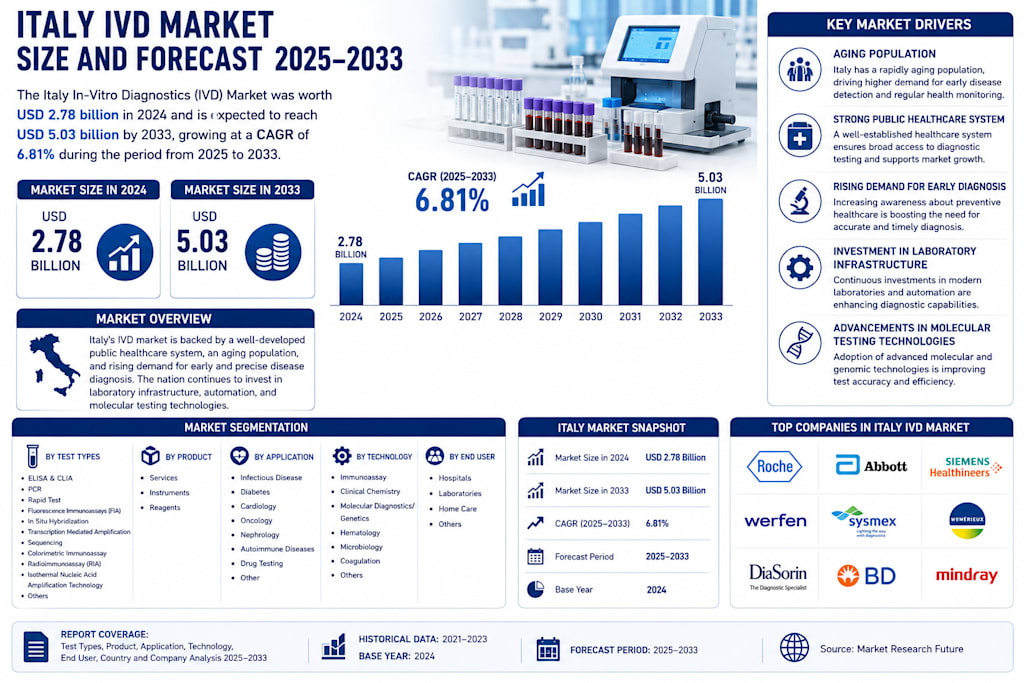
Italy In-Vitro Diagnostics (IVD) Market Overview
In-Vitro Diagnostics (IVD) refers to medical tests conducted on biological samples such as blood, urine, or tissue outside the human body to identify diseases, infections, genetic conditions, and chronic illnesses. These tests are essential for disease prevention, diagnosis, treatment planning, and patient monitoring. Technologies such as PCR testing, immunoassays, rapid tests, and clinical chemistry analyzers are widely used across hospitals, laboratories, and increasingly in home-care settings.
Italy’s IVD market has become increasingly important because of the country’s aging population, strong public healthcare infrastructure, and growing emphasis on preventive healthcare. Early diagnosis and disease monitoring are central priorities within Italy’s healthcare strategy, encouraging broader use of advanced diagnostic systems. The COVID-19 pandemic also increased awareness regarding the importance of diagnostic testing, particularly for infectious diseases, accelerating adoption of molecular diagnostics and rapid testing solutions nationwide.
Aging Population and Chronic Diseases Supporting Market Growth
Italy has one of the oldest populations in Europe, and this demographic trend is significantly increasing demand for diagnostic testing. Chronic diseases such as diabetes, cardiovascular disorders, cancer, and kidney disease require continuous monitoring and early diagnosis, making IVD technologies essential within Italy’s healthcare ecosystem.
According to Eurostat data cited in the report, Italy has the oldest population in the European Union, with a median age above 48 years. Around 24% of the population is over the age of 65, meaning approximately one in four residents falls into the elderly demographic. This creates sustained long-term demand for diagnostic services, particularly for chronic disease management and preventive screening programs.
Healthcare providers across Italy increasingly rely on diagnostic testing to support early intervention and long-term treatment planning. Public awareness regarding preventive healthcare is also improving, encouraging more routine health checkups and laboratory testing. These trends are driving stable demand for both centralized laboratory diagnostics and point-of-care testing solutions.
Government Investment and National Screening Programs Accelerating Adoption
Government support remains one of the strongest drivers of the Italy IVD market. National healthcare authorities continue investing in cancer screening programs, infectious disease monitoring, and genetic testing initiatives designed to improve early diagnosis and reduce long-term healthcare costs.
Public awareness campaigns and free screening programs are helping increase testing volumes across hospitals and laboratories. Italy’s alignment with broader European Union healthcare directives has also encouraged modernization of diagnostic infrastructure and expansion of advanced laboratory capabilities.
In December 2024, the Italian Senate approved a 2025 budget package that introduced incentives for innovative antibiotics through the national Fund for Innovative Medicines. The program provides financial support for WHO reserve-classified anti-infectives, with annual reimbursement coverage of up to EUR 100 million. Such healthcare investments strengthen Italy’s broader healthcare and diagnostic ecosystem.
Technological Advancements and Laboratory Automation Reshaping Diagnostics
Italy’s IVD sector is rapidly transitioning toward automation, digital diagnostics, and molecular testing technologies. Laboratories across the country are increasingly adopting advanced instruments capable of high-throughput testing, real-time monitoring, and greater diagnostic accuracy. Technologies such as CLIA, PCR, and next-generation sequencing are becoming increasingly important in oncology, infectious disease testing, and chronic disease management.
Laboratory automation is helping improve operational efficiency while reducing turnaround times and human error. Healthcare institutions are investing in scalable systems that integrate with Laboratory Information Management Systems to optimize workflows and improve data management.
A notable industry development occurred in August 2022 when DIESSE Diagnostica Senese partnered with Grifols to distribute Promonitor assays for biological drug monitoring. The collaboration supports both point-of-care and ELISA microplate testing applications, highlighting Italy’s growing focus on advanced diagnostics and personalized healthcare solutions.
Regional Healthcare Disparities Remain a Challenge
Despite strong market potential, Italy’s decentralized healthcare system creates regional differences in access to advanced diagnostics. Northern regions generally benefit from stronger healthcare infrastructure, more sophisticated laboratories, and greater adoption of modern IVD technologies. In contrast, some southern regions continue to face infrastructure limitations and resource shortages.
These disparities create uneven healthcare access across the country and limit the full growth potential of the IVD market. Policymakers continue to face pressure to improve diagnostic accessibility and modernize healthcare infrastructure in underserved areas. Addressing these inequalities will be important for long-term market expansion.
Cost Pressures and Reimbursement Challenges Affect Adoption
Italy’s publicly funded healthcare system provides broad access to healthcare services, but budget constraints remain an important challenge for the IVD sector. Advanced molecular diagnostics and high-end testing platforms can be expensive, and reimbursement procedures are often slow or incomplete for newer technologies.
Private laboratories sometimes struggle to justify investment in expensive diagnostic equipment because reimbursement coverage may not fully offset operational costs. Balancing healthcare affordability with continuous innovation remains one of the biggest strategic challenges facing Italy’s diagnostic industry.
Italy ELISA & CLIA IVD Market
ELISA and CLIA technologies continue to play a major role in Italy’s diagnostic ecosystem. These immunoassay platforms are widely used for detecting hormones, infectious diseases, and cancer biomarkers. Their high sensitivity, specificity, and automation compatibility make them ideal for both routine screening and specialized diagnostic applications.
Demand for immunoassays is increasing because of Italy’s growing focus on early diagnosis and large-scale screening programs. Hospitals and laboratories are increasingly adopting CLIA platforms to improve testing speed, throughput, and accuracy while supporting large patient volumes.
Italy Rapid Test Market
Rapid diagnostic tests are becoming increasingly popular across Italy because of their convenience, fast turnaround times, and suitability for home-care settings. These tests are widely used for infectious diseases, chronic disease monitoring, and public health screening initiatives.
The COVID-19 pandemic significantly accelerated public familiarity with rapid testing technologies, encouraging broader adoption among both healthcare providers and consumers. Italy’s aging population and increasing preference for home healthcare solutions are expected to continue supporting this segment in the coming years.
Italy IVD Instruments Market
The demand for sophisticated IVD instruments is increasing steadily as laboratories modernize operations and adopt automated systems. Hematology analyzers, molecular diagnostic instruments, and clinical chemistry systems are increasingly deployed across public and private laboratories to handle growing testing volumes more efficiently.
Italian healthcare providers are particularly interested in systems that integrate with Laboratory Information Management Systems to improve accuracy, reduce manual errors, and streamline workflow management. Investments in high-throughput diagnostic systems continue to strengthen this market segment.
Italy Infectious Disease IVD Market
The infectious disease diagnostics market remains one of the strongest segments within Italy’s IVD industry. Demand for testing solutions related to COVID-19, influenza, HIV, hepatitis, and sexually transmitted infections continues to remain high. Public health authorities continue emphasizing surveillance, early detection, and nationwide screening programs.
Molecular diagnostics and antigen testing are increasingly used in centralized laboratories and point-of-care settings. Syndromic testing panels and rapid molecular diagnostics are also gaining popularity because they allow faster pathogen identification and improve patient management outcomes.
Italy Clinical Chemistry Market
Clinical chemistry diagnostics remain a foundation of Italy’s healthcare system. Tests for glucose monitoring, electrolyte balance, metabolic panels, and enzyme analysis are critical for managing chronic conditions such as diabetes, cardiovascular disease, and kidney disorders.
Italian laboratories increasingly favor compact and automated clinical chemistry analyzers capable of handling large testing volumes efficiently. The reliability and routine nature of these diagnostics ensure continued long-term demand within hospitals and diagnostic centers throughout Italy.
Italy Laboratories Market
Public and private laboratories form the backbone of Italy’s diagnostic ecosystem. Laboratories are rapidly adopting automation, AI-assisted diagnostics, and digital laboratory information systems to improve testing efficiency and support rising patient volumes.
Centralized laboratories in urban regions continue handling the majority of diagnostic testing, while regional healthcare systems create localized laboratory networks across the country. Increased emphasis on quality control, faster turnaround times, and chronic disease management is driving further investment in laboratory modernization.
Recent Developments in Italy IVD Market
In December 2024, Italy approved a healthcare budget package supporting innovative antibiotics through the national Fund for Innovative Medicines.
In August 2022, DIESSE Diagnostica Senese partnered with Grifols for Promonitor assay distribution.
Italy continued increasing investments in molecular diagnostics and laboratory automation technologies.
Hospitals and laboratories accelerated adoption of PCR and CLIA testing systems across major regions.
Public health authorities expanded infectious disease surveillance and national screening programs.
Demand for point-of-care and home-based rapid testing solutions increased after the COVID-19 pandemic.
Clinical laboratories increasingly integrated Laboratory Information Management Systems for workflow optimization.
Italy strengthened diagnostic infrastructure investments under broader healthcare modernization initiatives.
Chronic disease management programs continued driving high demand for clinical chemistry diagnostics.
Diagnostic providers expanded automation and high-throughput testing capabilities across hospital laboratories.
Competitive Landscape and Key Players
Major companies operating in the Italy IVD market include Roche Diagnostics, Abbott Diagnostics, Siemens Healthineers, Danaher Corporation, Thermo Fisher Scientific, and Sysmex Corporation. These companies continue investing in molecular diagnostics, laboratory automation, immunoassays, and next-generation diagnostic technologies to strengthen their market presence in Italy.
Final Thoughts
The Italy In-Vitro Diagnostics market is entering a strong growth phase driven by demographic changes, healthcare modernization, and rising demand for advanced diagnostic technologies. Molecular diagnostics, automation, rapid testing, and clinical chemistry systems are becoming increasingly important as Italy strengthens its focus on preventive healthcare and early disease detection. With the market projected to reach USD 5.03 billion by 2033, Italy is expected to remain one of Europe’s most strategically important diagnostic markets.
About the Creator
Enjoyed the story? Support the Creator.
Subscribe for free to receive all their stories in your feed.
Comments
There are no comments for this story
Be the first to respond and start the conversation.