
Iran Attacks Again – Trump's Reaction and Why a Two-State Solution May Be the Only Path to Peace
Rising Regional Tensions, Fragile Ceasefires, and the Search for a Lasting Political Solution

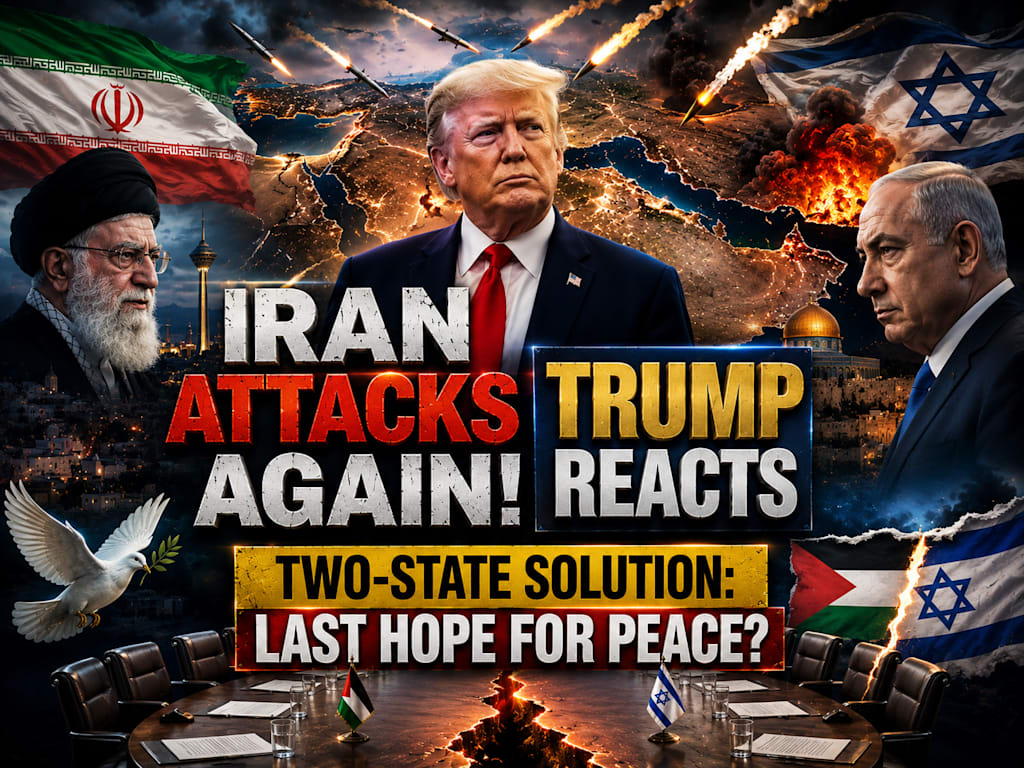
Iran Attacks Again – Trump's Reaction and Why a Two-State Solution May Be the Only Path to Peace
The Middle East remains one of the most complex and volatile regions in the world. Recent developments involving Iran, Israel, and the United States have once again raised concerns about regional stability and the possibility of a broader conflict. Reports of renewed military exchanges between Iran and Israel have put a fragile ceasefire under pressure, while U.S. President Donald Trump has called on both sides to halt hostilities and return to diplomacy. Recent reports indicate that Trump urged restraint and publicly called on Israel and Iran to stop military exchanges as ceasefire efforts faced renewed challenges.
The latest escalation began after military actions and retaliatory strikes increased tensions between the two countries. Iran and Israel exchanged missile attacks, threatening to undo months of diplomatic efforts aimed at reducing violence in the region. Although both sides later signaled a willingness to pause direct attacks, the situation remains highly unstable. Analysts warn that even a small incident could reignite a larger confrontation with consequences extending far beyond the Middle East.
President Trump has taken a public position in favor of de-escalation. He has repeatedly stated that both sides should stop fighting and focus on negotiations rather than military action. According to multiple reports, Trump contacted Israeli leadership and encouraged restraint while also expressing optimism that diplomatic efforts could still succeed. His administration has emphasized that peace negotiations should continue despite setbacks and renewed violence.
The renewed tensions highlight a larger issue that has troubled the region for decades: the absence of a comprehensive political settlement capable of addressing the concerns of all major parties. Military responses may temporarily change conditions on the ground, but history has shown that lasting peace is difficult to achieve through force alone. This reality has led many diplomats, international organizations, and political analysts to continue discussing long-term political solutions.
One proposal that frequently appears in international discussions is the two-state solution. In its broadest form, the concept envisions two independent states living side by side in peace and security. Supporters argue that such an arrangement could provide a framework for addressing competing national aspirations while reducing the likelihood of recurring conflict. They believe that political recognition, clearly defined borders, security guarantees, and economic cooperation could create conditions for long-term stability.
Advocates of the two-state approach often point out that military confrontations repeatedly demonstrate the limits of force as a conflict-resolution tool. Every new round of violence brings humanitarian suffering, economic disruption, and increased regional instability. Infrastructure is damaged, investment declines, and ordinary citizens bear the greatest burden. For these reasons, many international leaders continue to argue that diplomacy remains the most realistic path forward.
However, implementing a two-state solution would be extremely challenging. Questions related to borders, security arrangements, governance, refugees, and mutual recognition remain highly controversial. Political divisions within the region further complicate negotiations. In addition, deep mistrust built over decades cannot be eliminated quickly. Successful negotiations would require sustained commitment from local leaders, regional actors, and the international community.
The broader international impact of the conflict should not be underestimated. The Middle East plays a critical role in global energy markets, trade routes, and international security. Escalations involving Iran can affect oil prices, shipping lanes, and investor confidence worldwide. Financial markets often react quickly to signs of instability, demonstrating how regional conflicts can influence economies far from the battlefield. Recent fighting and concerns over broader conflict have contributed to market uncertainty and concerns about energy supplies.
For ordinary people across the world, the primary hope is that diplomacy prevails over confrontation. While military power remains an important aspect of national security, sustainable peace generally depends on dialogue, compromise, and political agreements. The challenge facing regional leaders is finding a path that addresses legitimate security concerns while creating opportunities for cooperation and development.
In conclusion, the latest tensions involving Iran, Israel, and the United States demonstrate how fragile peace can be in a region marked by decades of conflict. President Trump's calls for restraint reflect a broader international desire to avoid another major escalation. Whether diplomatic efforts succeed remains uncertain, but many observers continue to believe that long-term peace will require political solutions rather than military victories. For many, the concept of a negotiated two-state framework remains one of the most discussed pathways toward a more stable and peaceful future.
About the Creator
Wings of Time
I'm Wings of Time—a storyteller from Swat, Pakistan. I write immersive, researched tales of war, aviation, and history that bring the past roaring back to life
Enjoyed the story? Support the Creator.
Subscribe for free to receive all their stories in your feed.
Comments
There are no comments for this story
Be the first to respond and start the conversation.