
India's Air Pollution Crisis: Unveiling Hidden Threats and Systemic Failures in the Fight for Clean Air
Unmask India's air pollution crisis: PM2.5 dangers, policy failures, and solutions. Discover why Byrnihat, not Delhi, tops global pollution charts and how to combat this silent killer.

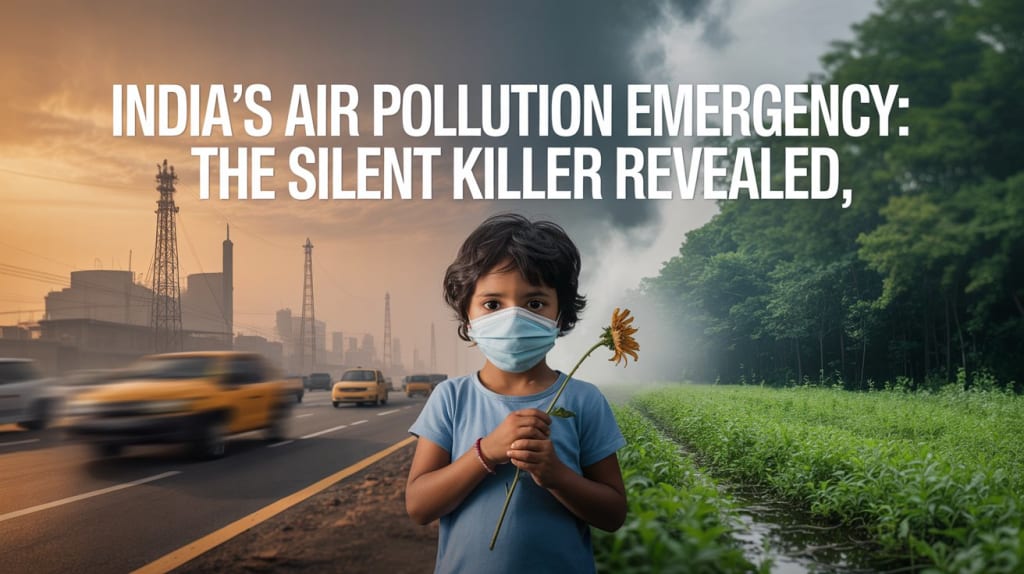
India's Air Pollution Crisis: A Year-Round National Emergency
The revelation that Byrnihat, a small city nestled between Assam and Meghalaya’s lush forests, has emerged as the world’s most polluted city shatters entrenched myths about air quality in India. Contrary to assumptions that pollution is confined to North India or winter months, IQAir’s latest data exposes a grim reality: toxic air plagues the nation from Kashmir to Kanyakumari, Mumbai to Kolkata, with PM2.5 levels routinely exceeding global safety thresholds by 10–20 times. This invisible crisis, normalised by lax standards and political apathy, silently devastates public health, economies, and futures.
The Great Deception: How India’s Air Quality Standards Mask a Catastrophe
India’s air quality index (AQI) categorizes PM2.5 concentrations up to 60 µg/m³ as “Moderate” (yellow), while European standards label the same “Extremely Poor” (dark red). The WHO’s safe limit—5 µg/m³—renders 98% of India’s air unsafe, yet systemic complacency persists. PM2.5 particles, 1/30th the width of a human hair, infiltrate bloodstreams, triggering strokes, heart disease, and lung cancer. Children, breathing disproportionately more air per body weight, suffer irreversible developmental harm, with studies linking pollution to 1.6 million annual premature deaths and reduced lifespans by 5–10 years.
Vehicular Onslaught: How Cars and Policy Failures Choke Cities
Vehicles contribute 40–80% of urban PM2.5, with Delhi’s 13 million registered vehicles emblematic of a national crisis. Despite BS-VI emission norms reducing particulate limits to 4.5 mg/km, unchecked vehicle growth and car-centric infrastructure negate progress. Public transport languishes—India has 1.2 buses per 1,000 people versus 8.6 in developed nations—while highways expand, trapping cities in toxic gridlock. Mumbai’s vehicular pollution surged from 16% to 30% in a decade, mirroring trends in Bengaluru and Hyderabad, where traffic congestion rivals global extremes.
Dust, Construction, and Stubble: The Triad of Environmental Neglect
Road dust, exacerbated by potholes and unpaved surfaces, accounts for 17–37% of urban PM. Construction sites, generating 20–50 kg of dust daily, flout containment norms, while stubble burning in Punjab and Haryana—though seasonal—peaks at 48% of Delhi’s winter pollution. The Green Revolution’s legacy—water-intensive rice farming and delayed harvests—forces farmers to burn 35 million tons of residue annually, a practice cheaper than ₹27,000/acre mechanized solutions the state underfunds.
Industrial Apathy and the NCAP Mirage
Industries contribute 10–30% of urban PM, spewing sulfur dioxide and nitrogen oxides alongside particulates. Despite the National Clean Air Programme’s (NCAP) 2019 pledge to cut pollution by 20–30% by 2024, only 60% of allocated funds were utilized, predominantly on superficial measures like water spraying. Just 1% addressed vehicular emissions, while industrial reforms garnered 3%, revealing a prioritization of optics over systemic change.
The Path to Survival: Solutions Beyond Smog Towers and Blame Games
- Public Transport Revolution: Redirect highway budgets to metro expansions and electric bus fleets, aiming for 50 buses per 1,000 people.
- Stubble Management: Subsidize Happy Seeders and promote crop diversification via MSP reforms to replace water-guzzling rice.
- Industrial Accountability: Enforce emission norms with real-time monitoring and shift subsidies to renewables.
- Urban Redesign: Mandate green belts, vacuum-sweep roads, and penalize uncovered construction debris.
- Citizen Mobilization: Demand transparency in AQI reporting and reject narratives trivializing pollution’s lethality.
Conclusion: A Fight for Breath and Future
Air pollution, indifferent to religion or region, demands urgent collective action. From adopting term insurance against ₹10 lakh medical emergencies to pressuring policymakers, every breath underscores the stakes. As thermal inversion traps poisons and political inertia persists, the choice is clear: prioritize roads or lives, complacency or change. The clock ticks—5.3 years of life lost in Delhi, 1.6 million deaths annually—and silence is complicity.
About the Creator
Enjoyed the story? Support the Creator.
Subscribe for free to receive all their stories in your feed.
Comments
There are no comments for this story
Be the first to respond and start the conversation.