
I Write About Climate Doom for a Living. Here’s What Kept Me Going in 2026.
From solar railways to stork villages, the year’s quiet wins prove the planet hasn’t given up. Neither should we.
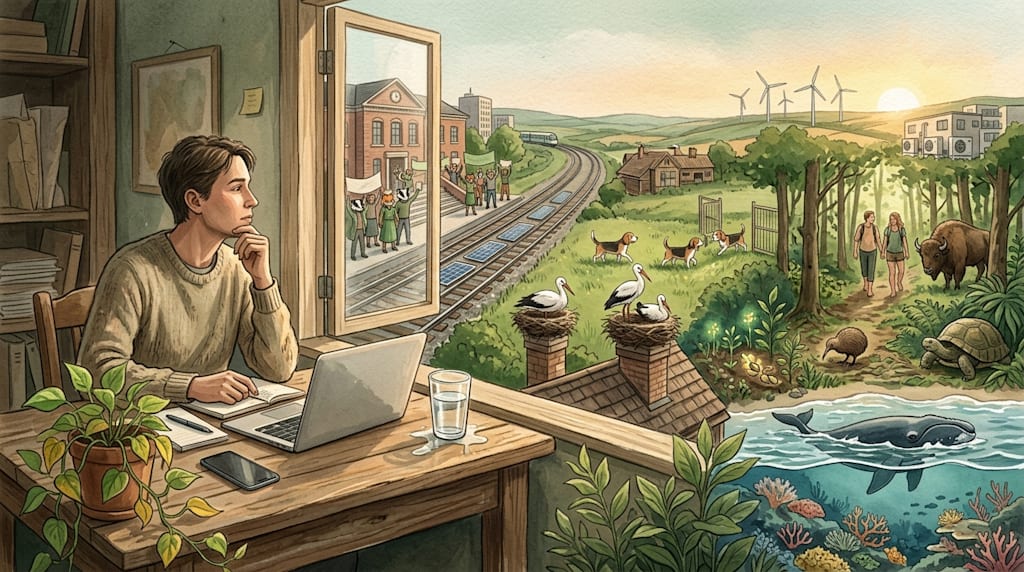
2026, Earth Is Still Breathing
At seven in the morning, he opened his phone.
Heat warning. Wildfires. A country withdraws from a climate agreement. He put the phone face down on the table and went to pour water. The water overflowed and scalded his hand.
He is a green journalist. This was not the first time the news had burned him.
But this year, he was also writing about other things. Solar panels between Swiss railway tracks. Storks on Croatian rooftops. Falling electricity bills in Spain. 1,500 beagles leaving laboratories and stepping onto grass for the first time.
He turned the phone back over and kept writing.
One
Eurostat data came out. In the first quarter of 2026, renewables accounted for 45.5 percent of EU electricity generation. A year earlier, it was 42.7 percent.
Denmark, Portugal, and Lithuania were at the front. Portugal's renewable energy association said that in January, 80.7 percent of electricity came from renewables. It was the best figure in nine months. Non-EU Norway was at 96.3 percent; Denmark, 78.8 percent.
That crossover had already happened once, in 2025. Wind and solar overtook fossil fuels for the first time, becoming the EU's largest source of electricity.
In Buttes, Switzerland, 100 meters of photovoltaic panels were laid between active railway tracks. When trains pass, the panels are right beside the wheels. It is the world's first solar railway. Italy may build the next one.
Rooftop solar is one of the fastest-growing pieces of the EU's energy transition. It lowers electricity bills and reduces dependence on oil and gas. There are also quieter effects: a family in a heat wave worries less about blackouts; a man in his garage checks the meter and sees a smaller number than last month.
The European Heat Pump Association did the math: the heat provided by European heat pumps equals the natural gas carried by more than 200 liquefied natural gas tankers. After the Iran war, gas prices soared. Heat pump sales rose with them.
Spain's electricity bills fell. Since the Strait of Hormuz closed in March, Spanish households have paid 10 euros less a month. Since 2019, renewables have reduced the influence of fossil fuels on electricity prices by 75 percent.
SolarPower Europe found that since March 1, solar power has saved Europe more than 100 million euros a day. In the first 20 days, it saved 2 billion euros in fossil fuel import spending. For all of 2025, clean energy saved the EU 51 billion euros.
Solar fences have appeared in European family yards. In Kenya, Nigeria, Ethiopia, Rwanda, and South Africa, farmers have begun using solar cold rooms. Their incomes rose by 50 percent, and food waste fell.
Turkey is building one of the world's largest solar facilities. Britain plans to give households discounted electricity on windy days instead of shutting down turbines. Belgium, Denmark, France, Germany, Iceland, Ireland, Luxembourg, the Netherlands, Norway, and the United Kingdom signed the Hamburg Declaration to build 100 GW of offshore wind in the North Sea by 2050.
Finns heat sand to store industrial heat. Industrial heating accounts for about one fifth of global energy consumption and is one of the hardest sectors to decarbonize.
In the United States, Trump supports coal and attacks clean energy. Solar still overtook coal power and continued to be the leading source of new electricity.
Two
On May 20, the UN General Assembly voted. The United States tried to withdraw a resolution. The resolution concerned countries' legal obligations to protect the planet from climate change. The result: overwhelming support.
The High Seas Treaty came into force. The high seas cover nearly half the planet's surface and belong to the global commons. Previously there was no dedicated legal framework to protect their biodiversity. Now there is.
France banned PFAS "forever chemicals." It took effect on January 1. More than 140,000 citizens called on lawmakers to support it. These persistent pollutants are linked to multiple health risks.
In Santa Marta, Colombia, 56 countries met. For the first time, they focused on a "fair and orderly exit from fossil fuels." The energy crisis had exposed how much of the world still runs on imported oil and gas.
Hungary held elections on April 13. After 16 years in power, Viktor Orbán was defeated. Péter Magyar, leader of the Tisza Party, took office. People are cautiously optimistic that weakened environmental protections may be restored.
France created seven new biological reserves and expanded two. It added 157,000 hectares of protected forest. The goal is to place 10 percent of its land under "strong protection" by 2030.
Wildlife will appear on British banknotes. Historical figures such as Winston Churchill will be replaced. More than 26,000 people voted to "put nature on the pound."
The Copernicus Atmosphere Monitoring Service released a report. Europe's air quality overall "remains encouraging," with major pollutants showing a "steady decrease."
Hannah Spencer became the first Green Party MP in northern England. She said: "A green wave is coming at the next general election." More and more women are leading green politics in Europe.
Three
In Čigoć, Croatia, the roofs are wooden. White storks nest on them. Every spring, they return from Africa. The village has fewer and fewer people, and more and more storks. An old man sits at his door, looks up at the birds. He says: "The storks were here before me."
He did not say, "We must protect them." He just sat there, soaking up the sun with the birds.
Wehrheim, near Frankfurt, Germany. On May 22, the sun rose. Four baby storks and their mother sat in the nest. Photographer Michael Probst captured the scene.
1,500 beagles came out of a breeding and research facility. Animal groups paid for them. They began new lives. One beagle stepped onto grass, stopped, and sniffed.
Kiwi birds disappeared from the hills around Wellington more than a century ago. Now residents of the capital have launched a campaign to bring the endangered flightless bird back. One resident said: "This animal has given us a sense of identity."
In Australia, the eastern barred bandicoot was once declared extinct on the mainland. After a world-first genetic rescue program, conservationists released up to 100 onto Phillip Island. They began running around the island.
The European bison is back. In the early 20th century, it was driven to the brink of extinction by hunting and habitat loss. Now herds can be found in the UK, Romania, Germany, Switzerland, Poland, Belarus, and Lithuania. Bison graze in ways that store carbon in the soil and open habitat for other species.
In Ukraine, hundreds of bats were rescued from the eastern war zone. They were released when spring arrived. Onlookers cheered.
Jonathan is still alive. Reports of the death of the world's oldest living land animal turned out to be a "hoax" linked to cryptocurrency. Guinness World Records still lists him as the oldest living land animal and the oldest tortoise ever. When he was brought to St. Helena in 1882, he was believed to be about 50 years old.
The kākāpō, New Zealand's flightless parrot. Its population grew from 50 to more than 200. It took 30 years. A bumper berry harvest brought new hope.
Galápagos Islands, Floreana Island. Nearly 150 years after the last giant tortoises disappeared, on February 20, dozens of juvenile hybrids were released. They began restoring the island's ecosystem.
Sardinia's griffon vultures were on the brink of extinction in early 2010. Indirect poisoning, including pesticides and chemicals. Now there are more than 500 on the island. The population recovered.
The North Atlantic right whale, with an estimated population of 384. It is slowly rising after years of decline. To avoid extinction, the population needs many more calves.
European hedgehogs declined by 30 percent over the past decade. In 2024 they were listed as "near threatened." New finding: ultrasound may help protect them.
New research from the Smithsonian Tropical Research Institute: rebuilding coral fish stocks and managing them at a "sustainable level" may help tackle global malnutrition. In some places, it could be achieved in six years.
In Rwanda's Volcanoes National Park, scientists are using environmental DNA to protect mountain gorillas and golden monkeys. eDNA identifies species through genetic traces in soil and water: hair, feces. Researchers do not need to physically find the animals. The technology is turning water and soil samples into a global biodiversity map.
In the Amazon, the Akuntsu tribe has only three women left. Government-backed rainforest development destroyed the people. Many thought the tribe would vanish when they died. In December 2025, Babawru, the youngest of the three, in her 40s, gave birth to a boy.
At Milan City Hall, people wore animal masks. Pigeons, frogs, beetles. They are the "Parliament of Living Species." The goal is to convince policymakers to consider the rights of urban animals when deciding what to build and where.
Animal behaviorists from a Florida zoo went to Africa. An endangered white rhino faced blindness from a parasitic infection. They developed a plan based on experience at Palm Beach Zoo, letting the animal voluntarily participate in its own care. One expert said: "The rhinos are thriving now, and they feel very confident this solved the problem."
Four
Human composting, also called "terramation," is moving toward legalization in Europe as a green alternative to burial and cremation. In the UK, Kristoffer Hughes, who works in the death industry, is leading the campaign.
On May 24, Malmö FF's home stadium, Eleda Stadion, opened its toilets. The goal was to collect 1,000 liters of human urine. Sweden depends on imported fossil fuel-based synthetic fertilizers, which generate 1.13 billion tonnes of CO2 equivalent annually.
A Spanish research team created plants that glow in the dark and change color when infected. Ordinary cameras can achieve early detection of crop pests and diseases.
Moringa tree seeds have been used for purification for a thousand years. A study showed they can filter out 98 percent of aged PVC microplastics, matching or even outperforming chemical alternatives.
Air fryers generally use less electricity than conventional ovens. New research says that under certain conditions, they are also better for indoor air quality.
In Stockholm, an electric "flying" ferry appeared at the end of 2024. More than a year later, the Swedish Transport Administration evaluated the pilot route as a great success. Quiet, comfortable, low-emission.
France has thousands of kilometers of abandoned railway tracks; converting them for modern heavy trains is too costly. Engineering firm SICEF turned hybrid vans into "Ferromobiles" that run on the tracks.
A study commissioned by the UK's Department for Energy Security and Net Zero shows that small-scale space-based solar power could become cost-competitive with other commercial power sources as early as 2040.
France banned fungicides that vineyards relied heavily on. Sean Smith, CEO of UK tech company Eden Research, offered a "viable and sustainable" alternative to copper pesticides.
At the edge of Germany's Black Forest, visitors walk barefoot along shaded paths. Podiatrists say it benefits emotional health and foot health.
Five
Germany's Black Forest, a barefoot trail. Visitors take off their shoes. Soles press on soil, stones, fallen leaves. A podiatrist says it is good for mood and feet.
Čigoć, Croatia. An old man sits at his door, soaking up the sun with the storks.
Ukraine. Rescued bats are released in spring. Onlookers cheer.
New Zealand. Kiwi birds return to the capital. A resident says: "This animal has given us a sense of identity."
The Amazon. A tribe on the brink of disappearance welcomes a newborn.
Florida. Zoo experts used a "ridiculous" plan to save an African rhino's eyesight.
Milan. People in animal masks enter City Hall to speak for pigeons, frogs, and beetles.
Britain. Wildlife will appear on banknotes.
Europe. Women are leading green politics. Hannah Spencer says: "We change the future."
David Attenborough turned 100 in May 2026. Artists Skip and Katherine Khangurra say their lives were changed by the "Attenborough effect."
Six
He finished writing the piece.
Outside the window, it was dark. He opened his phone and saw a new message: Italy may build a solar railway. He turned off the screen.
On the desk was a pothos plant. Its leaves were a little yellow. He picked up his cup and went to get water. The water did not overflow.
Tomorrow he still had to write.
About the Creator
Jin
Writer of reamstories
https://reamstories.com/jin
Enjoyed the story? Support the Creator.
Subscribe for free to receive all their stories in your feed. You could also become a paid subscriber, letting them know you appreciate their work.
Comments
There are no comments for this story
Be the first to respond and start the conversation.