
I watched a king cobra swallow a banded krait. The “mutual bite” question answered itself.
A duck net, a half-swallowed tail, and a reservoir full of rats show why a fair fight between these snakes is mostly a story we bring to the woods.
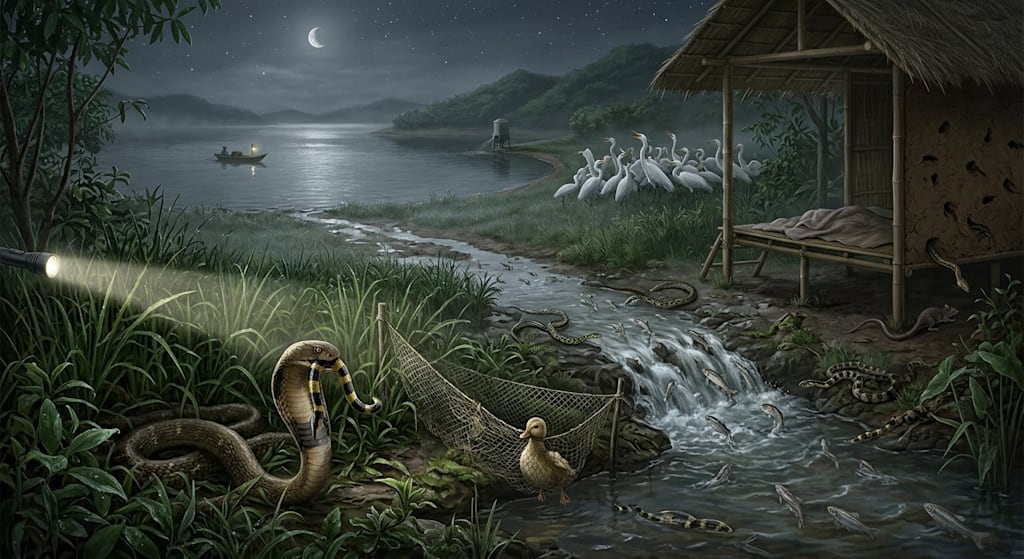
The flashlight hit the king cobra when most of the banded krait was already down its throat. The last section of tail hung outside, black and yellow bands stretched by the swallow. The tail was still looped around the cobra’s neck. It looked like a rope that had gone slack. The cobra turned into the grass. Beside it, a small duck lay dead with its neck caught in the net. The net was still there, its mesh just wide enough to trap a snake whose head could pass and whose body could not.
That scene answers the question people ask about these two snakes. A king cobra and a banded krait do not meet as duelists. One is a predator. The other is prey. The tail around the neck was not a counterattack that nearly worked. It was the last movement of an animal already inside another animal.
If you force the hypothetical, the result is still lopsided. The king cobra lives. The banded krait dies.
Why the king cobra can eat the krait
The king cobra’s scientific name is Ophiophagus hannah. Ophiophagus means “snake-eater.” It is not a member of the cobra genus Naja. It is a large snake that makes its living on other snakes. Banded kraits, many-banded kraits, rat snakes, water snakes, and other cobras all show up on its menu. When you see it swallow a banded krait, you are watching routine work.
A snake that eats snakes cannot be helpless against snake venom. The king cobra has tolerance for many of the neurotoxins found in its prey. This is not a magic shield. Its blood and receptors have evolved ways to blunt those toxins. When banded krait venom enters a king cobra, the venom is not harmless. It just struggles to reach a lethal dose.
The banded krait’s venom attacks the nervous system. It paralyzes breathing, disrupts the heart, and kills by suffocation. That weapon works on rats, frogs, small fish, and small snakes. Against an animal that eats snakes for a living, it loses much of its force.
Venom dose and body size
The size gap decides much of the fight before either snake opens its mouth.
A king cobra is a giant among venomous snakes. Adults of two or three meters are common. Three or four meters is not rare. A large adult can weigh several kilograms, sometimes more than ten. Its single bite delivers a large dose of venom, enough to bring down big prey.
A banded krait is slender. Adults are usually around one meter and often weigh about one kilogram. Its venom is potent, but its single dose is small. Against an opponent several times its size, that dose is a cup of water thrown at a wall.
The king cobra also bites fast and aims near the head and neck. It injects, controls the prey, and avoids a clean counterbite. The krait may still turn and bite. Its dose is unlikely to break the cobra’s tolerance. The cobra’s dose is far past the krait’s lethal threshold. A juvenile cobra, a very large krait, and repeated bites could change the outcome. In the adult-versus-adult scene I saw, the outcome was settled before the first strike.
The duck net
The duck net was a trap for more than ducks. Small ducks pushed their heads and necks through the mesh. Their bodies stuck. They did not back out. They died there. Snakes did the same. A small snake passed through. A very large snake found a way. A medium snake pushed its head through, then could not get its body through. It did not reverse. It tried a nearby mesh and became tangled.
On night rounds, I pressed a snake’s head down with a branch, cut the net, and drove the snake off. Then I mended the net. The king cobra came for the duck smell. It killed a small duck. It also ate banded kraits. It was not a symbol of the “king of venomous snakes.” It was a predator with a route, a smell, and a habit of slipping into grass when a flashlight found it.
Banded kraits were scarce there. Many-banded kraits were common. Green pit vipers were fairly common. Water snakes and shuinan snakes were more common still. The edge of a reservoir, with its mud, grass, and shallow water, favors small snakes that eat fish and frogs. The king cobra sits at the top, and top predators are never numerous. Its rarity comes from its need for space, prey, and a whole working ecosystem.
One evening I found nearly ten snakes gathered where rainwater ran down a channel. They watched fish swim upstream. A many-banded krait bit a two-finger tilapia. The fish spread its fin spines, arched its body, and stopped struggling. The krait dragged it into the grass. A snake leaves after one fish. Snakes kept leaving. Soon only one water snake still waited. The snakes did not attack one another. Their attention was on the fish. Separate niches soften competition. Concentrated food brings everyone close for a while.
Fish that climb the road
On rainy days, the mountain road becomes a stream. Fish swim against the current. Where there is a drop, they jump. Where the water is shallow, they lie down and push upward. When the rain stops, the water becomes land again. The fish are left on the hill.
Snakes come to test them. Two-finger and three-finger fish go down easily. A fish of two jin or more is too much for most snakes. They still try. They try, fail, and leave. Another snake comes and tries. A wildcat takes some. Ants take others. One kind of ant buries the fish under loose mud and carries the flesh away in pieces.
Egrets and cranes wait downwind of the automatic feeder. The feed powder blows back to the water’s edge. Small fish come for the powder. The birds come for the fish. Dozens or more than a hundred crowd together like a morning bus. People walk close and the birds still do not leave. Their calls sound cheerful. After dark they return to the trees and keep calling. I stood there with a bowl of rice and laughed with them.
When shuinan snakes came to eat fish near the feeder, the birds did not attack them. Food was everywhere. The birds had no reason to fight.
Rats under the bed
My shed cost less than three thousand yuan. The bed sat on grass. The grass died. The ground became mud, packed hard by my feet. Rats dug under the bed. Sometimes the mud from a new hole pushed against the boards. I looked out and saw one hole after another. A rat looked back at me from the dark. Round eyes. Long whiskers.
I put a brick over one hole. The rat dug out somewhere else and made noise half the night. It chewed the bed legs. Sometimes I heard a rat scream under the bed and lifted the mosquito net. A shuinan snake had one rat in its mouth and was watching another. The big rat ran without looking and hit the cement tile with a bang.
The shuinan snakes knew where the rats were. Two or three would come together and fight over them. The bed boards banged. The rats screamed. I wanted the snakes in the feed room. Later I caught cats and threw them in. If I saw rat droppings, I shut a cat inside for a few days. The rats died. Dogs were useless. A dog shut inside howled all night and begged to be let out. The noise was worse than the rats.
In those years I moved in and out of the reservoir. I walked the hills at night and climbed to the top to look at stars. Sometimes I rode a cow. Sometimes I took dogs or carried a cat. Sometimes I slept on the dam and watched the mountains and clouds. The night was quieter than I was. The moon sat in the sky and in the water. I rowed a small boat into the middle of the reservoir, lay down, and waited for wind to push me wherever it wanted.
What the scene actually says
So, would a king cobra and a banded krait kill each other in a mutual bite?
In the wild, they rarely get the chance to try. The banded krait is prey. An adult king cobra has strong tolerance for its venom. A banded krait bitten by a king cobra has almost no way out. The tail around the neck was the end of a meal, not a draw.
The woods do not run fair fights. No referee. No rounds. There is who is on the menu and who is not. There is who has tolerance and who does not. There is who is large and who is small. There is who found a fish today and who will be caught in a net tomorrow. I saw that order most nights by the reservoir. Snakes ate snakes. Snakes ate fish. Egrets ate fish. Cats ate rats. Ants carried off what was left. People mended nets and released snakes. The king cobra swallowing the banded krait was one scene in that order. It was ordinary. That is why I still remember it.
About the Creator
Jin
Writer of reamstories
https://reamstories.com/jin
Enjoyed the story? Support the Creator.
Subscribe for free to receive all their stories in your feed. You could also become a paid subscriber, letting them know you appreciate their work.
Comments
There are no comments for this story
Be the first to respond and start the conversation.