
I Spent My Childhood Trying to Swat One Fly. Here’s Why I Never Could.
A backyard mystery led me to the strange science of animal time.
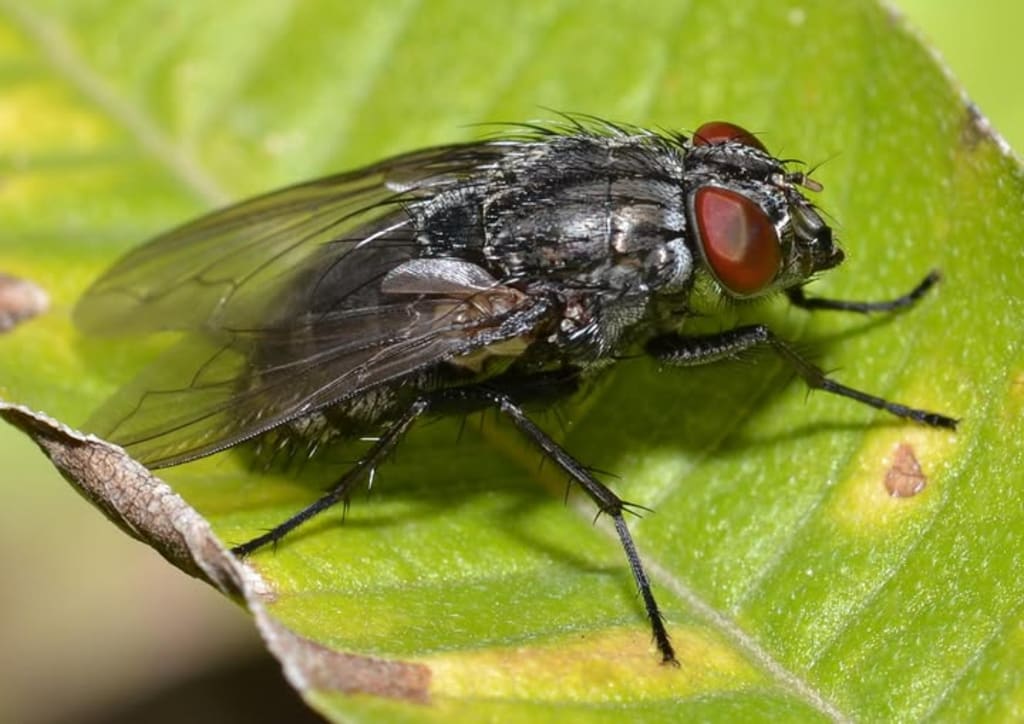
Why You Can Never Swat a Fly
1
I believed insects had eyes in the backs of their heads.
Summer. Yard. A fly on the table corner, wings open. I crouched, held my breath, moved my palm closer. Then I slapped down.
Smack.
The table shook. My palm stung. The fly was gone. It flew up through the gap between my fingers with a short buzz. It sounded like laughter.
I tried again with a basin of water. I threw the whole thing at the fly. Water spread like a net. For a moment I felt clever.
The fly left. Water hit the table, the ground, the wall. The fly passed through the gaps between streams. It found the one opening that did not exist.
I stood in the puddle. It had not looked at me. It had not moved. How did it know where the water would leave a hole?
2
Later I learned that the fly had not predicted anything. It lived in a different time.
To me, the slap was fast. The water was a disaster. To the fly, the same events may have played like a film slowed down four or five times. My hand pressed down slowly. The water unfolded slowly. Air ripples reached its antennae before the water did. It had time to adjust its feet, judge the wind, and take off.
I thought speed beat me. Time beat me.
Physical time treats everything alike. A stone and a mountain in the same gravitational field experience almost the same time. A stone does not live faster because it is small. A mountain does not age slower because it is large. For inorganic matter, time is an even ruler. It does not care whether you are a grain of sand or a planet.
Life is different. Life does not live in physical time. It lives in a version translated by a nervous system.
Light, sound, air pressure, and vibration are collected by receptors, turned into electrical signals, and sent along nerves to the brain. The brain packages, decodes, compares, and predicts. Then it produces a world that feels like it is happening. This process takes time and has a speed limit. Different organisms process information at different speeds. They live in different subjective times.
Neurophysiologists measure this with the critical flicker fusion frequency, or CFF. In plain terms, it is the highest frame rate a brain can handle per second.
When a light flickers fast enough, the human eye stops seeing flicker and sees steady light. That threshold is the CFF. For humans it is about 50 to 60 hertz. Film at 24 frames per second looks continuous. Old fluorescent lamps flicker about 100 times per second. We usually cannot detect it. The light looks steady.
Flies are different. Studies of dozens of animal species have found that smaller animals with higher metabolic rates often have higher CFF. Humans sit near 60 hertz. Some insects and small birds reach 200 hertz or more. Some flies go higher.
A second in our eyes can split into hundreds of instants in theirs.
3
People often assume their senses show them the world as it is.
We see continuous motion. We hear continuous sound. We feel time as a steady river. That is only the version our nervous system gives us. To save energy and avoid overload, it compresses the world into a version of about sixty frames per second.
We miss a lot. We cannot see the ultraviolet patterns on a bee’s flower. We cannot see the infrared heat image a snake sees. We cannot hear a bat’s ultrasound. We cannot follow the high-speed flicker inside a fly’s compound eyes. We think we are the measure of all things. We are prisoners of our own senses.
A higher refresh rate does not automatically make eyes comfortable. Comfort also depends on brightness, flicker, blue light, and viewing habits. But higher temporal resolution does help an animal see fast motion. To a fly, the world is not brighter. It is faster. To us, the world is not slower. It is fast enough.
Evolution is stingy. It does not hand out extra computing power. Each organism’s temporal resolution matches its body and its survival needs.
4
Why would nature give flies such an energy-hungry high-frame-rate system?
The answer sits in nerve distance and physical inertia.
A fly receives light at its retina, then sends a signal to flight muscles in its thorax. The distance is less than a millimeter. The impulse barely travels. Delay is tiny. Its compound eyes are built to catch motion. Its airflow sensors pick up pressure changes early. Its flight muscles often stay primed to fire.
The fly is also very light. A tiny insect has almost no momentum. It can hover, turn, or climb 180 degrees in a few milliseconds. If the body can act in five milliseconds, the brain must refresh the world at hundreds of frames per second. If it lags by two frames, it hits a wall or dies under a predator.
High frame rate is a survival requirement.
Elephants, sea turtles, and Greenland sharks may have CFFs of only 10 to 20 hertz. Their brains do not lack the desire to see clearly. Their bodies cannot use the information. A body that weighs tons carries enormous inertia. Even if an elephant’s brain could see every millisecond, its bones and muscles could not brake or turn in ten milliseconds.
High-frequency sampling costs the brain glucose and neural metabolism. For a slow, large animal, slowing down time perception wastes energy. In a long, slow life, low-frame-rate perception saves power.
Nature gives each species a subjective time scale that matches the mechanical limits of its body.
5
This logic leads to a larger idea. If smaller bodies experience faster subjective time, could advanced civilizations exist at microscopic scales?
At that scale, signals travel shorter distances. Metabolism runs faster. Evolution may run faster. One second for us could be many years for them. A speck of dust could be their planet. A wave of our hand could be a slow disaster in their world.
The idea is good for science fiction. It also runs into hard problems.
The smaller the scale, the stronger the thermal fluctuations. Information storage and computation are easier to erase by random noise. A microscopic civilization would have to fight thermodynamic noise. Computation produces heat. Small bodies have trouble dumping heat. They also struggle to find stable energy gradients. A high-frame-rate brain burns a lot of energy. A small, intelligent life form may hit an energy ceiling.
Intelligence also needs neurons, working memory, long-term memory, and social learning. A high refresh rate alone does not produce mathematics. Flies have high CFF. They did not evolve calculus. High temporal resolution is an adaptation for motion. It is not a sufficient condition for an intelligence leap.
If microscopic civilizations exist, how would they affect the macroscopic world? Would they leave waste heat, electromagnetic signals, or altered materials? We have not seen anomalies.
Until there is evidence, microscopic civilization stays a science fiction and philosophy hypothesis. It is not a mature scientific direction.
6
Humans have long searched for extraterrestrial civilizations on macroscopic planets. We listen for radio signals. We look for Dyson spheres. We study exoplanet atmospheres. We launch probes. Some people ask whether this direction is wrong at the root.
It is not. Macroscopic planet search is a practical choice. The life we know needs liquid water, energy gradients, and chemical complexity. Planets provide stable environments over long periods. Radio, optical, infrared, and atmospheric spectroscopy are tools we can use now.
That does not close the door on multi-scale or multi-messenger searches. We can imagine life in extreme environments. We can imagine life based on different chemistry. We can imagine civilizations with time scales completely different from ours. But a scientific hypothesis must be testable. If microscopic civilizations exist, they should leave some observable effect. Without that, they remain in the imagination.
The Fermi paradox has many explanations. Civilizations may be rare, short-lived, or silent. Our technology may be too limited. They may be beside us and we cannot recognize them. The microscopic hiding place is not the explanation with the most observational support.
7
Back to the summer yard.
I held a basin of water and thought I had made a disaster that covered everything. To the fly, it may have been a slow rain. It had time to find an opening, take off, and vanish under my nose.
I could not catch it because my hand was slow. I could not catch it because I lived in a world too slow for the fly.
On a physical clock, one second is equal for all things. A stone’s second, a mountain’s second, a human’s second, and a fly’s second are the same in physics. In the sensory world, one second breaks into different pieces. Humans cut it into sixty. Flies cut it into hundreds. The same afternoon becomes long, wide, and slowly dismantled for a fly.
We think time is a river. Every living thing rows its own boat. Some boats are slow. Some are fast. Some see ripples. Some see every drop.
That little insect on the table corner may have lived in an afternoon cut finer, slower, and wider. In that afternoon, humans are slow giants. The palm falls slowly. The water unfolds slowly. Danger comes slowly. It has time to slip through the gaps in the slow motion.
We think we are swatting a fly.
We are inside a slow film that belongs to the fly, playing a clumsy giant.
About the Creator
Jin
Writer of reamstories
https://reamstories.com/jin
Enjoyed the story? Support the Creator.
Subscribe for free to receive all their stories in your feed. You could also become a paid subscriber, letting them know you appreciate their work.
Comments
There are no comments for this story
Be the first to respond and start the conversation.