
Hypatia and the Solar System.
Hypatia, the most Mysterious Stone in the Solar System.
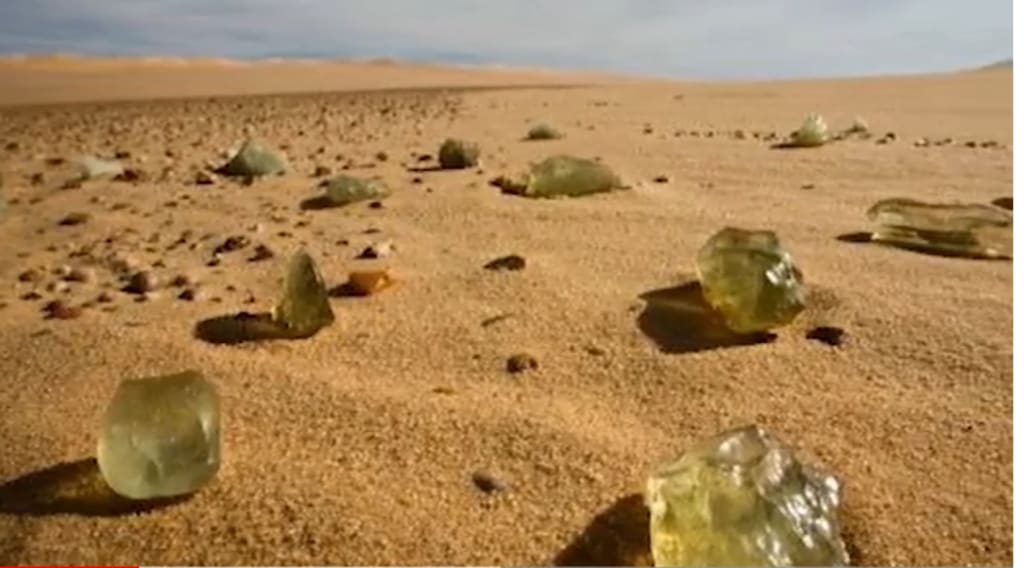
It has long been a goal of scientists to understand the beginnings of the solar system, this planet, and life. The discovery of a little stone that includes components that are not only not found anywhere on our planet but are also not found anyplace in this solar system may now throw into question everything we thought we knew about that. But allow me to begin from the beginning. The Great Sand Sea, which spans a massive 28,000 square miles in western Egypt and extends into eastern Libya, is located there. One area of this large desert is covered in yellow glass, the origins of which many experts think to be extraterrestrial. Small stones containing diamonds were discovered while exploring this glass field. That defy all accepted theories about how our solar system formed were found while exploring this glass field.
Dr. Ali A. Barrichatt was investigating a region of the Great Sand Sea that is rich in desert glass in 1996. The Libyan Desert Glass Stone Field is well-known. Researchers are baffled by the bits of yellow glass that litter this 25,000 square mile area. The glass is now quite comparable to tranitite. The first atomic bomb detonation, known as Operation Trinity, caused glass to develop in the desert of New Mexico.
The fact that this glass was used in jewelry that graced the mummies of Pharaohs, including the common ones, shows how significant it was to the ancient Egyptians. Anyhow, Vericat's 1996 excavation discovered a few fragments of unremarkable stones that were encircled by this enigmatic yellow glass. These rocks bear the name Hypatia, a well-known female mathematician and astronomer who lived in Alexandria, Egypt, in the fourth and fifth centuries AD.
Additionally, it was shown in 2013 that these stones were extraterrestrial in origin following further examination of the noble gas and nitrogen isotopes. A 2015 declaration that the Hypatia stones were not the result of any known comet or meteor collision came after that. The discovery that the stones were virtually entirely carbon with very little silica also caused the scientists to sit up and take attention. contrary to what has been seen in every other meteor or typical fragment that has been studied up to this point.
Researchers assume that the shock diamonds developed before unknown impactor entered our atmosphere because they differ from Earth's nitrogen isotope ratios in unique ways. We might imagine the poorly mixed fruit cake dough as reflecting the majority of the Hypochlor pebble, or what geologists refer to as two mixed matrices.
The glazed cherries and nuts in the cake represents the mineral grains found in Hypatia inclusions, and the flower dusting the cracks of the fallen cake represent the secondary materials we found in the fractures in Hypothia, which are from Earth. This spanking analogy gets even stranger due to the presence of a few exceedingly rare components because pure metallic aluminum was found. And aluminum is really never found in this form on the Earth and it's not to be extremely rare even in our solar system. Also, an even more astounding discovery was an alloy of phosphorus and nickel that contains no iron. This has really never been observed before.
Kramer's went on to say, “Even more unusual, the matrix contains a high amount of very specific carbon compounds called polyaromatic hydrocarbons or PAH, which is a major component of interstellar dust which existed even before our solar system was formed”. Interstellar dust is also found in comets and meteorites that have not been heated up for a prolonged period in their history. Basically, the South African professor believes the data is telling him that the formation process must have happened very far from the warmth of a star like our sun.
“And we currently know very little about these parts of our solar system. Hypatia was likely produced in a chilly environment, below the temperature of liquid nitrogen on Earth,”according to Kramer. When compared to the asteroid belt between Mars and Jupiter, where the majority of meteorites originate, where would it have been in our solar system? The Kuiper Belt, which is nearly 40 times as far from the sun as we are and beyond Neptune's orbit, is where the majority of comments come from. Some originate even further away, from the Oort Cloud. We know relatively little about the chemistry of extraterrestrial objects. So, in our next inquiry, we'll delve more deeply into Hypatia's origin story.
Now, where is the crater if this yellow glass was created by Hypatia exploding with the force of an atomic bomb, leaving only minute fragments of itself as hints for later researchers? It turns out that one contender for the location of the crater left by the incident that gave rise to all of this nuclear glass was too large to be observed from Earth. It wasn't until 2007 that Egyptian scientists, using data from orbiting satellites, found what they thought to be a 19-mile-diameter crater, which may very well have been the source of the desert glass and Hypatia stone fragments.
However, because of its extreme isolation, virtually little additional research has been conducted on it. So yeah, a lot of questions contained in a tiny little pebble. Also, I wonder, you remember the story about King Tut's Dagger that was made with meteorite? I wonder if that's somehow related to the Hypatia stones.
About the Creator
Enjoyed the story? Support the Creator.
Subscribe for free to receive all their stories in your feed.
Comments
There are no comments for this story
Be the first to respond and start the conversation.