
How We Succeeded in an AI-Driven Life
A story of ambition, failure, learning, and building a new kind of human success with artificial intelligence

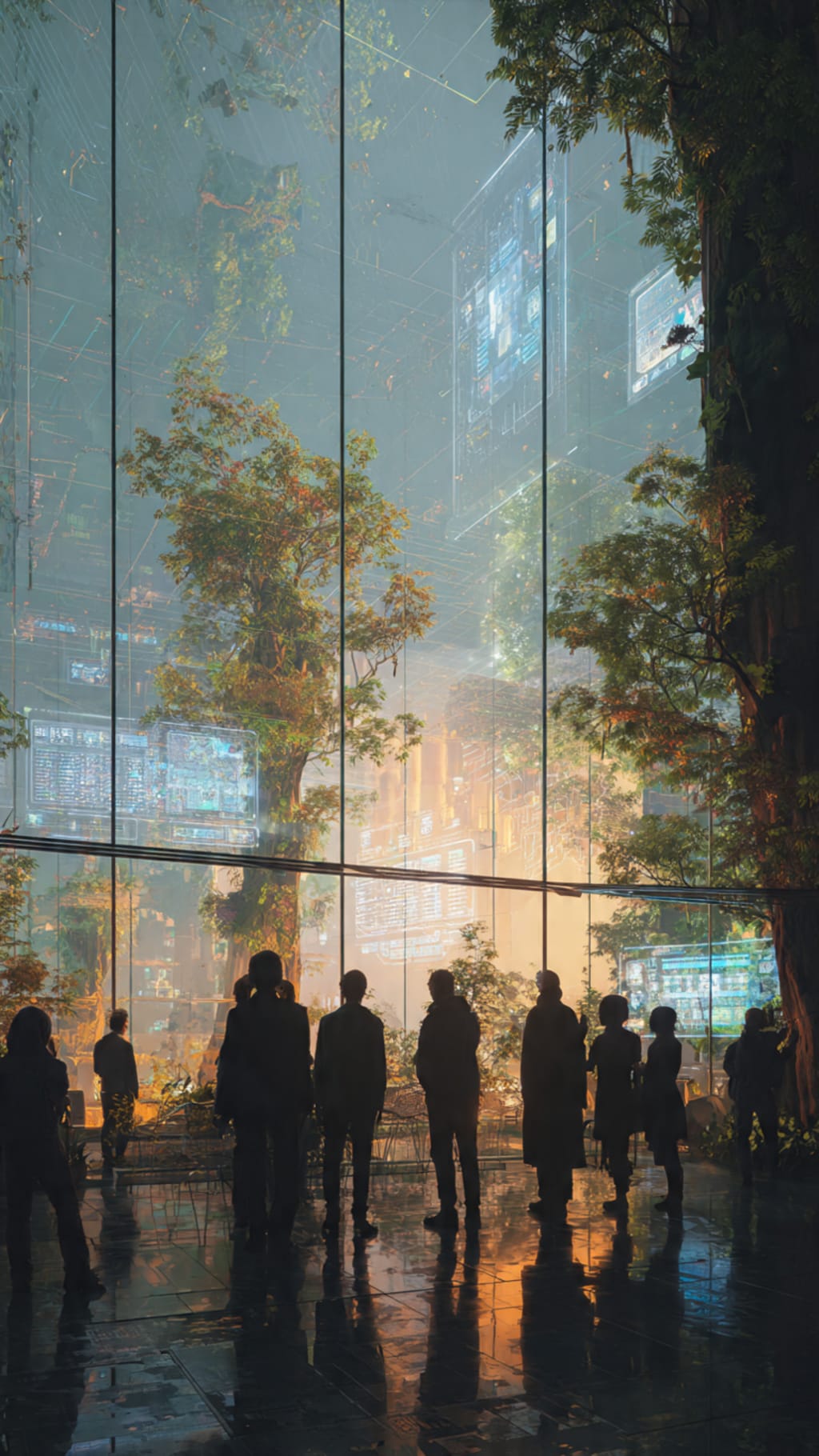
Chapter 1: The Ordinary Beginning
We did not start in a place that looked like the future.
Back then, life was simple in the way that most beginnings are simple—only in hindsight do they feel small. Our days were shaped by routines: waking up early, commuting through cold mornings, and sitting in rooms filled with screens that didn’t yet feel like gateways to anything extraordinary.
In those days, AI was not something we “lived with.” It was something we read about. Headlines spoke of automation, job replacement, and distant revolutions. People argued about whether AI would help humanity or replace it. Most of us didn’t know where we stood. We were too busy surviving deadlines, bills, and expectations.
But something was quietly forming beneath the surface. A curiosity. A question that wouldn’t leave us alone:
What if AI wasn’t just a tool… but a partner in how we build our lives?
That question became the seed of everything.
Chapter 2: The First Encounter with Intelligence That Wasn’t Human
The first time we truly worked with an AI system, it felt strange. It was not like using a calculator or a search engine. It responded. It adapted. It made suggestions that sometimes felt eerily aligned with how we thought—but faster, cleaner, less emotional.
We tested it like skeptics.
We asked it to write, to plan, to solve, to simulate ideas we had no time to fully develop ourselves. And each time, it responded not with perfection—but with possibility.
That was the shift.
We stopped seeing AI as a machine that executed commands and started seeing it as something closer to a thinking mirror—one that reflected our intentions and amplified them.
Still, success did not come immediately. In fact, we failed more in this stage than at any other point in our journey.
We overtrusted it sometimes. We underused it other times. We treated it like magic when it was still math. And slowly, painfully, we learned balance.
Chapter 3: The Collapse That Forced Reinvention
Everything changed during what we now call “the collapse year.”
It wasn’t a global collapse. It was personal, quiet, almost invisible to the outside world. Projects failed. Work became unstable. Systems we relied on became outdated overnight. Skills we thought were permanent suddenly felt temporary.
For a moment, it looked like we were falling behind the world instead of moving with it.
But collapse has a strange function—it removes everything unnecessary.
We were forced to ask harder questions:
What work actually matters in a world filled with intelligent tools?
What is still uniquely human?
And how do we build a future instead of reacting to it?
In that uncertainty, AI stopped being optional. It became structural. Not something we used, but something we built around.
We didn’t just use AI tools anymore. We began designing workflows, systems, and thinking patterns that included AI at every layer.
That was the turning point.
Chapter 4: Learning to Think With Machines, Not Against Them
The biggest mistake people made in the early AI era was competition.
They thought success meant being faster than AI, smarter than AI, or more efficient without AI. That was never the real game.
We learned something different:
Success meant learning how to think with intelligence that wasn’t human.
We started building “dual cognition”—a way of thinking where human intuition and machine computation worked together.
Humans became the direction-setters.
AI became the expansion engine.
For example:
We would define meaning; AI would expand possibilities.
We would choose emotion; AI would optimize structure.
We would decide purpose; AI would simulate outcomes.
It was no longer about doing everything ourselves. It was about orchestrating intelligence.
And slowly, life began to shift.
Chapter 5: The First Real Breakthrough
The breakthrough didn’t come as a sudden explosion. It came as accumulation.
Small improvements stacked over months:
Faster learning cycles
Better decision-making systems
Reduced wasted effort
Increased creative output
Then one day, something became obvious:
We were no longer reacting to opportunities. We were generating them.
Projects that used to take months took weeks.
Ideas that used to die in notebooks became real systems.
Work that once required teams could now be prototyped by one person with AI support.
This was the moment we realized we were not just adapting to the AI era.
We were building inside it.
Chapter 6: Redefining Success in an AI World
Old definitions of success began to feel outdated.
It was no longer just about money, titles, or job stability. Those things still mattered, but they were no longer the center.
We started measuring success differently:
How quickly we could learn something new
How effectively we could turn ideas into systems
How much creative freedom we had
How aligned our work was with our values
AI changed the economy of effort.
What used to require thousands of hours now required clarity and direction more than raw time.
The most valuable skill was no longer repetition—it was intention.
Chapter 7: Building a Life That Thinks With You
Eventually, AI stopped feeling like a tool and started feeling like infrastructure.
It was in how we planned our days.
It was in how we designed our projects.
It was in how we explored ideas before committing to them.
We built systems where:
AI handled structure, analysis, and iteration
Humans handled meaning, judgment, and direction
Life became less about grinding through tasks and more about designing intelligent pathways.
Even creativity changed. Instead of waiting for inspiration, we could generate it, test it, refine it, and evolve it in real time.
It didn’t remove effort—it removed waste.
And that made everything feel more focused, more deliberate.
Chapter 8: The Human Core That Remained
Despite everything AI could do, something remained unchanged.
It could not decide what mattered.
It could not feel the weight of regret or pride.
It could not define purpose in a deeply personal way.
That part stayed human.
And ironically, the more we used AI, the more important that human core became.
We realized success in an AI-driven life was not about becoming machine-like.
It was about becoming clearer about what only a human should decide.
AI expanded what was possible.
Humans defined what was meaningful.
Chapter 9: From Users to Builders of a New Era
Eventually, we stopped seeing ourselves as users of AI.
We became builders.
Not necessarily builders of software—but builders of systems of living:
How we learn
How we work
How we collaborate
How we make decisions
We designed environments where intelligence—human and artificial—worked in harmony.
And the results were not just productivity gains.
They were life gains:
More time for thinking
More time for creation
More time for living intentionally
The future didn’t feel distant anymore.
It felt operational.
Chapter 10: Arrival Is Not a Place
There was no final moment where everything became perfect.
Success in an AI-driven life did not arrive like a destination.
It arrived like a shift in perception.
We stopped asking, “What will AI do to us?”
And started asking, “What will we build with it?”
That question changed everything.
Because it turned fear into design.
Uncertainty into experimentation.
And survival into creation.
We never “arrived” at success.
We built it continuously, one system, one idea, one decision at a time.
Final Reflection: The Life We Didn’t Expect but Learned to Build
Looking back, nothing about the path was linear.
There were failures. Confusion. Missteps. Revisions. Entire ideas abandoned halfway through.
But that was the point.
AI did not replace the human journey—it accelerated it, sharpened it, and exposed its structure.
We did not become less human.
We became more intentional humans in a world where intelligence is abundant.
And that is what success became:
Not outperforming machines.
Not escaping change.
But learning to shape a life where intelligence—both human and artificial—builds forward together.
About the Creator
AFTAB KHAN
SUBSCRIBE ME AND READ STORY
Storyteller at heart, writing to inspire, inform, and spark conversation. Exploring ideas one word at a time.
Writing truths, weaving dreams — one story at a time.
From imagination to reality
Enjoyed the story? Support the Creator.
Subscribe for free to receive all their stories in your feed.
Comments
There are no comments for this story
Be the first to respond and start the conversation.