
How to Reduce Your Carbon Footprint While Flying Private
Practical Ways to Fly Private with Lower Emissions

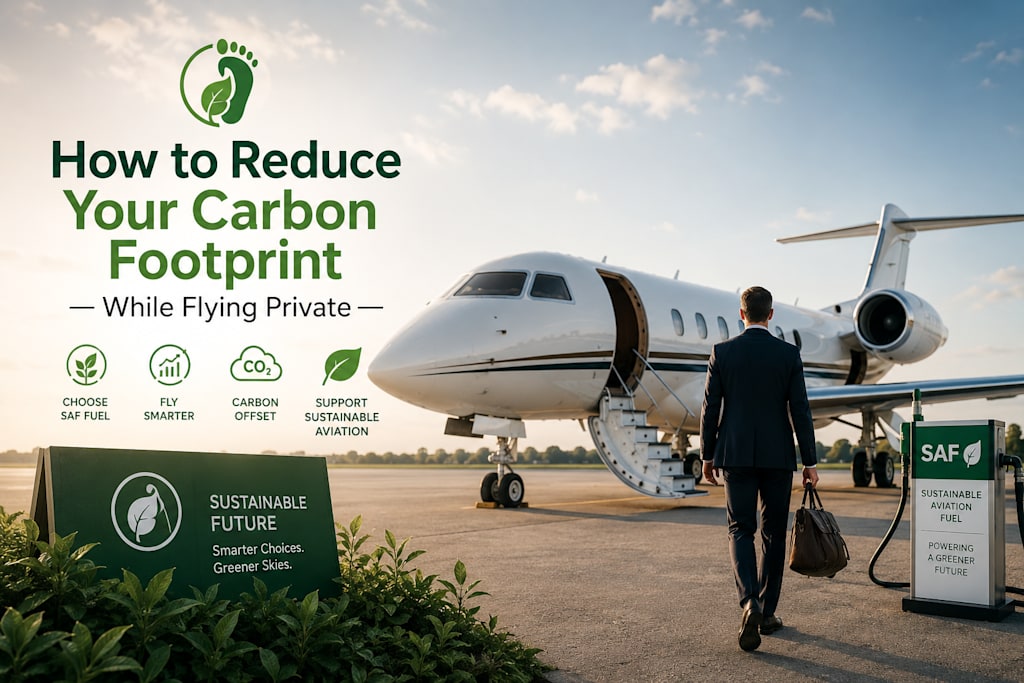
Private aviation offers unmatched convenience, speed, privacy, and efficiency for global executives and families. However, in 2026, the environmental impact of luxury travel is an issue that can no longer be overlooked. Private jets emit significantly more carbon dioxide per passenger than commercial airliners.
As awareness of climate change grows, the luxury travel sector is changing. The good news is that you do not have to sacrifice the comfort of private flight to be an eco-friendly traveler. By adopting modern, sustainable aviation practices, you can enjoy flying while greatly reducing your environmental impact.
1. Opt for Sustainable Aviation Fuel (SAF)
The most significant change a private flyer can make today is choosing aircraft that use Sustainable Aviation Fuel (SAF). This fuel comes from renewable waste and residues, such as used cooking oil and municipal waste. SAF can reduce lifecycle carbon emissions by up to 80% compared to regular jet fuel.
Most modern private jets can fly on SAF blends. When booking through a charter broker or managing your own aircraft, ask specifically about SAF availability. Mike Savage, a New Canaan blogger who often writes about combining a premium lifestyle with responsible choices, notes that supporting SAF infrastructure is the quickest way to speed up the green transition in luxury travel.
2. Leverage High-Yield Carbon Offset Programs
If SAF is not available at a certain regional airport, carbon offsetting becomes an important second choice. Carbon offsetting involves calculating the emissions of your flight and purchasing equivalent carbon credits to fund verified environmental projects.
When choosing an offsetting program, avoid general options. Invest in high-quality, third-party audited projects that focus on:
Reforestation and Afforestation: Planting native trees that absorb carbon from the atmosphere.
Renewable Energy Infrastructure: Funding wind, solar, or methane-capture projects in developing areas.
3. Minimize "Empty Leg" Flights
An "empty leg" occurs when a private jet flies without passengers to return to its home base or to get ready for its next chartered flight. These flights create a significant amount of unnecessary carbon emissions in the private aviation industry.
Many luxury travelers are now using digital booking platforms to match their schedules with available empty legs. By booking an empty leg flight, you are using a jet that was already scheduled to fly, reducing the net carbon footprint of your trip. New Canaan’s blogger Michael Savage often points out that using these smart digital logistics benefits everyone, allowing travelers to enjoy private comfort at a lower cost while improving aviation efficiency.
4. Choose Modern, Fuel-Efficient Aircraft
Not all private jets are the same in terms of fuel efficiency. Older aircraft models are much less efficient and produce higher levels of greenhouse gases.
When chartering, focus on newer aircraft that have aerodynamic winglets, lightweight composite materials, and modern propulsion systems. Choosing a mid-size or super-midsize jet over a heavy, ultra-long-range jet for short regional trips also significantly cuts down on unnecessary fuel use.
5. Reduce In-Flight Plastic Waste and Weight
Sustainability goes beyond the engines; it includes the cabin experience. The overall weight of an aircraft directly affects its fuel consumption.
• Encourage catering services to use sustainable, lightweight, and reusable materials instead of single-use plastics.
• Travel light whenever possible, as removing excess cargo weight reduces the overall fuel burn of the jet.
A Greener Horizon for Luxury Travel
Flying private with an eco-friendly mindset is completely achievable. By using sustainable fuels, offsetting emissions, and making smart choices about the aircraft you charter, you can help protect the earth while enjoying the freedom of the skies.
About the Creator
Mike Savage New Canaan
Below is a list of Mike’s personal websites. Each one represents a different part of his work and interests.
Enjoyed the story? Support the Creator.
Subscribe for free to receive all their stories in your feed.
Comments
There are no comments for this story
Be the first to respond and start the conversation.