
How Himalayan Beekeepers Harvest the World’s Rarest Cliff Honey
Did you know there exists a centuries-old honey in one of the highest corners of the world? Explore more here.

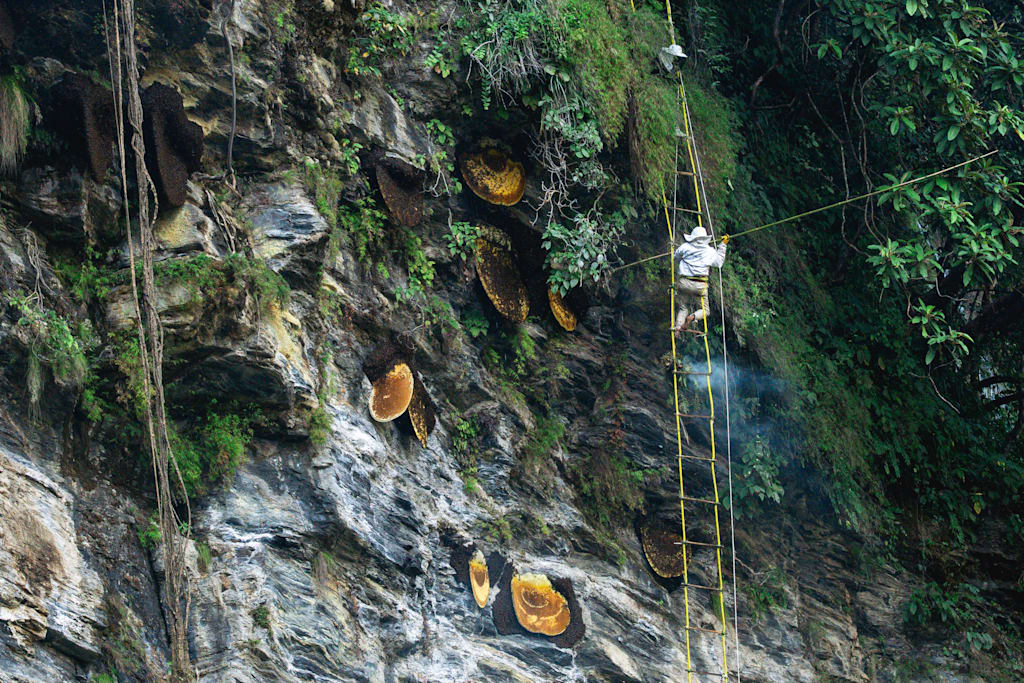
Himalayan Cliff honey, also known as "mad honey", is a honey type found in the forests of the rarest, highest altitudes around 3,000 to 4,000 metres. The honey is unique in kind as it gets to rest in the different microclimates of the Himalayas. The result is each jar carrying the pure essence of wildflower nectar only found in the alpine and subalpine zones.
Only the native harvesters hunt down hives of mad honey. The expertise and skill they possess are in complete harmony with nature. Least harm to bees, habitat site preservation, the native knowledge and practice are what have kept the hunting tradition, bees and Himalayan cliff honey alive for centuries.
World's Rarest Cliff Honey
Nobody would have ever thought mountains could give a honey type, until it was discovered in reality! A rare honey bee species—Himalayan giant bees are the daredevils that have evolved with unique adaptations to survive here. No other honeybee species has been found to live at extreme temperatures of around zero and even below it.
To conserve energy, these bees build huge hives, where colonies live in clusters and create warmth for survival. In this same hive, a tremendous quantity of mad honey, more than 80 kgs per hive is stored. The honey is stored only two times a year- spring and autumn- and this is when the harvesting is done.
The nectar from the flowers grown in clean, mineral-rich soil makes the honey nutritionally dense. The environment is such that antioxidants are also high in the plant that gets transferred to honey. So, if compared, Himalayan cliff honey or mad honey has a substantially larger amount of nutrients than regular honey.
Himalayan Beekeepers and How They Harvest
Himalayan indigenous people are the only group of harvesters practising the mad honey hunting tradition. No modern approaches have been allowed to preserve the ancient techniques. The long-standing custom stands on practices that show full respect to both bee colonies, the environment, and the local community.
They have their own unique process, let’s have a look below:
Traditional ritual for day selection: The community priest is the initiator of harvesting. He acquires all the traditional and spiritual knowledge, and based on the astrological, seasonal, and environmental knowledge he first determines the day of harvesting.
Preparation for harvesting: For the mad honey harvest day, different tools are needed. All the community members come together and prepare the basics- climbing ladder, ropes, sticks, baskets to collect the harvest, everything is handmade. The recent changes are only safety gears; now we can find harvesters wearing protective climbing and honey hunting gear for safety.
Harvesting day: The harvesting day begins with prayers and offerings from the priest. After performing the spiritual traditions, the main harvester begins the ascent. Mad honey harvest from each hive requires 3-4 hours of continuous hanging in the air, just with the support of the tools prepared beforehand.
The harvester drops the combs fully reaped, juicy and filled with mad honey. After completing the harvest, it’s time for the harvesting group to distribute the honey among the members who participated.
Use of the Harvest
Himalayan cliff honey thus harvested is separated for self-use, selling and storage. Mad honey is a key ingredient of many traditional delicacies and even fermented drinks. It is a valuable economic commodity and is a prestigious gift used to honor guests and celebrate special occasions.
Continuity of Traditional Harvesting Technique
The traditional mad honey harvesting technique was developed through years of trials, observing and understanding the environment deeply, and adapting according to the demands of nature.
Significances
Unity among the community members: The tradition is completely dependent on how the individuals of the mountain village function. Thankfully, the community still lives in harmony and there is no halt in this traditional culture.
Respect for nature and tradition: As these native communities know intimately how the ecosystem here functions, their ancient knowledge and experience have helped them do the hunting responsibly without posing any harm to nature, be it about the vulnerability of bees or the mountain ecosystem.
Moreover, the honey hunting technique also has a cultural significance towards preserving ancestral knowledge.
Sustainability maintenance: Modern mad honey harvesting techniques may overharvest resources with no guarantee of replenishment for future generations. However, this is not true while using traditional techniques.
Conclusion
In this era where processed honey makes most percentage of the global supply chain, Himalayan cliff honey stands as a living proof of a distinct honey type that still remains uninfluenced by modern extraction and processing methods. The quality that it continues to deliver is also linked to the harvesting technique.
Able to still thrive, the traditional mad honey hunting practices of Himalayan honey hunters represent one of the most valuable traditions. The continuity with sustainability is a reminder that with nature-friendly adaptations, we can preserve both the bees and rare natural delicacies for future generations.
About the Creator
Himalayan Cliff Honey
Hunters on ropes. Beekeepers and ancient hives. Wild rhododendron and highland blooms at 4,000m. This is Nepal's rarest harvest, and we bring it to you, raw and untouched.
Visit: https://cliffhoney.com/
Enjoyed the story? Support the Creator.
Subscribe for free to receive all their stories in your feed.
Comments
There are no comments for this story
Be the first to respond and start the conversation.