
How an Icy Shipping Route at the Top of the World Is Bringing China and Russia Together
The Northern Sea Route is becoming a strategic trade corridor, strengthening China-Russia cooperation while reshaping the future of Arctic commerce.
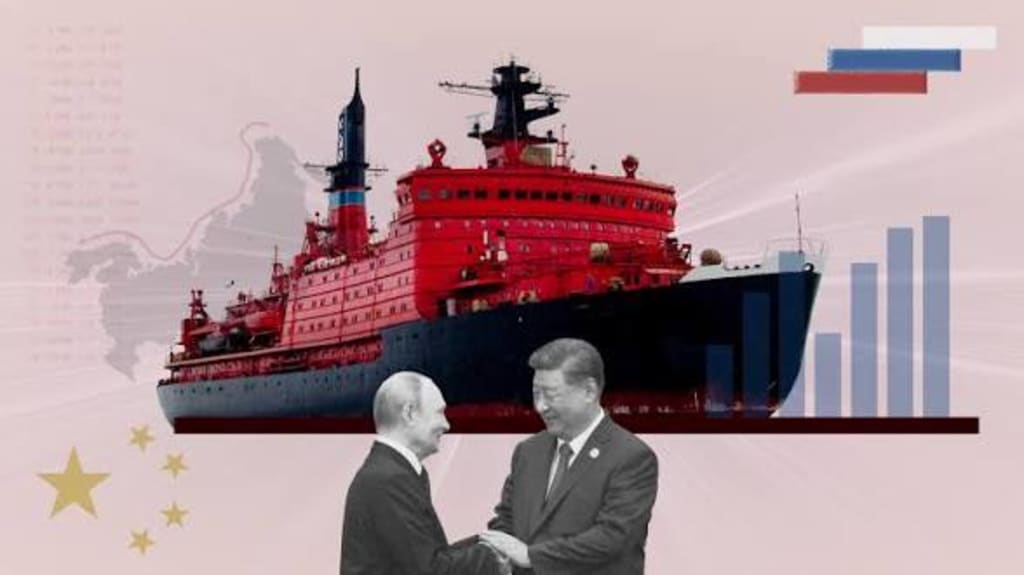
The Arctic is rapidly becoming one of the most strategically important regions in the world. As temperatures rise and sea ice patterns change, an ancient geographical barrier is opening new possibilities for international shipping. At the center of this transformation is the Northern Sea Route (NSR), a maritime corridor running along Russia’s Arctic coastline between the Atlantic and Pacific oceans.
For China and Russia, the route represents far more than a shortcut for cargo ships. It is becoming a symbol of expanding economic cooperation, energy partnerships and strategic coordination. Russia controls most of the coastline and infrastructure surrounding the route, while China has strong manufacturing capacity, shipping interests and growing demand for energy and raw materials.
Why the Northern Sea Route Matters
Traditional shipping between Asia and Europe generally passes through the Suez Canal. The Northern Sea Route offers a potentially shorter connection between northern European ports and East Asian destinations.
The route can significantly reduce sailing distances on some Europe-Asia journeys, although actual savings depend on the origin, destination, vessel type, weather and ice conditions. Unlike conventional shipping lanes, however, the NSR remains challenging because of harsh Arctic conditions, seasonal sea ice, limited infrastructure and difficult emergency-response conditions.
Russia has invested heavily in developing the route because it sees the Arctic as an important component of its long-term economic and national strategy. Ports, icebreakers, navigation systems and energy infrastructure are being expanded to support increased traffic.
China, meanwhile, views Arctic shipping as another potential component of its international trade network.
China’s Growing Arctic Interest
China does not have an Arctic coastline, but it has increasingly described itself as a stakeholder in Arctic affairs. Beijing has developed scientific, economic and diplomatic interests in the region and has promoted cooperation with Arctic countries.
The Northern Sea Route fits naturally into China's broader interest in diversifying trade routes. A functioning Arctic corridor could provide an alternative to heavily used maritime chokepoints.
For Chinese companies, the attraction is particularly strong when the route can support the transportation of energy resources and industrial commodities from Russia toward Asian markets.
China's interest also extends beyond shipping itself. Investments and commercial cooperation can involve ports, logistics, shipbuilding, satellite navigation, Arctic research and specialized vessels.
Russia’s Energy Strategy
Energy is one of the strongest foundations of China-Russia Arctic cooperation.
Russia possesses enormous reserves of natural gas and other resources in its northern territories. Projects such as Yamal LNG have demonstrated the potential for Arctic energy production to reach Asian markets.
China has participated in Russian Arctic energy development, while Chinese companies have become important customers for Russian energy exports.
The Northern Sea Route therefore connects two strategic interests: Russia wants reliable markets for its Arctic resources, and China wants secure and diversified energy supplies.
This relationship has become particularly significant as Russia has sought to strengthen economic links with Asian markets.
Icebreakers Are Essential
One of the biggest challenges facing Arctic shipping is ice.
Even as climate change reduces sea ice in some areas, the Northern Sea Route cannot simply become an ordinary open-water shipping lane. Ice conditions can remain dangerous, particularly during winter and in areas where thick or multi-year ice persists.
Russia has developed one of the world's most capable fleets of nuclear-powered icebreakers. These vessels can escort commercial ships through difficult Arctic waters and help maintain navigation for longer periods.
For Russia, icebreakers are therefore not only transportation tools but also strategic infrastructure.
China has also developed Arctic-capable vessels and has gained experience operating in polar waters. Cooperation between the two countries could increase their ability to handle the logistical challenges of Arctic shipping.
A Changing Global Trade Map
The growth of the Northern Sea Route could eventually influence global trade patterns.
If the route becomes more predictable, commercially viable and available for longer periods each year, shipping companies may increasingly consider it as an alternative to traditional routes.
However, the NSR is unlikely to replace the Suez Canal completely. The Arctic route remains more difficult, insurance costs can be higher, infrastructure is less developed, and ships may require specialized equipment or icebreaker assistance.
Environmental concerns are another major issue. Increased Arctic shipping creates risks involving oil spills, underwater noise, black carbon and disruption to fragile ecosystems.
Strategic Cooperation Beyond Trade
The significance of the Northern Sea Route goes beyond economics.
Closer cooperation in the Arctic can strengthen diplomatic ties between Beijing and Moscow. Shared interests in shipping, energy, infrastructure and research create additional channels for cooperation.
For Russia, Chinese investment and demand provide an important economic connection to Asia. For China, Russia offers access to Arctic resources and a northern maritime corridor.
This does not mean that China and Russia have identical interests. Moscow remains highly protective of its sovereignty over Arctic territories and shipping infrastructure, while Beijing generally seeks greater international participation in Arctic governance.
Their cooperation is therefore based primarily on overlapping interests rather than complete strategic alignment.
What the Future Could Look Like
The future of the Northern Sea Route will depend on several factors: climate conditions, infrastructure investment, international sanctions, energy demand, shipping costs and geopolitical developments.
Technology could also play a major role. Better satellite monitoring, autonomous navigation systems, improved ice forecasting and stronger communications could make Arctic shipping safer.
If these developments continue, the Northern Sea Route could become an increasingly important part of Eurasian trade.
For China and Russia, the route offers something particularly valuable: a shared economic project in a region where both countries see long-term strategic opportunities.
Conclusion
The Northern Sea Route is transforming the Arctic from a remote and difficult environment into an increasingly important commercial and geopolitical corridor. Russia provides the geography, energy resources and icebreaking infrastructure, while China brings investment, industrial capacity, shipping expertise and access to major Asian markets.
Their cooperation around this icy maritime route could reshape Arctic trade over the coming decades. Yet the future is not guaranteed. High operating costs, unpredictable ice, environmental risks and geopolitical tensions remain significant obstacles.
Still, the message is clear: the Arctic is no longer simply the top of the world—it is becoming a new crossroads of global trade, energy and strategic competition.
About the Creator
Enjoyed the story? Support the Creator.
Subscribe for free to receive all their stories in your feed.
Comments
There are no comments for this story
Be the first to respond and start the conversation.