
How about “Trade Winds: The Winds That Shaped Our World”?
Trade Winds: The Winds That Shaped Our World
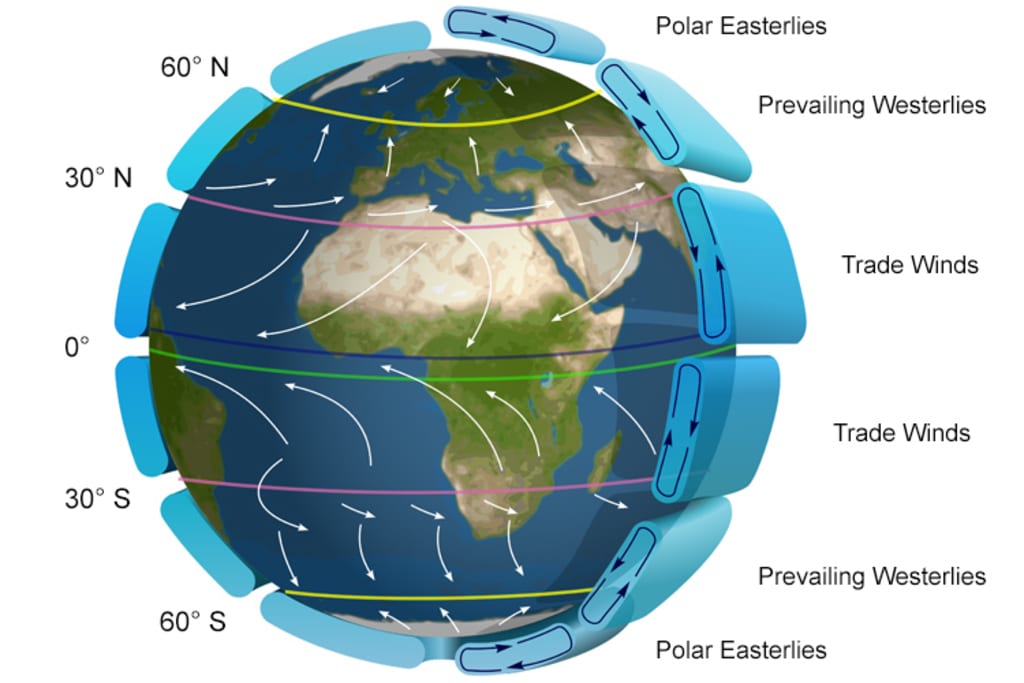
Trade winds are the permanent east-to-west prevailing winds that flow in the Earth’s equatorial region. They blow mainly from the northeast in the Northern Hemisphere and from the southeast in the Southern Hemisphere, strengthening during the winter and when the Arctic oscillation is in its warm phase.
Trade winds have been used by captains of sailing ships to cross the world’s oceans for centuries. They enabled colonial expansion into the Americas, and trade routes to become established across the Atlantic Ocean and the Pacific Ocean. In meteorology, they act as the steering flow for tropical storms that form over the Atlantic, Pacific, and southern Indian oceans and make landfall in North America, Southeast Asia, and Madagascar and East Africa.
Shallow cumulus clouds are seen within trade wind regimes and are capped from becoming taller by a trade wind inversion, which is caused by descending air aloft from within the subtropical ridge. The weaker the trade winds become, the more rainfall can be expected in the neighboring landmasses. The trade winds also transport nitrate- and phosphate-rich Saharan dust to all Latin America, the Caribbean Sea, and to parts of southeastern and southwestern North America. Sahara dust is on occasion present in sunsets across Florida. When dust from the Sahara travels over land, rainfall is suppressed and the sky changes from a blue to a white appearance which leads to an increase in red sunsets. Its presence negatively impacts air quality by adding to the count of airborne particulates.
The term “trade winds” originally derives from the early fourteenth century sense of trade (in late Middle English) still often meaning “path” or “track”. The Portuguese recognized the importance of the trade winds (then called “volta do mar”, meaning “turn of the sea” or “return from the sea”) in navigation in both the north and south Atlantic Ocean as early as the 15th century.
From West Africa, the Portuguese had to sail away from continental Africa, that is, to west and northwest. They could then turn northeast, to the area around the Azores islands, and finally east to mainland Europe. They also learned that to reach South Africa, they needed to go far out in the ocean, head for Brazil, and around 30°S go east again. This is because following the African coast southbound means sailing upwind in the Southern hemisphere.
In the Pacific Ocean, the full wind circulation, which included both trade wind easterlies and higher-latitude westerlies, was unknown to Europeans until Andres de Urdaneta’s voyage in 1565. The captain of a sailing ship seeks a course along which winds can be expected to blow in direction of travel. During Age of Sail, pattern of prevailing winds made various points of globe easy or difficult to access, therefore had direct effect on European empire-building and thus on modern political geography.
In conclusion, trade winds are an important meteorological phenomenon that have played a significant role in shaping our world’s history. From enabling colonial expansion into Americas and establishing trade routes across Atlantic Ocean and Pacific Ocean to acting as steering flow for tropical storms that form over Atlantic, Pacific, southern Indian oceans and make landfall in North America, Southeast Asia, Madagascar East Africa; trade winds have had profound impact on our world. They continue to play important role today by transporting nitrate- phosphate-rich Saharan dust to all Latin America Caribbean Sea parts southeastern southwestern North America impacting air quality rainfall patterns.
About the Creator
Enjoyed the story? Support the Creator.
Subscribe for free to receive all their stories in your feed.
Comments
There are no comments for this story
Be the first to respond and start the conversation.