
He Was Reassigned to Equine Science. Then He Became China’s Only Undergraduate Farrier.
A 522 gaokao score almost left Fu Huadong with no college seat. He picked the one farrier track in his year and turned a cold major into a rare skill.
One
When Fu Huadong got the call from admissions, he had already accepted that he might not go to college.
He scored 522 on the gaokao. He applied to Sports Rehabilitation and checked “do not accept adjustment.” His score fell short. His file came back. He lost his spot. Then the phone rang. Would he accept a transfer to Equine Science? He said yes.
He is from Laohekou, Xiangyang. Born in 2004. His family is ordinary. Wuhan Business University, International Equestrian College. Tuition is about 4,000 yuan a year. The campus holds Yuma Sports Park. The school keeps 50 horses. He learned these numbers slowly.
In his sophomore year, in an equestrian class, he first touched farriery.
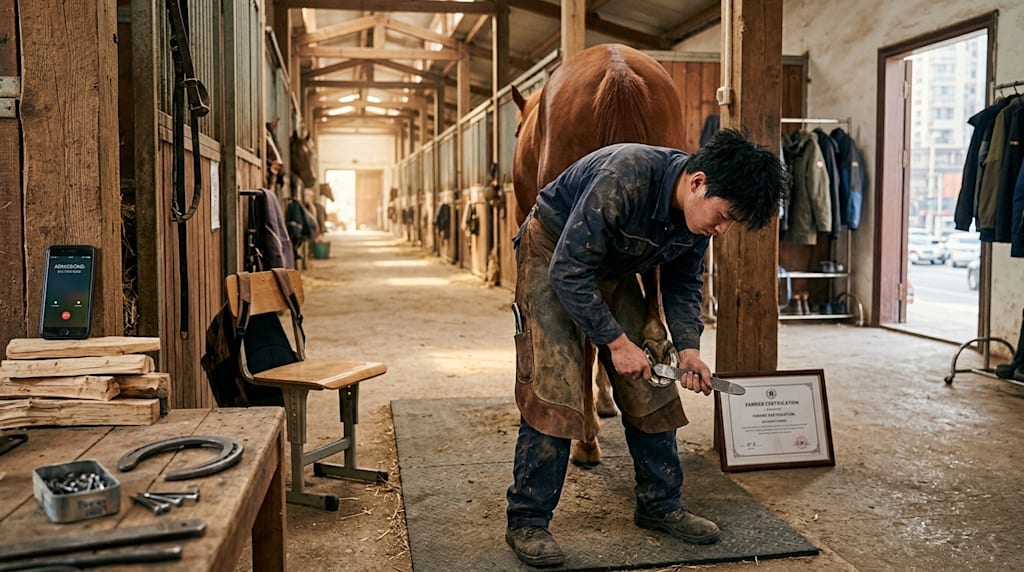
Farriery means trimming a horse’s nails. The hoof is hard keratin at the end of the toe. The shoe is nailed into keratin, which has no nerves. Done right, it does not hurt. It is like trimming and filing a human nail. The hoof goes between the legs. One hand holds it. The other uses a hoof knife to cut away old, cracked keratin. A rasp smooths the sole. The handmade shoe is checked against the curve of the hoof, again and again.
He chose the farriery track. In his year, he was the only one.
Two
He apprenticed under Li Jixin. Li has worked in the trade for more than thirty years.
His master did not let him touch a horse at first. He whittled wooden boards and copied the motion of trimming a hoof. He did this for half a month.
After half a month, his feel passed. He started trimming real horses.
He has shod all 50 horses on the school registry. The work goes like this: clamp the hoof between your legs, hold it with one hand, cut away old keratin with a hoof knife. Rasp the sole. Check the handmade shoe against the hoof curve. The full process includes pulling the old shoe, trimming the sole, cutting the hoof wall, rasping it flat, forging the shoe, driving nails, and finishing. He also has to restrain the horse and control the workspace.
One horse takes at least forty minutes. A morning usually covers two.
He bends over for long stretches. After a full session, his back often locks up. He said he fears short ponies most. Holding them means squatting, which hurts his lower back.
Three
Learning the trade brought bruises.
A month in, he failed to hold a horse’s hind leg while driving a nail. The horse pulled back. The nail missed and cut his finger.
Another time, he gave the wrong signal. The hoof knife landed on his left foot.
He has been kicked, stepped on, and cut by nails. He calls this normal.
During training, he worked on a Thoroughbred named “Sun Xingzhe.” The horse had fragile hooves from genetics. Large cavities had opened in its front hooves. The shoe was exposed. Under his master’s guidance, he cleaned the cracked material, disinfected and filled the cavities, and refitted the shoe. He finished the repair.
Cases like this taught him that the same horse changes each time. No two horses are alike. Farriery cannot follow one template.
Four
To build feel, he stayed at school for two winter and summer breaks. He moved between the stable and the library. When he had no class, he used breaks to practice farriery and learn horse behavior.
His life ran on three points: classes, stable training, dragon boat training.
The pace did not push him out. Each finished hoof and solved problem gave him satisfaction. He treated the work as rest.
In June, he earned the farrier certificate from the China Horse Industry Association. Among more than 70 certified farriers in the country, he is the only undergraduate and the youngest.
His goal is to keep learning, build experience, and pass the senior farrier exam before taking related work.
Five
Outsiders ask about income first.
Some reports say a shoeing costs more than 1,000 yuan and a good farrier can make six figures a month. Fu Huadong gives a cooler number. An ordinary farrier makes less than five figures a month. Six figures belongs to the top of the trade.
That correction matters. When a job gets a high-pay reputation, the top earners get repeated. Most workers’ pay gets left out. Treating top pay as normal misleads young people and hides how hard the craft is.
Nationwide, farriers are scarce. Only about 70 hold certificates. The field started late. Li Jixin, who has worked more than thirty years, is thinking about retirement. His younger son coaches at an equestrian club in Qingdao. The craft needs new hands. An undergraduate who enters this niche fills a gap.
This does not make it a boom.
China has a limited number of horses. Far fewer need professional farriery. Demand is steady. The market is small. The scarcity comes from hard conditions, a long apprenticeship, and a high skill threshold. The job advantage comes from small supply, not exploding demand.
Six
Fu Huadong’s major came from adjustment. He picked a niche direction and turned an ordinary major into a rare skill.
If you get reassigned, do not just call the major a pit. Ask: Is there a niche inside it that needs high skill and few people want to do?
You cannot pick the major. You can pick the direction.
That sounds simple. It takes initiative and research. You need to know the courses, the jobs, the skills, the certificates, the masters, and the paths into the trade.
Every industry has six-figure earners. Most workers make ordinary money. Before you enter, ask: If I only made the average, would I still do this? If the answer is no, slow down.
Fu Huadong said it plain: An ordinary farrier makes less than five figures a month. Six figures is the top. That line is more useful than any high-pay rumor.
Seven
You mentioned a middle school classmate who studied equestrian instruction at a vocational high school. He taught people to ride. Two years ago, you asked him about the field. He said there was basically no money in it. Now he sells Arc’teryx jackets. His Moments feed is full of clothing posts and sales pitches.
That contrast is sharp.
Equestrian instruction and farriery sit in the same horse world. Their career logic differs.
Instruction, or coaching, stays close to clients and far from technical barriers. A good rider can be trained for the job. The core skills are communication, teaching, and service. Income comes from lesson commissions. It depends on client count and the club’s health. If the industry shifts, a club closes, or clients leave, a coach is easy to replace.
Farriery is the opposite. It stays far from clients and close to technique. It needs anatomy, mechanics, metalwork, and animal behavior. It passes through long apprenticeships. It cannot be rushed. Better technique brings steadier clients and a stronger personal name. Older farriers with experience stay in demand. Experience is the asset. They can work independently.
Coaching depends on a platform and client resources. Farriery depends on skill and reputation. Coaching is a red ocean. Farriery is a narrow gate. When the industry shakes, skill holds up better than platform access.
This does not mean coaching has no future. It does not mean farriery fits everyone. It means that inside one industry, positions differ in value, replaceability, and career length. When you pick a major or direction, look past the industry name. Look at where you sit in the chain.
Eight
“Unpopular” usually means one of two things. One: demand exists but few people will do it. Farriery, funeral services, and special education fit here. Two: demand has not broken out yet. Computers and e-commerce fit here years ago. Fu Huadong chose the first kind. Demand is steady. Most people avoid it because it is hard, tiring, and dirty.
Opportunity often sits where people will not bend down. First, learn why the field is cold. Is demand missing? Or is the threshold high and the cost heavy? If it is the second, and you can pay the cost, it can become your moat.
When everyone calls something a boom, it is no longer a boom. Equestrian coaching looked like a boom. Too many people entered. Supply outran demand. Farriery kept a high threshold and avoided the crush. When you pick work, watch supply and demand, not heat.
Fu Huadong said, “You don’t have to sit in an office to be excellent.” That line names the mental block. Many high-value technical jobs require letting go of “respectable.” When you can accept the unglamorous parts, you pass most competitors.
Nine
Fu Huadong is still moving.
His goal is not the legendary six-figure farrier. He wants to keep learning, build experience, pass the senior exam, and then work in the field.
The goal is not flashy. It is not loud. It is plain. It is solid, like a shoe hammered into shape, like a hoof trimmed cut by cut.
His path changed at college adjustment. The direction was his to choose. Turning a cold path into something hard to replace, turning a narrow gate into a moat, may help young people who worry about their major more than any high-pay rumor.
Some enter a cold major and call it a pit. Others see a chance. Adjustment is a chance for some. For others stuck in the mud, it is a trap. The difference is not the major. It is whether you understand why the field is cold, where demand sits, what the cost is, and whether you will bend down for it.
Only at hiring do you learn the pot is iron. Everyone knows the boom. How many apply? Civil service exams draw few for prison work. Funeral majors stay small. There are many reasons. If you can accept the trade, it is an edge. If you walk away, you have reasons.
A cold major does not mean no path. You need to know why it is cold. Think it through, then decide. If you cannot, you will not go. If you can, go.
About the Creator
Jin
Writer of reamstories
https://reamstories.com/jin
Enjoyed the story? Support the Creator.
Subscribe for free to receive all their stories in your feed. You could also become a paid subscriber, letting them know you appreciate their work.
Comments
There are no comments for this story
Be the first to respond and start the conversation.