
He Reported His Employer for Unsafe Dust. Then the Government Fined Him.
Li Weizhi has stage III pneumoconiosis, no labor contract, and a revoked 50,000 yuan penalty. His fight for a diagnosis is still going.
1. The fine
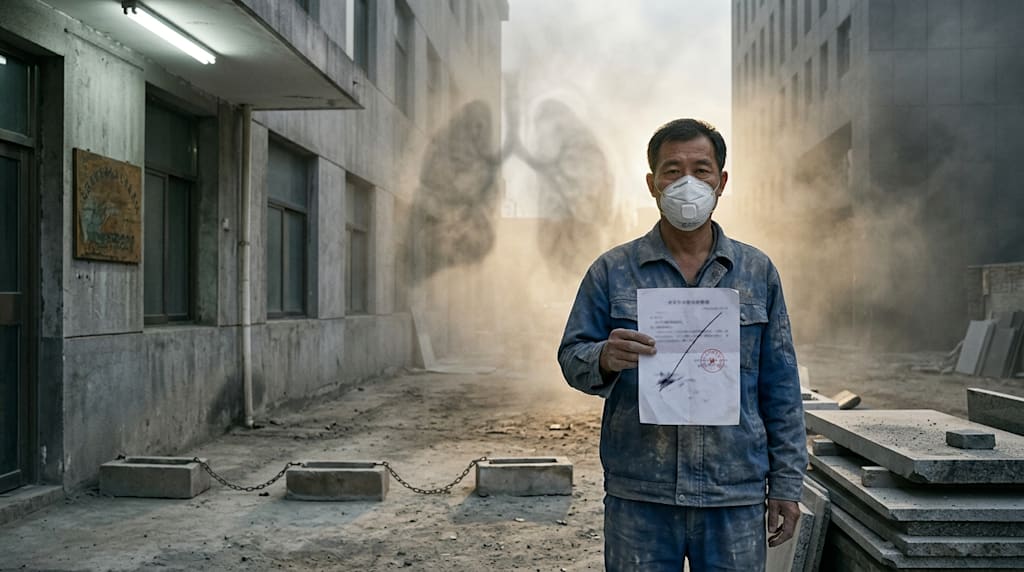
On March 3, 2026, Li Weizhi received a 50,000 yuan fine.
The reason was the harm done to him. The Wuhua District Health Bureau said Li violated Article 31 of the Occupational Disease Prevention and Control Law. He accepted work that produces occupational disease hazards, stone countertop installation, without protection. That was the harm. The fine punished him for being the person harmed.
In May 2020, Li began renovation work in Kunming. He took dispatch orders from Yunnan Shilai Trading Co., Ltd. on piece rates. He installed stone countertops in homes. The work kept him in dust. According to Li, the company gave no protection training and no masks. In July 2023, he was diagnosed with suspected stage III pneumoconiosis. He could not work.
He asked Shilai for the materials needed for an occupational disease diagnosis. The company did not give them. In June 2025, he reported the company to the Wuhua District Health Bureau. He also asked the bureau to do its job and make the company provide the materials. The company was fined 210,000 yuan. Months later, Li received his own fine: 50,000 yuan.
He had reported the company. The bureau punished him. “I reported the company and got fined,” he said. “Did I report myself?”
The case is not just about one bad enforcement decision. It shows failures in four areas: how the law is read, how enforcement works, how courts review it, and how the system protects workers. On September 18, the Wuhua District Health Bureau revoked the 50,000 yuan fine. That corrects one error. It does not solve the case.
II. Article 31
The bureau’s first penalty looked complete.
Article 31 says no unit or individual may transfer work that produces occupational disease hazards to units or individuals without protection conditions. It also says units and individuals without protection conditions may not accept such work. Article 75(5) allows a fine of 50,000 to 300,000 yuan for violations.
The bureau reasoned: Li is an individual. He lacked protection conditions. He accepted hazardous work. Therefore he should be fined.
That reasoning uses a syllogism. Legal interpretation is not just a syllogism. It requires reading the concepts, the purpose, and the whole law.
Article 1 states the purpose: prevent and control occupational disease hazards, protect workers’ health and related rights, and promote economic and social development. The law puts the employer first. Article 4 says workers have the right to occupational health protection. Article 20 requires employers to adopt effective protection facilities and provide personal protective equipment.
Article 31 aims to stop the transfer of hazards at the source. The first half targets the transferor. It targets employers that avoid protection costs by sending hazardous work to people who cannot protect themselves. The second half targets the accepting party. That party is an individual acting as a business operator: a labor contractor, a work organizer, a team leader, an individual contractor. These people take on work, organize labor, and profit from it. They should answer for health and safety during the job.
Li’s lawyer, Ma Kan, said the “individual” in this clause usually means “a labor contractor, work organizer, construction team leader, or individual contractor who organizes labor and benefits from it, not an ordinary migrant worker like Li Weizhi who only sells his labor.” Li took orders on piece rates. He provided labor. He did not organize others. He did not make business profits. The clause’s basis for blame does not fit him.
Applying a clause about business operators to a worker is an abuse of expansion. It is like a criminal law that says no individual may rob, then sentencing the person who was robbed because he was part of the robbery. The reasoning is absurd on its face.
The penalty also violated the proportionality principle in the Administrative Punishment Law. Punishment must match the facts, nature, circumstances, and social harm of the violation. Li’s conduct caused no social harm. He suffered the hazard. He did not create it. Punishing him cannot prevent occupational disease or correct illegal conduct. It only chills reports.
III. Procedure
The procedure also raises questions.
In June 2025, Li reported the company. The company was fined 210,000 yuan. On March 3, 2026, Li received a 50,000 yuan fine. The report came first. The punishment came later. The timing is close. It creates a reasonable suspicion of retaliation.
Article 13 gives any unit or individual the right to report and accuse violations. If an agency fines the reporter after receiving the report, the effect is to punish reporting. Workers will stop reporting. Employers’ violations will be harder to find.
Timing alone does not prove retaliation. But an agency must show that its punishment was independent and justified. The revocation decision does not. It says only that after reviewing the case file and facts, the bureau decided to revoke the penalty. That vague language makes the revocation look like a response to public pressure, not a correction of a legal error.
If the bureau knew the penalty had a fundamental legal error, it should say so. Was the error in legal application? In fact-finding? In procedure? In discretion? Clear correction would guide similar cases. It would show the public that this was not special treatment.
The revocation also came after the first-instance hearing and before the court ruled. Li sued the bureau on March 11, 2026. The hearing was on May 25. The Wuhua District Court extended the trial by six months, with approval from the Yunnan Provincial Higher People’s Court, because the case was complex. Then the bureau revoked the penalty. That let the agency leave judicial review early.
If the court dismisses the case or confirms the original act was illegal, the first outcome leaves the legal question open. The second requires Li to keep litigating. Li said he will not withdraw. “This case started with my report,” he said. “The report was to get materials for an occupational disease diagnosis. I still do not have them. I want to finish the judicial process.”
His persistence matters beyond his own case. A court ruling can bind similar enforcement. It can confirm that punishing a reporting worker is illegal. It can give later workers a precedent. Revocation is self-correction. Judicial review is the final word on legality.
IV. The deadlock
The 50,000 yuan fine is an open enforcement error. The deeper problem is institutional.
Li’s path shows a loop: prove a labor relationship, get an occupational disease diagnosis, get a work injury ruling, get compensation. Li had no labor contract and no social insurance. He could not prove a labor relationship. That blocked him at step one.
He did renovation work in Kunming. He took orders on piece rates. That work model is hard to recognize as a standard labor relationship. He tried labor arbitration and court cases to confirm a relationship with Yunnan Shilai Trading Co., Ltd. He lost. Without proof of a labor relationship, the Third People’s Hospital of Yunnan Province refused to diagnose him. Without a diagnosis, he is not a legal occupational disease patient. Without that status, he cannot get work injury compensation.
He asked health departments to make the company provide diagnostic materials. The Yunnan Provincial Health Commission replied that under current rules it cannot diagnose an occupational disease without a labor relationship. He recently applied to the Yunnan Provincial Government for administrative reconsideration. He wants the commission to act under the Occupational Disease Prevention and Control Law, collect evidence, and move the diagnosis forward. That case is ongoing.
This is a system deadlock. Employers fail to sign contracts, fail to pay social insurance, and fail to provide protection. Workers cannot prove a labor relationship. They cannot get a diagnosis. They cannot get compensation. When they report, the agency that should make the employer provide materials fines the worker instead. Every step hits a wall.
Li is not alone. In renovation, stone processing, mining, and other industries with high rates of pneumoconiosis, flexible hiring, subcontracting, and unclear labor relationships are common. Workers often know who gave them work. They do not know the legal employer. When they get sick, the employer can change entities, deregister, or refuse to cooperate. The diagnosis system requires workplace hazard tests and occupational history from the employer. Workers cannot produce that evidence alone.
V. What to change
Policy has started to move. Last year, the Ministry of Human Resources and Social Security and eight other departments expanded a pilot for occupational injury protection for people in new forms of employment. The pilot tries to move past the labor relationship requirement for work injury compensation. The Supreme People’s Court and the ministry also issued documents. If an illegal enterprise subcontracts or contracts out work and a worker is injured or killed, the worker can apply for work injury recognition even without a labor relationship.
The direction is right. The coverage is narrow. The pilot mainly covers instant delivery, ride-hailing, and urban freight. It has not reached renovation, stone processing, and other traditional flexible work where pneumoconiosis is common. Li wants the pilot to include pneumoconiosis workers so he can get occupational injury compensation.
To prevent the next Li Weizhi, changes are needed in at least five areas.
Set the boundary of Article 31. Judicial or administrative interpretation should state that “individual” means an individual acting as a business operator, such as a labor contractor, work organizer, or individual contractor. It should not mean a worker who only sells labor. This stops agencies from turning a protective clause into a punitive tool.
Protect reporters. After receiving an occupational disease report, an agency should keep the reporter’s identity confidential. It should avoid adverse treatment of the reporter during enforcement. If it must investigate or punish a reporter, it should send the matter to a higher agency for review and give written reasons. Retaliation should carry legal consequences.
Shift the burden of proof in diagnosis. When a worker cannot prove a labor relationship, the health department should collect and preserve evidence on its own. It should order the employer to provide diagnostic materials. If the employer refuses, it should face adverse consequences. A presumption rule could help: if the employer does not cooperate, presume the worker’s disease is linked to the workplace.
Expand occupational injury protection. Include pneumoconiosis patients and other traditional flexible workers. Do not make a labor relationship the first requirement. Use fund pooling, industry contributions, and government subsidies to provide coverage.
Let courts finish the review. After an agency revokes a penalty, a court should still judge the original act. If the plaintiff keeps the case, the court should continue and decide whether the original act was illegal. That gives the individual case an answer and gives similar enforcement a rule.
VI. Conclusion
For Li, the revocation is progress. He left the hospital in late July. For a man with pneumoconiosis, the news is rare relief. But he will not withdraw the case. “This case started with my report,” he said. “The report was to get materials for an occupational disease diagnosis. I still do not have them. I want to finish the judicial process.”
His persistence goes beyond his own case. If the case leads to a ruling that punishing a reporting worker is illegal, if it pushes health departments to protect reporters, and if it breaks the labor relationship barrier in diagnosis, it will help thousands of workers who labor in dust and fight for rights in the cracks of the system.
A law meant to protect workers’ health should not punish victims. Revocation corrects one error. Justice requires the victim to get a diagnosis, recognition, and compensation. The law should return to its starting point: protecting workers. Every Li Weizhi should find a way out inside the system. That is the lesson of this case.
About the Creator
Jin
Writer of reamstories
https://reamstories.com/jin
Enjoyed the story? Support the Creator.
Subscribe for free to receive all their stories in your feed. You could also become a paid subscriber, letting them know you appreciate their work.
Comments
There are no comments for this story
Be the first to respond and start the conversation.