
Introduction
A lawn is essentially an area of man- managed land covered with short length grass. History tells us that lawn originated in Europe in the 16 century. Kings and dukes and lords kept large tracts of land covered only with a layer of shorn grass around their castles. This was called lawn. It served a dual purpose. The open ground ensured visibility up to a great distance and thus enabled the castle custodians to keep watch on incoming forces so as not to be taken down by surprise. The other benefit was that this open ground was used for the training of their knights and soldiers. Soon it became a status symbol and wealthy barons and landlords adopted lawns to show off their wealth in the form of land areas and the strength of their serfs. At that time, lawn grass was cut by shears and scythes and thus required intensive labour.
In 1830, Edwin Beard Budding invented the lawn mower, a mechanical device with rollers which cut grass rapidly and could be moved all around easily on its wheels. The lawn mower significantly reduced the manpower requirement and thus greatly cut the maintenance cost of lawns. However, although keeping a lawn is now much easier and less costly, it still retains its status symbol.
Now the affluent middle class people can afford to have a lawn in their front yard, and most of them do have it. Some sports like Golf and cricket are played on natural turf lawns, while parks, gardens, official residences of government bigwigs are usually adorned with spacious lawns. In the present era our urban areas have become jungles of concrete and our traffic and factories are pouring out pollution in the form of poisonous smoke of carbon dioxide, creating hazardous smog which makes breathing difficult and poses very serious threats to our lives. In order to improve the environment and to reduce depletion of the ozone layer we desperately need more and more green zones.
Thus, it is that development and maintenance of lawns bearing carpets of lush green grass has now gained significant importance, quite apart from its aesthetic value. The benefits of natural turf on the lawn are many.
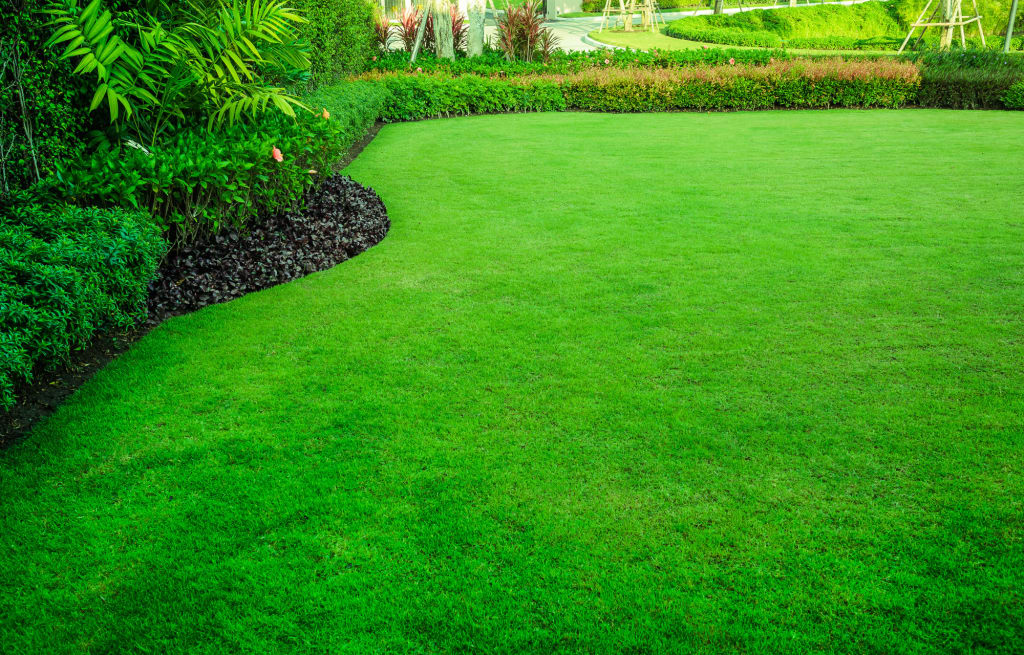
The green grass is nature friendly. It improves air quality as well as water quality. It prevents soil erosion, cools the air, reduces noise levels by absorbing and deflecting sounds, and cleanses and beautifies the environment. A well maintained lush green lawn is a thing of beauty. It is a delightful treat to our eyes whereas a neglected lawn is an eye sore and reflects poorly on its owners.
Lawn Making
Preparation of Ground:
The first step of lawn making is the preparation of the site. The ground has to be dug up to break the compactness of the subsoil surface. All debris, pieces of rocks and stones, gravel, and other unwanted things should be removed. It is then thoroughly mixed with decomposed farmyard manure (cow dung) or some chemical fertilizer. When using fertilizers care should be taken not to over apply it as it can cause damage. The ground is then properly levelled. This is best done by treading on it and then raking it. Different types of manual and power driven tools are also available for leveling the surface of soil. It is of utmost importance that the ground is leveled uniformly and there are no bumps and hollows. This is necessary to get a good even looking lawn.
Grass Planting
There are three widely used methods for planting grass which are known as Seeding, Sodding and Dribbling method. These are described here below:
a) Seeding means putting grass seed in the prepared soil. Selection of the grass seed to be used must be done carefully for on it depends the quality of grass on the lawn. Seed of Doob grass, Bermuda grass, Kentucky Bluegrass, Zoysia Grass are a few examples of grass seed that may be considered for selection. The selected grass seed is put in the soil. There is no need to cover the seeds by putting on a layer of topsoil as it obstructs the germination process of the seeds. Water is then sprinkled on the ground. Depending on the weather conditions the seeds will germinate within two weeks’ period.
b) Sod is a piece of turf, a slab of soil on which grass is growing. There are sod farms which produce sods. Sodding means putting sods in the prepared soil and firmly pressing it down so that it remains fixed in the position it has been placed. The sods are so laid that they join each other with no gap (like floor tiles) and a uniform level is ensured over the entire lawn area. Water is then sprayed on it. The advantage of this method is that you do not have to wait for germination as fresh grass is already growing on the sods. You get a ready made grass field. The disadvantage of using this method is that it is very expensive as sods have to be purchased from sod farms.
c) Dribbling method is more laborious than both the above methods. In this process holes are made in the prepared soil and root parts and divisions of fresh grass are placed inside the holes. This resembles sowing rice plants in a rice field.
Lawn Care and Maintenance
Now that we have made our lawn, we must take care to maintain its green freshness and ensure that it keeps on flourishing. Lawn care is not easy. It is a constant battle with natural elements, insects, pests, etc. Routine tasks that need to keep the lawn in good order are described in the following lines.
1. Watering the lawn.
Water is the life of all living things and grass lawn is no exception. Sprinklers are installed in the lawn which spray water over the entire area. It is recommended that watering be continued till there is about one inch of water standing on the ground. This ensures that water will reach the grass roots under the topsoil. When the ground becomes dry the watering process is repeated.
2. Mowing the lawn.
Lawn mowers are used to cut the grass uniformly over the entire lawn and it is this that gives the lawn the look of a green carpet laid on the ground. Lawn mowers are driven by gasoline engines or they may be hand pushed. The lawn is mowed when there is no water on the ground and the grass is dry. It is best not to mow in one direction every time. Proper method of mowing the lawn is that if you mow the lawn (say) in the north south direction then the next time. you should mow it in east west direction. The grass must not be cut too short. Very closely cropped grass makes it a scalped lawn with more weeds than grass in it. Recommended length of grass is 2.5 to 3 inch after mowing. There is no need to remove the grass cuttings. Let it lie on the lawn as it acts like fertilizer and enriches the soil.
3. Fertilization
Is necessary to add nutrients to the soil for the growth of healthy grass. In general, fertilizers are of two types. Natural fertilizer which is farmyard manure (cow dung) and Chemical fertilizer (urea). For lawn fertilization both types of fertilizers can be used but care must be taken not to over fertilize.
4. Weeding
Weeds are undesirable natural growth of various types which sap up the nutrients from the soil and thus hamper the growth of grass. Weeds ruin the beauty of grass lawns. It is necessary to keep the lawn free from weeds. This is a back straining job as weeds have to be pulled out from the soil by hand. As weeds grow rapidly, weeding is needed on a regular basis.
5. Soil Aeration
Pedestrian traffic on lawns gradually compacts the soil. When the soil gets fully compacted, it closes the pores through which air passes down the soil to the roots of grass. In the absence of air, grass roots do not get the life giving oxygen and they wither and die. To let in air into the soil, as well as water and nutrients, the lawn is perforated with small holes. This process is called aeration. Aeration is done by a Spike aerator or a Plug aerator. A spike aerator is used to poke holes in the ground with a solid tine. Plug aeration is done by means of a lawn aerator which is a machine with hollow tines and it mechanically removes 2-3’’ inch cores or plugs of soil and thatch from the ground. Aeration holes are usually 3-4’’ deep and about 6’’ apart. The plugs of soil thus extracted are spread over the lawn.
6. Thatch
Thatch is a layer of living and dead grass shoots, roots, stems and other decaying plants around the base of lawn grass. A thick layer of thatch causes serious damage to the grass as it creates a barrier hindering the supply of water, air and plant nutrients to the grass roots, thus suffocating the grass and ultimately killing it. Detaching or removal of thatch is usually done by raking the lawn with a thatching rake.
7. Over-Seeding
After the processes of detaching, soil aeration, mowing and watering the ground is covered with a layer of grass seeds mixed with fertilizers. This will fill in all thin patches in the lawn and give it more colour.
Implementation of the above maintenance tips is usually enough to keep your lawn healthy and lush green. Enjoy its ecological benefits and the aesthetic beauty and live in harmony with nature.
About the Creator
Enjoyed the story? Support the Creator.
Subscribe for free to receive all their stories in your feed.
Comments
There are no comments for this story
Be the first to respond and start the conversation.