
From Hydrogen to Life: The Story of Matter
Part 16 of the Elucidation series. Previously: The Primordial Cloud: Where Everything Began
• • •
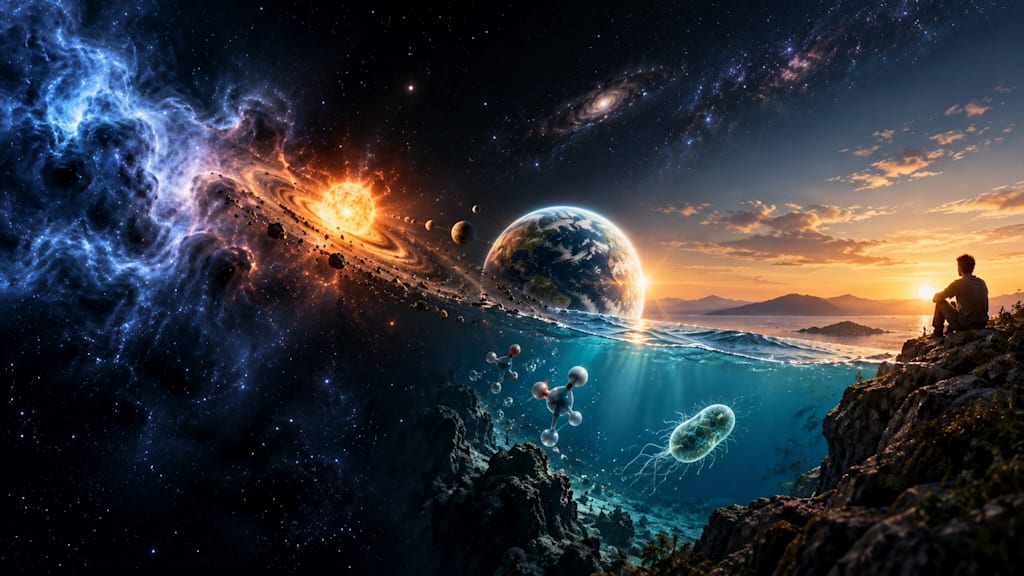
We left off with a universe of stars, elements, and increasingly complex molecules forming on the surfaces of young planets. The process had already demonstrated a clear direction, from simple toward complex, from formless toward structured. But the most extraordinary chapter was still ahead.
Life.
The Bridge Between Chemistry and Biology
How does inert matter become alive? This question haunted scientists for centuries, and many concluded that it could never be answered, that life was fundamentally different from non-life, separated by an unbridgeable gap.
Professor Oparin showed otherwise. In his landmark work, he demonstrated that the transition from non-living matter to living matter was not a sudden miracle but a continuous process of increasing molecular complexity.
"Life could arise only through a process of the orderly increase in the complexity of organic compounds," he wrote. "Without organic matter, life could never have come into being."
The key was carbon. Carbon atoms can bond with other atoms in an almost infinite variety of configurations, producing molecules of staggering complexity. On the early earth, simple carbon compounds combined into more elaborate ones. Amino acids formed. Nucleotide chains assembled. Molecules appeared that could store information and replicate themselves.
At some point, gradually, not instantaneously, these molecular systems crossed a threshold. They began to metabolize energy from their environment. They began to reproduce. They began to respond to external conditions.
They were alive.
The Explosion of Complexity
Once life appeared, the pace of complexification accelerated dramatically. What had taken billions of years in the mineral stage now unfolded in hundreds of millions.
Single-celled organisms gave rise to multicellular ones. Organisms developed specialized structures, membranes, organelles, primitive sensory systems. The living world diversified into forms of astonishing variety.
Then came the great transitions. The development of the eye, perhaps the most remarkable single organ in the history of life. The evolution of the lung, traceable from the simplest breathing apparatus in early aquatic animals to the sophisticated respiratory system of mammals. The development of the nervous system, from simple reactive networks to the extraordinary complexity of the vertebrate brain.
As Oparin noted: "If we study the history of the development of life by tracing the passage from lower forms to higher ones, we will soon be convinced that the material progress of life consists in the continuous increase in the complexity of living bodies."
From Water to Land
One of the most dramatic leaps was the transition from water to land. For hundreds of millions of years, all complex life existed in the oceans. Emerging onto dry land required simultaneous transformations: new ways to breathe, new ways to move, new ways to prevent desiccation, new ways to reproduce.
Across thousands of incremental changes, fish developed structures that could function in air. Fins became limbs. Gills gave way to lungs. An entirely new mode of existence opened up, not by abandoning what came before, but by building upon it.
This pattern, each new stage growing organically from the previous one, carrying its history forward while adding new capacities, is one of the defining features of evolutionary development.
The Arrival of Consciousness
The most recent and most extraordinary product of this process is human consciousness.
The human being is not separate from the story. We are its latest chapter. The same process that turned hydrogen into helium, helium into carbon, carbon into amino acids, and amino acids into living cells also produced the nervous system, the brain, and ultimately the capacity for self-awareness, abstract thought, and moral reasoning.
But with the human being, something qualitatively new appeared. For the first time in fifteen billion years of evolutionary development, the process produced a being that could understand the process itself. A being that could look back across the entire history of existence and ask: what does it mean?
The human being does not merely adapt to the environment, as other organisms do. The human being changes the environment. In winter, instead of migrating or hibernating, humans heat their surroundings. Instead of evolving new physical structures to meet new challenges, humans invent tools, build shelters, create technologies.
This capacity, to consciously transform conditions rather than passively adapt to them, places the human being at a unique point in the entire story of existence. And it raises a question that the next article will take up directly.
• • •
Next: From Fish to Civilization**
Elucidation is a series of articles inspired by philosophical lectures given around 50 years ago. New articles are published weekly.
This article is part of the Elucidation series. The articles have been written and reviewed by the author with the assistance of AI.
About the Creator
Han Elucidation
Why do we exist? A searcher. Exploring existence, meaning, and what it means to be human through the Elucidation series.
Enjoyed the story? Support the Creator.
Subscribe for free to receive all their stories in your feed.
Comments
There are no comments for this story
Be the first to respond and start the conversation.