
From Fish to Civilization
Part 17 of the Elucidation series. Previously: From Hydrogen to Life: The Story of Matter

• • •
With the arrival of human beings, the story of existence entered a new stage, one governed not by biological laws alone, but by something unprecedented: conscious social organization.
The Social Revolution
Animals live in groups. Many species show rudimentary forms of social behavior, cooperation, hierarchy, communication. But human society is qualitatively different. It is not simply a collection of individuals living alongside one another. It is an organized system in which people occupy different roles, perform different kinds of work, form institutions, establish rules, and develop shared ways of understanding the world around them. These relationships are connected to one another, and as society develops, the entire system can change, reorganize, and become increasingly complex.
The earliest human communities were small, simple, and largely undifferentiated. Everyone did more or less the same work. Social relations were direct and personal. The division between individuals was minimal.
But as productive capacity grew, as humans developed agriculture, domesticated animals, and built permanent settlements, social structures became more elaborate. Roles differentiated. Specialists emerged. The division of labor produced surplus, and with surplus came new possibilities for inequality and social differentiation.
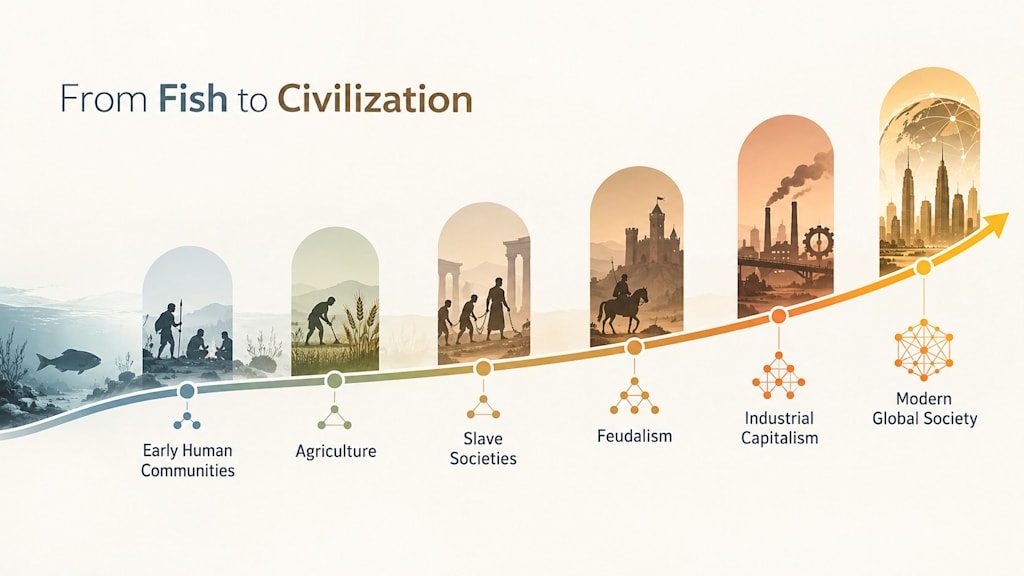
From these conditions emerged increasingly complex forms of social organization, including tribal societies, slave-based economies, feudal systems, and eventually industrial capitalism. Each was more complex than the last. Each developed more elaborate institutions and more specialized roles, while relationships between people became increasingly organized through larger networks of production, cooperation, trade, and exchange.
Social Evolution Follows the Same Pattern
Here is the critical observation: social evolution follows the same fundamental pattern as mineral, organic, and biological evolution. It moves from simple to complex. It accelerates over time. And it builds upon what came before, carrying forward the achievements of earlier stages while adding new capacities.
The earliest major transformations in human society unfolded over thousands of years. Later transitions, such as the movement from feudalism to capitalism, took place over centuries. In the modern era, profound social and technological changes can occur within decades. The pace of change appears to accelerate, just as it did in the transition from mineral to organic, and from organic to biological development.
And just as in biological evolution, each new social stage represents a leap, a qualitative transformation that cannot be reduced to the gradual accumulation of small changes within the previous stage. The difference between a feudal society and a capitalist one is not merely quantitative (more trade, more technology). It is structural. The very nature of social relations has changed.
The Human Difference
But there is one crucial difference between social evolution and everything that came before it.
In the mineral, organic, and biological stages, development was unconscious. Atoms did not choose to form molecules. Cells did not decide to become organisms. Fish did not plan to develop lungs. The process happened through the blind operation of natural laws on material conditions.
With human beings, consciousness enters the equation. Humans can study their own conditions. They can identify the forces shaping their society. They can consciously choose to align with the direction of evolutionary development, or to resist it.
This does not mean that human willpower overrides material conditions. Social development has a material basis. Economic structures, productive forces, and the real conditions of life shape what is possible at any given stage. Ideology alone, disconnected from material reality, changes nothing.
But within those conditions, conscious human action makes a real difference. When people understand the conditions of their society and the changes taking place within it, they can act in ways that help those changes develop further. When they fail to understand them, they may resist necessary change, slow it down, or even push society backward for a time, while the broader direction of historical development continues forward.
The Question This Raises
We have now traced the story of existence from hydrogen to human civilization, a single continuous process spanning about 14 billion years. And at every stage, the same pattern appears: increasing complexity, accelerating pace, forward direction.
But not everyone agrees that this pattern is real. Some thinkers have argued that history goes in circles. Others have argued that it is declining, that each era is worse than the last. Still others claim that social development has no direction at all, that it is merely change without progress.
These objections are serious. If they are right, then the entire framework of the Elucidation series collapses. There would be no summit, no direction, no basis for judging one step as higher than another.
The next article examines these objections directly.
• • •
Next: Does History Have a Direction?
Elucidation is a series of articles inspired by philosophical lectures given around 50 years ago. New articles are published weekly.
This article is part of the Elucidation series. The articles have been written and reviewed by the author with the assistance of AI.
About the Creator
Han Elucidation
Why do we exist? A searcher. Exploring existence, meaning, and what it means to be human through the Elucidation series.
Enjoyed the story? Support the Creator.
Subscribe for free to receive all their stories in your feed.
Comments
There are no comments for this story
Be the first to respond and start the conversation.