
From Atoms to Life: The Rise of Complexity
Part 22 of the Elucidation series. Previously: The First Law of Evolutionary Development: Why the New Always Replaces the Old

• • •
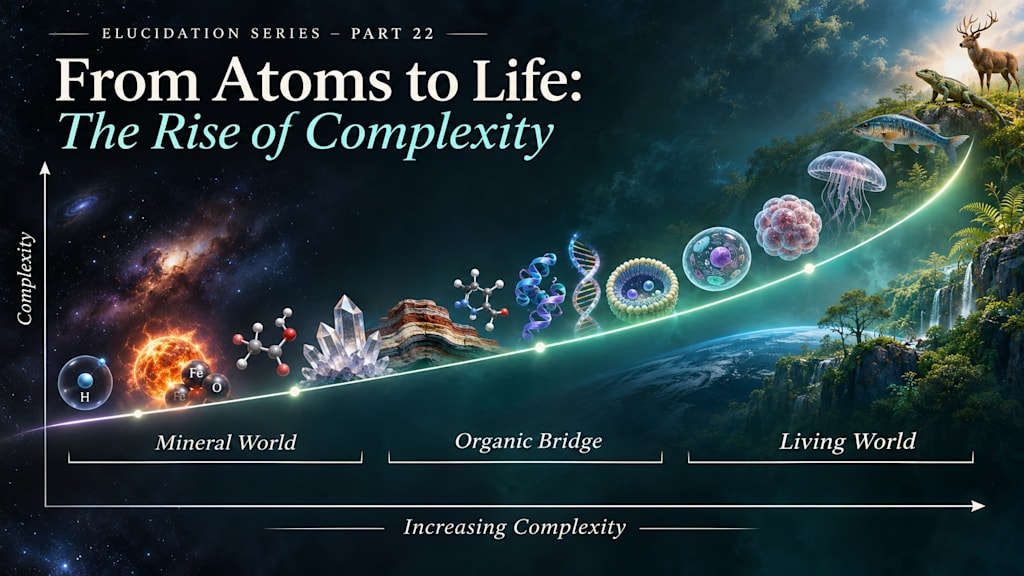
In the previous article, we introduced the first law of evolutionary development: the law of complexity. According to this law, the development of existence involves a continuous movement from simpler forms to more complex and highly organized ones, as new structures emerge from older ones.
But this is not merely an abstract principle. We can observe this process in the material world itself, tracing the rise of complexity through the mineral and organic stages, and ultimately to the emergence of life.
The Mineral World
Everywhere in the cosmos, development and transformation are at work. They may unfold differently in different solar systems, but they always follow the inner logic of matter. The same fundamental pattern governs the formation and organization of matter and its increasing complexity.
Hydrogen, the simplest element, was transformed into helium inside the first stars. Through nuclear processes, heavier elements emerged, including carbon, oxygen, and iron. Each successive element has a more complex nuclear structure than the lighter ones that preceded it.
But it was not only atoms that grew more complex. Atoms combined to form molecules, which in turn developed into increasingly elaborate structures. On planetary surfaces where conditions were suitable, mineral development reached its fullest expression in complex crystalline structures, layered geological formations, and intricate chemical systems.
Eventually, however, mineral development reached its limit. Atoms and simple molecules could achieve only so much complexity on their own. To advance further, something new was needed.
The Organic Bridge
That something was organic chemistry. With its extraordinary capacity to form chemical bonds, carbon became the foundation for a new level of complexity that mineral chemistry alone could never produce.
As Alexander Oparin argued, life could only emerge through the gradual and orderly development of increasingly complex organic compounds. Organic matter was therefore an essential precondition for the emergence of life.
The organic world is not separate from the mineral world. It grows out of it. The same atoms that make up the mineral world, including carbon, hydrogen, oxygen, and nitrogen, combine to form structures of astonishing complexity. These include amino acids, proteins, nucleic acids, and lipid membranes.
Each stage emerges through chemical processes governed by the same physical laws. There is no magic or sudden break with those laws. Instead, complexity continues to develop through the properties and interactions of matter itself.
The Living World
With the emergence of life, organic development entered a new stage. The pace of increasing complexity accelerated dramatically.
As Alexander Oparin emphasized, biological complexity is not simply the addition of more parts. It is the development of increasingly organized structures with specialized functions.
The earliest living organisms had no eyes, hands, or specialized organs. Over the course of evolutionary development, organs gradually emerged and became more specialized through interactions between organisms and their environments.
Consider the evolution of respiratory systems. In the simplest organisms, gases pass directly through cell membranes. As more complex organisms evolved, specialized respiratory structures appeared. These included gills and lungs, which allowed organisms to exchange gases more effectively in different environments. Through evolutionary development, respiratory systems became increasingly specialized and capable of performing more complex functions.
The same general pattern can be observed in the development of organs, biological systems, and organisms. The history of life reveals not merely an accumulation of changes, but the emergence of increasingly complex and organized forms of existence.
A Stubborn Tendency
Matter appears to possess a persistent tendency toward increasingly organized forms. Over time, chaos and formlessness give way to structure and organization. Patterns emerge, develop, and become more complex.
This is the first law in action. If this tendency did not exist, conditions in that barren primordial world could never have changed in such a way that we would be here today. The process of growing complexity and the continual replacement of older forms by more advanced ones represent a reality so deep and persistent that it has driven the story of existence from hydrogen to humanity without ever permanently stopping.
In the next article, we follow this same law through the further development of life and into human society, where its consequences become even more dramatic.
• • •
Next: Complexity from Organisms to Civilizations**
Elucidation is a series of articles inspired by philosophical lectures given around 50 years ago. New articles are published weekly.
About the Creator
Han Elucidation
Why do we exist? A searcher. Exploring existence, meaning, and what it means to be human through the Elucidation series.
Enjoyed the story? Support the Creator.
Subscribe for free to receive all their stories in your feed.
Comments
There are no comments for this story
Be the first to respond and start the conversation.