
Facts you didn't know happening in space
space facts - Aditya
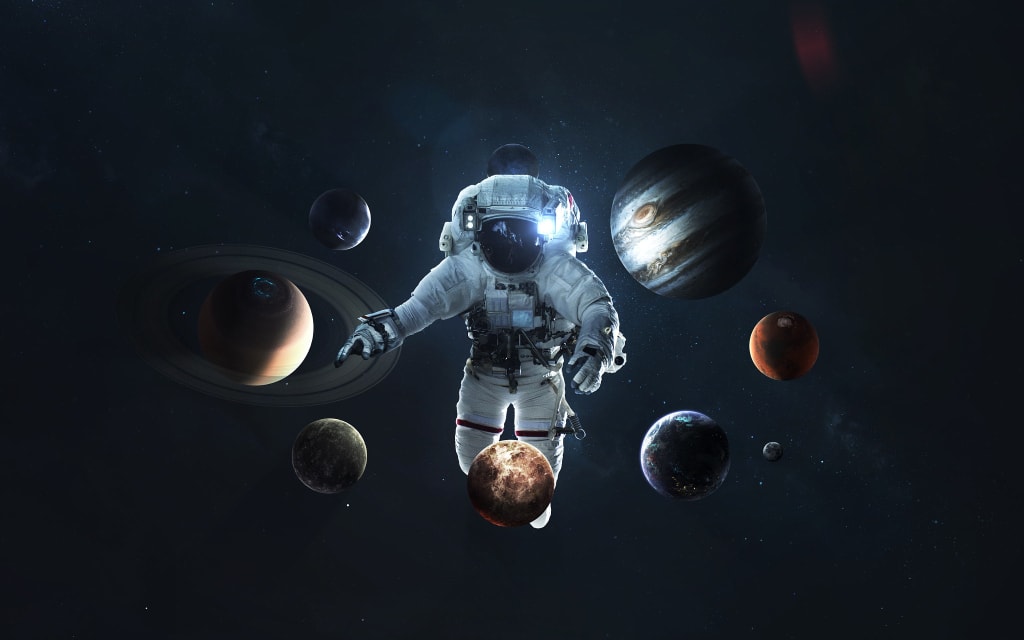
The winds on Neptune reach speeds of up to 1600 miles per hour, which is three times faster than a commercial airplane. The temperatures at the moon's south pole plummet to a bone-chilling minus 397 degrees Fahrenheit, possibly making it the coldest location in the entire solar system. Saturn, less dense than water, would actually float if placed in a massive pool due to its unique composition. Meanwhile, Jupiter's moon Europa is encased in a thick layer of ice concealing a vast ocean below, estimated to be up to 100 miles deep. The surprising presence of water ice is not exclusive to Earth, as it's found throughout the solar system, even on Mercury and the Moon.
Saturn boasts its magnificent ring system, composed of space debris originating from a disintegrated moon. Although Jupiter, Neptune, and Uranus also have rings, Saturn's are by far the most spectacular. Even some asteroids possess rings. While eight planets have been confirmed in the solar system, there's potential for a ninth, though it remains undiscovered. Comets could have transported organic matter to Earth, as such matter has been detected on several comets.
Saturn features a perpetual storm, akin to Jupiter's, but it stands out due to its hexagonal shape composed of six distinct sides. Mercury and Venus are the sole planets lacking known moons. Jupiter, in contrast, hosts an impressive 79 moons, the largest of which, Ganymede, surpasses the size of Mercury. The Milky Way, previously believed to be a belt, is now recognized as a spiral galaxy.
On the Moon, footprints don't vanish due to the absence of wind. A theoretical counterpart to a black hole, known as a white hole, is postulated—a region where nothing can enter from the outside, but light and matter can escape from within. Neptune's moon Triton orbits in a retrograde motion, an enigma that continues to puzzle scientists. Despite the countless stars in space, only a fraction is visible from Earth. Charon, Pluto's moon, is half its planet's size, leading Pluto to wobble around a spot off its axis.
In space, galaxies, planets, and interstellar dust comprise just about 4 percent of the universe; the rest is composed of dark matter and dark energy, still not fully understood. A planet named Tres 2b experiences a perpetually dark, scorching environment, with an ocean of molten lava. It's larger than Jupiter but absorbs light more effectively than charcoal. In the 55 Cancri star system, four gas giant planets circle their star, while the fifth—55 Cancri e—endures half-molten, half-dark conditions due to its proximity to the star.
Kepler-70, a hot blue dwarf star, consumed one of its planets, Kepler-70b, transforming it into a blazing hot rocky world. Six missions are currently exploring Mars, making it a haven for robotic exploration. Proportional comparisons between the Sun and Earth highlight the Sun's immense size. Moon rocks erode very slowly, and Apollo astronauts' footprints could persist for millions of years. Jupiter's moon Io is one of the few bodies with active volcanoes in the solar system, named after a mythological figure. A neutron star rotates rapidly, emitting powerful electromagnetic pulses, and its planets face gradual destruction due to these pulses.
The concept of space being devoid of sound is debated, as particles in space allow for potential sound wave transmission. Space agencies like NASA convert space phenomena into audible sounds. Stars' cores and layers are heated by fusion reactions. Saturn has rings, and other gas giants, including Uranus and Neptune, possess faint rings. The Voyager program significantly contributed to planetary exploration, with Voyager 1 in interstellar space. An enormous water reservoir exists near a supermassive black hole.
KELT-9b is the hottest known planet, with extreme temperatures. A moon day aligns with about 29 Earth days. The moon keeps the same face toward Earth due to tidal forces, while the other side is mountainous. Craters on the moon were caused by asteroids billions of years ago.
About the Creator
Enjoyed the story? Support the Creator.
Subscribe for free to receive all their stories in your feed.
Comments
There are no comments for this story
Be the first to respond and start the conversation.